
Book News
Battle of the Arctic: The Maritime Epic of World War Two.
Hugh Sebag-Montefiore
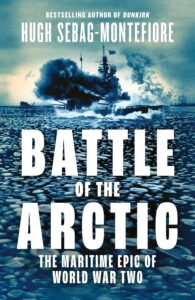
Readers might like to hear about the paperback edition of historian Hugh Sebag-Montefiore’s Battle of the Arctic: The Maritime Epic of World War Two. It is to be published by William Collins price £12.99 on 5th November. The hardback was published near the end of last year.
As the book’s title implies, Battle of the Arctic, about the Arctic convoys’ carrying arms to Russia during WW2, tells a unique story. Progress through the Barents Sea, north of Norway, was complicated by terrific storms, snow, ice, and fog, not to mention whales and Arctic mirages.
The action unfolded as Allied naval and merchant seamen, airmen, submariners, soldiers and intelligence officers delivered on their countries’ promises to take the aid to Russia notwithstanding the German attempts to hunt them in their aircraft, U-boats and surface fleet spearheaded by the warships Tirpitz and Scharnhorst. When ships were attacked, and went down in seas so cold that a man could die after five minutes of immersion, it triggered events reminiscent of the do-or-die moments during the sinking of the Titanic. Men perished one by one in lifeboats, and as castaways on deserted Arctic islands where they were stalked by polar bears. Frostbitten and wounded survivors ended up in primitive Russian hospitals where amputations were carried out without anesthetics. Others, while stranded for months in the communist state they were aiding, experienced the murky worlds of the NKVD, and the gulag, as well as famine and prostitution.
Most readers will have heard about the heroism exhibited by our seamen during the Battle of the Atlantic. This book shows comparable but undeservedly unappreciated bravery in a different theatre.
Review of Battle of the Arctic by Linda Parker
Battle of the Arctic. Hugh Seabag-Montefiore
William Collins: London, 2025 ISBN-13: : 978-0008335779
816 pp, black and white illustrations.
Britain has a long history of exploration and seafaring in the Arctic Ocean, with may tales of courage, disaster and tragedy. In this book the author had described the fate of ships in the Second World War Arctic Convoys which equals any in the history of Arctic exploration, with the perils of sinking shipwreck and Ice being faced in maritime battle conditions previously never encountered.
In the Summer of 194 Russia was desperate for help in the shape of a second European front or substantial military aid. An agreement between Moscow and London on 12th July had been practical sign that Britain and the United States were committed not to let Russia fight alone.
In view of Stalin’s repeated demands for second front in Europe and his grumbles about the volume of aid being delivered it was crucial that the promised aid reached Russia as quickly and efficiently as possible, mainly by the Arctic convoys.
Hugh Seabag-Montefiore has written a new history of the convoys in which he describes in detail the experiences of the British Merchant Navy, the US Merchant Marine and the Royal Navy as they fought German aeroplanes, U boats and surface ships hampered by atrocious Arctic weather in efforts to deliver the promised military aid . Using new sources and detailed research, the book is an exhaustive ,and sometimes exhausting at over 800 pages, description of the complex story of the Arctic convoys
The narrative is largely chronological but concentrates on the actions which show the changing strengths and tactics of both sides as they reacted to changing circumstances. The controversial fate of the PQ17 is covered in detail with some fresh insights and incisive analysis by the author. The decision to provide the convoys with increased cover in the aftermath of the PQ17 convoy improved the chances of subsequent convoys.
Detailed research into new sources both primary and published from Norway, Germany, Russia and America have allowed the story to be told through the words of the men on the convoys and their hunters. We follow the many tales of death and injury on sinking ships and some miraculous escapes and rescues. Especially vivid and dramatic are the accounts of what it was like to be in small lifeboats in the Arctic Sea and the extreme difficulty in surviving in those conditions, retold with some shocking and gruesome details.
When the injured and shipwrecked sailors arrived at Kola inlet their troubles were not over, as they found themselves in hospitals with little staff, medication or equipment conditions in the hospitals were grim. The Russian Doctors answer to severely frost bitten limps was to amputate them, often without anaesthetic. They also faced hostility and sometimes violence from Russian citizens. (here the chap who was sunk, rescued and sent home to be sunk again)
The description of two of the ships in the unprotected F8 convoy who were sunk in Nov 1942 is worthy of the most dramatic and heroic stories of Arctic survival. The story of the Russian ship Dekabrist is from the testimony of the ship’s female doctor, Ndezdah Natalich, who describes their ordeal of surviving in a lifeboat until being shipwrecked on Hope Island at the mercy of the winter weather and polar bears. The injured captain was rescued by a German U-boat in July 1943 but the other 2 survivors were eventually rescued in October 1943. The Chulmleigh ran aground on Spitsbergen in November 1942 and faced similar conditions of cold and starvation until the 9 survivors were rescued by Norwegian troops in July 1943.
The plentiful maps add interest and diagrams of the way in which the convoys were set up and organised are helpful to the non-naval reader.
There is plenty to appeal in the book, which contains human interest, analysis of the tactics, both successful and mistaken, and movements of the convoys alongside the context of the strategic and political background. It is highly recommended as a splendid and possibly definitive addition to the history of the brave men who served on the Arctic Convoys.
Dr Linda Parker
About the Author - Hugh Sebag-Montifiore

Hugh Sebag-Montefiore was a barrister before becoming a journalist and historian. He has written for the Sunday Times, Sunday Telegraph, Observer, Independent on Sunday, and Mail On Sunday. His first book Kings On The Catwalk: The Louis Vuitton and Moët-Hennessy Affair was published in 1992.
Bletchley Park, the backdrop to much of the action in his first history book Enigma: The Battle For The Code (published in 2000), used to be owned by Hugh’s great great grandfather, Sir Herbert Leon. Hugh’s father, Stephen, used to stay at Bletchley Park every Christmas, at a time when the house was humming with servants, and when the garden was tended by no less than forty gardeners. During the run up to the 70th anniversary of the capture of the Enigma codebooks from German U-boat U-110, Hugh was commissioned by Bletchley Park to supply the text and photos for an exhibition describing the capture.
The location for the climax of his next book, Dunkirk: Fight To The Last Man(published in 2006), also summoned up forgotten memories within Hugh’s family. His cousin Denzil Sebag-Montefiore lost his precious ivory backed hair brushes engraved, with his initials, which had to be thrown into the sea at Dunkirk, along with other heavy items in his backpack, so that he would be more buoyant. He eventually made it back to England, after being heaved into one of the boats ferrying British soldiers out to the larger ships waiting off shore. Another cousin, Basil Jaffé, passed the time waiting to be rescued from the shallows near one of the Dunkirk beaches by reading his miniature edition of Shakespeare’s plays.
The Western Front, where the World War 1 action portrayed in his most recent book Somme: Into The Breach took place, has a mixed reception when it is discussed in Hugh’s family. On his father’s side, Tom Sebag-Montefiore, Hugh’s grandfather’s first cousin, thrived as a gunner on the Somme, and elsewhere on the Western Front. Tom’s letters to his mother describe how although he was a mere captain at the time, he sometimes dined with generals on the Somme, with whom he had become acquainted while riding for Great Britain in a pre-war international horse show. His letters also disclose the extraordinary steps he took to practice his religion in the trenches, fasting on the Day of Atonement until he was too weak to walk back to his unit after attending the service, and ordering his mother to send him matzah, the biscuit like unleavened ‘bread’, and the flourless cakes, that observant Jews eat instead of normal bread and cakes during the 8 day festival of Passover. Cecil Sebag-Montefiore, Hugh’s great grandfather, was less fortunate: he sustained a serious head injury on the Western Front and never fully recovered. Shortly after the War he took his own life. Bertie Woolf, the step brother of Hugh’s grandmother, on his mother’s side, survived his service as a gunner on the Somme, only to be killed in the trenches the following year.