Behind Enemy Lines
Victor M Hanks
The following first-hand account is a transcript of a talk given by our father in 1993. Valerie Siddiqui and Paul Hanks
My last Pathfinder Operation, 21st January 1944
Pathfinder Force
I was a navigator with 35 Squadron of the Pathfinder Force and I’d like to tell you about my experiences while I was serving with the RAF.
Initially, I did five operations with Bomber Command in 77 Squadron of 4 Group before being transferred to No 8 Group, which was the Pathfinder Force.
The purpose of the Pathfinder Force was to mark the targets for the main bomber force in the attacks on German cities. And for the first 4 or 5 trips you acted as a support aircraft to the “professional”, as one might say, markers of the targets by stooging round the targets from 5 minutes before the attack until zero hour when the blind markers had had the opportunity to identify the target accurately and drop their indicators. Our responsibility then was to add our own indicators to those markers so the main force had a clear indication of where the target area was.
As we became more experienced, our job was to operate later in the attack and support the markers who continued to mark the targets during the attack by dropping back 4 minutes firstly, zero hour, then 4 minutes after zero hour and then 8 minutes and then later on.
Target Magdeburg
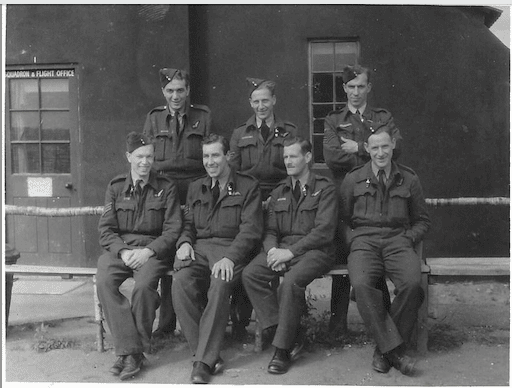
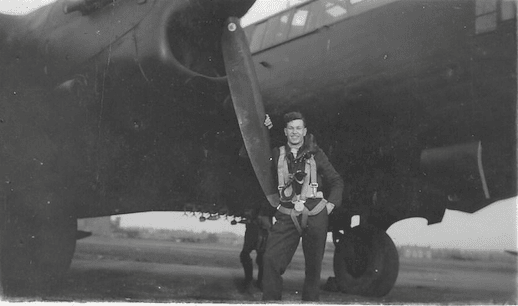
By January 21st 1944, we had become a sufficiently experienced crew, after having operated for 13 Pathfinder trips over Germany, to carry out a blind backing-up operation which meant we were instructed to fly straight and level over the target and on this occasion at plus 14 minutes during an attack which had been scheduled to last for 18 minutes. On that night, the target was Magdeburg. We were carrying a route marker which we were ordered to drop 10 miles south of the island of Heligoland to give the main force bombers an accurate pin-point so that they could themselves adjust their courses to reach the target in the right time and the right area.
As we approached the target at approximately 11 o’clock we completed a time-wasting leg to ensure we reached our target at the time indicated to us for our attack and I calculated our new estimated time of arrival on the target at 8 minutes past 11. This was far too soon, and I was about to give the pilot new instructions for time wasting when there was a tremendous explosion.
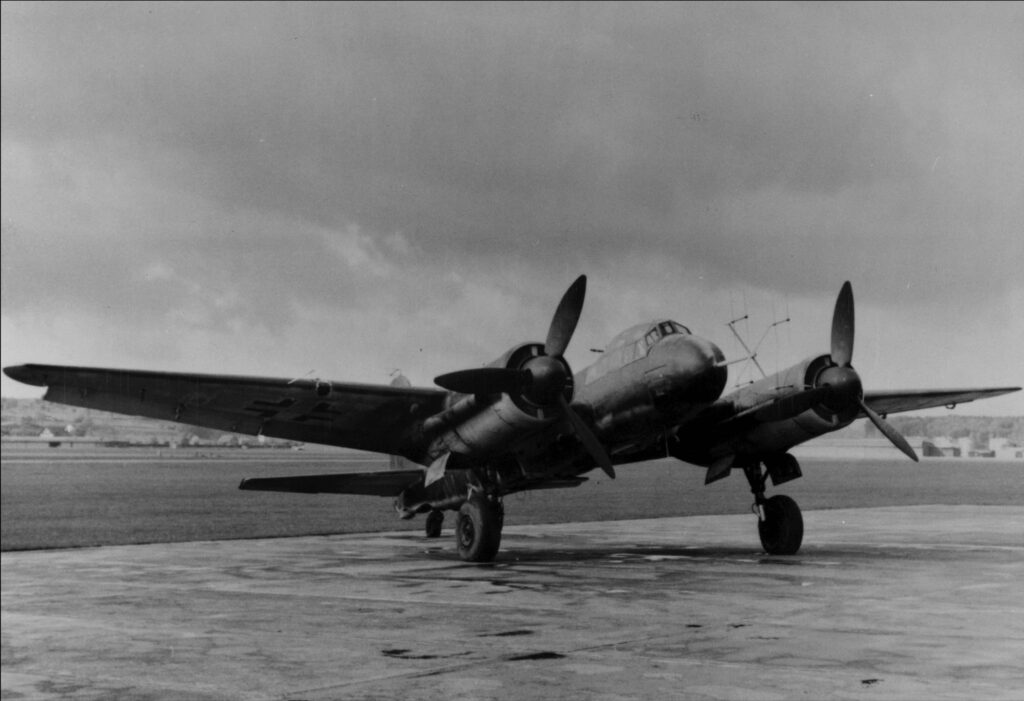
Attacked by a JU 88 night fighter
With knowledge I gained after the attack I realised that we had been attacked by a Junkers 88 which operated to “Schragemusik”- 4 cannons mounted vertically on the fuselage. Such an aircraft was able to home in on our airborne radar which we had used for the Pathfinder operation and get underneath our aircraft. So, we were a sitting target for his cannons which caused the route marker, (which we hadn’t managed to drop at Heligoland because we hadn’t been able to pinpoint it accurately) to blow up inside the aircraft fuselage and the port wing and port inner engine to burst into flames. All four engines stopped immediately and we started to glide through the air. The engines picked up gradually, but with the port wing on fire and the fuselage on fire there was nothing we could do about it.
Ordered to bail out
The engineer reported to the pilot that he had been hit in the leg. I asked the pilot what we should do and he gave instructions to bail out. The bomb aimer had already opened the escape hatch and I signalled to for him to go. I clipped my own parachute onto my chest harness and put my thumb through the D-ring and dropped through the escape hatch myself. As we were doing about 220 knots, I pulled the D-ring as soon as I hit the slip stream because as I was so shocked at the force that I was hit by. The parachute opened immediately with such force that my flying boots went straight off my feet and landed in Germany long before I did.
I found that, having gone out at such an angle, the parachute canopy kept collapsing as I swung down through the air. I immediately followed instructions for preventing this by reaching up and pushing the cord sideways to stabilise it. But this had no effect, and I continued my downward path swinging quite violently through the air.
Bailing out
As it was 21st January it was extremely cold. The temperature was minus 36 degrees at that height of 21000 ft. My concern was that I shouldn’t get frostbite because, as the navigator, I had been doing my plotting without gloves. I was able to put one hand in my trouser pocket and pushed the other down my mouth as far as I could to make sure the finger ends didn’t get cold.
Before long I went through the low cloud and was horrified to see what appeared to be wave tops beneath me. After 2 or 3 more swings though, I was relieved to find they were in fact the tops of trees – pine trees that had been planted in nice, neat rows – and the conical shape of the tops initially gave the impression of being wavelets on the sea. Had it been the sea, I would have been even more horrified because, as the navigator, I believed we were about 100 miles over land and something would have gone badly wrong if we had still been over the sea. Before long, I hit the tree-tops, swung through them like Tarzan and finished up amongst the broken branches dangling from the top of the trees, not knowing how far the ground was beneath me.
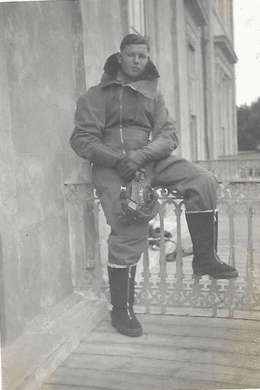
Out of the tree and I hit the ground
I was glad to be down and waited there a short while I recovered my breath and then decided to climb down the tree. It was a lot further than I thought but the branches supported my weight until I was about 12ft from the bottom where there were no more branches, so I just dropped to the ground. I waited there some time. I was rather expecting the whole of the German army to be there waiting for me, but it was absolute quietness all round so I sat there and rested for a while. But then I began to get so cold I decided it would be sensible to get back up the tree for my parachute and wrap myself up in that. But it was out of reach and I couldn’t get it. So the next morning when it became light I started walking north.
As air crew we were expected to escape and we were provided with small buttons on our battle dress which you cut off and placed one on top of the other. As one was magnetic with the dot pointing to the magnetic north, we were supposed to be able to guide ourselves to the Baltic or wherever we intended to go to effect an escape. I did this but I found that whichever way I turned, magnetic north just seemed to turn round with me. So, I just took to the paths in the forest hoping that eventually I would find some way of establishing where I might be and which way I might go.
Towards the middle of the afternoon, I bumped into a group of foreign workers under the control of a German who arrested me and took me to the local police headquarters. They handed me over to the Luftwaffe who arranged for me to be transported to the interrogation camp at Frankfurt. The Germans gave me some Army Air Corps flying boots which had belonged to an American airman who, unfortunately, had had his foot shot off and no longer required them.
The interrogation centre
At Dulagluft, the interrogation centre in Frankfurt I was interrogated for 9 days. It was obvious from what they said to me, they knew I was a member of the Pathfinder crew but of course our instructions were to only say our name, rank and air force number and I continued to do this throughout the interrogation. Eventually they gave up interrogating me, presumably because they had other crews, and they needed to maintain some sort of throughput. So, I was sent to a transit camp and was transferred to Stalagluft 6 at Heydekrug on the border of East Prussia and Lithuania. I was there for some months but in July 1944 the Russians began their push into Germany and East Prussia and we could hear the rumble of artillery by the time the Germans decided to evacuate the camp.
The hell ship, the “Insterberg”
Those members of the compound that I was in were transferred to the port of Memel and we were put aboard the small collier, the SS Insterberg. About 2000 British and American airmen were put down in the hold and we sailed down the Baltic for the next 2 days. The hold was so crowded that I only managed to have some comfort by hanging my American great coat, which I’d been issued with, in the rivet holes of 2 of the ribs of the hold. I and another colleague sat in this great coat for the two days of the voyage and we lived on a packet of biscuits that I’d kept in the coat pocket. When we reached Swinemuende we disembarked just at the time that there was an air raid by the American Army Air Corps so we sheltered under the cattle trucks in the sidings of the dock while the battleship Prince Eugen used its anti-aircraft guns to fire at the American aircraft.
The “run up the road”
After the air raid we were loaded into the cattle trucks and a number of us, myself included, were manacled together. I was manacled to a Polish airman even though we were also expected to carry our crudely made haversacks, with our kit in. We were then transported by train in cattle trucks to the village of Kiefheide, on the other side of Stettinerhaf.
When we got out of the train in the heat of the afternoon of July 19th the transport officer told the Kriegsmarine cadets who were to escort us to the camp what terrible people we were, referring to us as “Terrorflieger”. They all fixed bayonets, unleashed the dogs and the Kriegsmarine cadets started jabbing us with the bayonets to make us run up the road to the camp which was 2 to 3 km further away. This was quite a horrifying experience because, as we were manacled together, we could not get our kit bags off our backs to run. With the dogs yapping at our heels and the Kriegsmarine cadets jabbing our backsides with the bayonets it was not at all pleasant.
Fortunately, someone managed to cut the haversack off my back and also the Pole’s and we ran together manacled managing to avoid further injury. We stayed at this new camp until the beginning of 1945 when the Russians made a further push into Germany and we set out on a march on February 6th1945.
Three months forced march (6th February – 2nd May 1945)
With the weather being rather bad and with snow at that time of year it wasn’t pleasant underfoot. But it was good to feel free of the barbed wire of the camp. As I had always spent quite a lot of the time walking around the outside of the compound, I was still quite fit. We marched across the north of Poland, the islands of Stettinerhaf, various districts of North Germany and the Mecklenburg Lakes until we were quite close to Hanover when we were put onto a train for about the last 50 miles of the journey.
But because of the shortage of rolling stock and because there were so many prisoners we were put into the cattle trucks, 80 men instead of the “normal” capacity of 40. By this time, we were all suffering very badly from severe diarrhoea because of the poor diet. It was very unpleasant for 80 men to be standing in a cattle truck unable to squat down. Conditions became rather difficult to say the least for the 2 days in the cattle trucks we spent on the journey to Fallingbostel camp.
We had been at Fallingbostel for 10 days when the British armies crossed the Rhine. The Germans decided then to evacuate the camp and get us to march east this time instead of west. We marched for about 10 days and I believed the Germans would hold the allied troops up when they reached the Elbe. If that was the case, I would continue to be a prisoner of war for longer than I really wanted to be. One lunch break, (I couldn’t really call it lunch time because there wasn’t really any food to eat), I decided to leave the column. Fortunately, the guards didn’t notice and I walked off into the woods, ostensibly to meet the needs of nature.
But I continued walking and the column went on without me. After 3 days, during which time I walked through the woods or over the roadways, at first or last light in order not to be detected, I met up with what I believe was the 15th Scottish division. They were pleased to see me, put me on one of their armoured vehicles and took me back to the medical unit at Melbeck, where I bumped into my wireless operator, whom I hadn’t seen since we were moved initially from Stalagluft 6.
After one day at this medical centre one of his friends “borrowed” a car from some German family (without their permission of course!) and we drove as far as we could towards Celle. Unfortunately, it broke down and we eventually managed to get a lift on an army jeep which took us to Celle and from there we arranged our transit back to Rheine airport and to fly back to England.
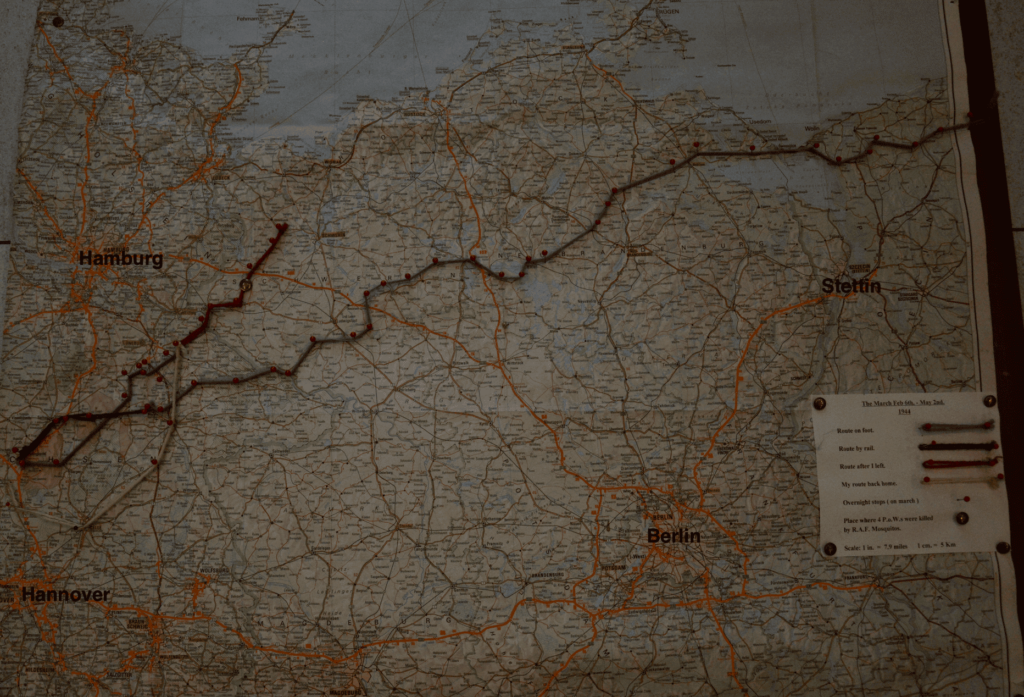
Conditions were so bad on the march that Victor went from 11st 7lb to just under 9 stones. The only official way the Medical Officer on return to the UK could ensure that Victor got supplementary rations was to provide him with a certificate saying that he was pregnant!
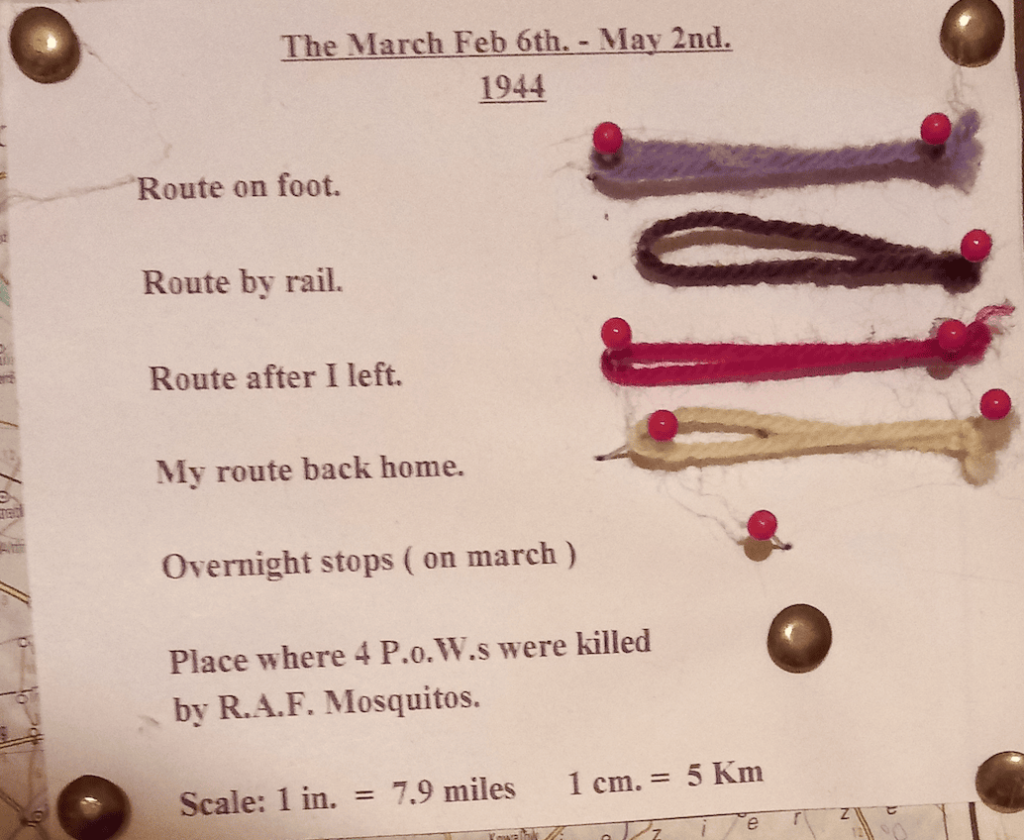
© Valerie Siddiqui and Paul Hanks 2025
Photos: Valerie Siddiqui and Paul Hanks collection and Wiki
Additional Information
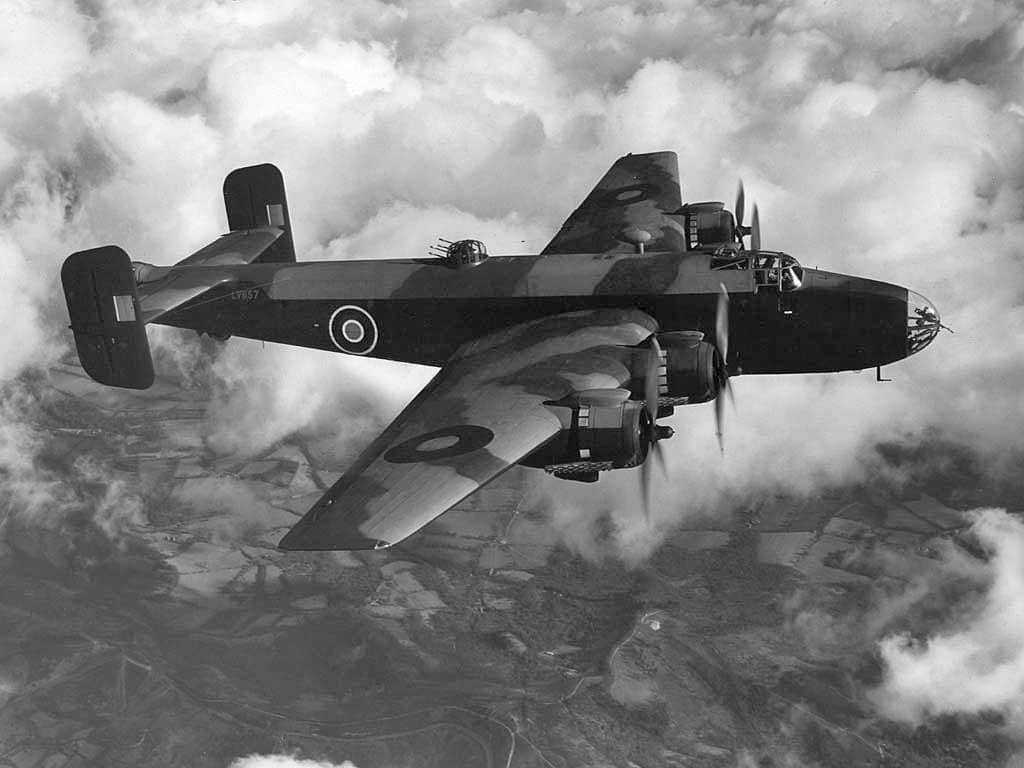
Halifax HX317 was one of the twenty one No. 35 Squadron aircraft detailed to attack Magdeburg on the night of 21st / 22nd January 1944.
It was equipped with IFF, Gee, Nav Aid Y (H2S), Monica and Fishpond and was carrying 3 x 1000lb GP T.Inst and various Target Indicators. Its designated Path Finder role was Blind Backer Up.
Its seven-man crew comprised:
- Thomas William Hill (Pilot)
- Victor Maurice Hanks (Navigator)
- William Carl Lawes (Air Bomber)
- Sidney George Murrell (Wireless Operator)
- Peter Ross Jung (Air Gunner)
- Reginald Charles Bailey (Air Gunner)
- William McCulloch (Flight Engineer)
HX317 failed to return and it was reported as “missing, nothing being heard of it after take off”.
The Crew
“They comprised Bill Hill, a well-built north-countryman aged 27 who had worked in a foundry and was immensely strong. The Bomb Aimer, Bill Lawes, whom we called “Willie”, to avoid any confusion over Christian names, was a typical Cockney, short, wiry and with an impish sense of humour. At 29 he was the second oldest member of the crew and had worked as a “spider-catcher” at Woolwich Arsenal, or at least he said that was one of his jobs. He maintained that they used a particular type of spider’s web for gun-sights, perhaps he was correct, but we could never be sure that he was not pulling our legs. He was closely followed in terms of age, by Syd Murrell, the Wireless Operator, at 28, who had worked in the Post Office administration at Norwich. He took great exception to being called a postman, but that did not stop us from doing so. The Flight Engineer, Bill McCulloch, was a Scot from Maybole in Ayrshire and although another Bill, he was quite naturally called “Jock”. At 32 he was the oldest member of the crew and had already completed 17 operations with another crew but was obliged to go with a new crew to complete his “tour” of 30 operations before being rested. He was quite happy to be with this crew and his experience was likely to prove invaluable. The Mid-Upper Gunner, R.V.M. Daniels, “Danny” to the rest of us, was a quiet young man with a very pleasant nature who came from Ipswich. The Rear Gunner, Reginald Bailey, at 18 was the baby of the crew and as a result was nick-named “Nipper”. He was a good-looking young man with wavy blond hair and although naturally shy, was a target for the young W.A.A.F.’s. “
Further information on the 35/635 Pathfinder Squadron Association website about the crew on the Magdeburg raid https://35squadron.wordpress.com/2017/07/15/halifax-hx317-21011944/
Log of the Long March.
A section of the log as compiled by Harry Bastion R.A.A.F, the Australian POW that Victor Hanks escaped with.


Click to see full BMMHS event listing pages.
Contact us at [email protected]
Copyright © 2026 bmmhs.org – All Rights Reserved