BEWARE! Balloons over Birmingham
This is an article kindly provided by Steve Richards
RAF Balloon Command was an integral part of Britain’s air defence, but these silvery beasts were hard to control and would bite friend and foe alike
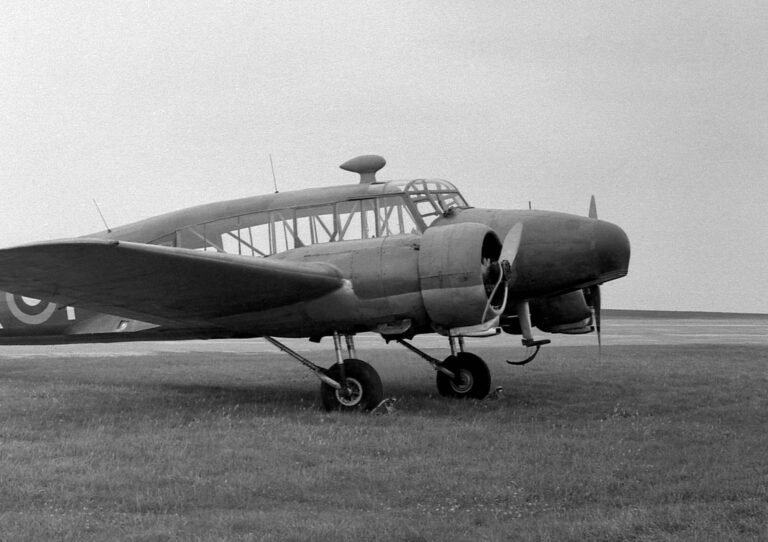
Towards the end of 1940, Birmingham was in the thick of the Blitz. Things were, however, relatively quiet on the night of 8th November, with just two German bombers belonging to a crack Luftwaffe unit dropping bombs on the city. There was though, a third aircraft droning overhead. This was a lumbering RAF Avro Anson. On board was the normal four-man crew, plus a specialist wireless expert. The aircraft belonged to the Wireless Intelligence Development Unit based at Wyton, Huntingdonshire (this RAF airfield continues to specialise in electronic intelligence gathering). On this particular winter’s night, their task was to gather information on German radio beam transmissions then being used by the Luftwaffe to guide bomber aircraft to their targets. The dedicated fifth man in the Anson would have been especially eager to pick up signals being used by the two Heinkel He 111s that had been operating over the city because they came from the unit KGr100, which was using a sophisticated radio beam system known as X-Verfahren.
Shortly after midnight, while flying over the Stechford area of the city, the Anson’s airframe shook violently and turmoil ensued inside the cabin. The machine was plunging earthwards. Within the cramped, dark fuselage there was little hope of any of the men grabbing a parachute and managing to locate the rear door or, indeed, any emergency exit. The aircraft had struck a barrage balloon cable. It crashed onto the LMS railway track. All of the crew were killed.
The Anson was not unique in falling foul of the balloons suspended over Birmingham and its outskirts. In fact, during the war, a dozen friendly aircraft came to grief because of these balloons, resulting in many allied personnel dying.
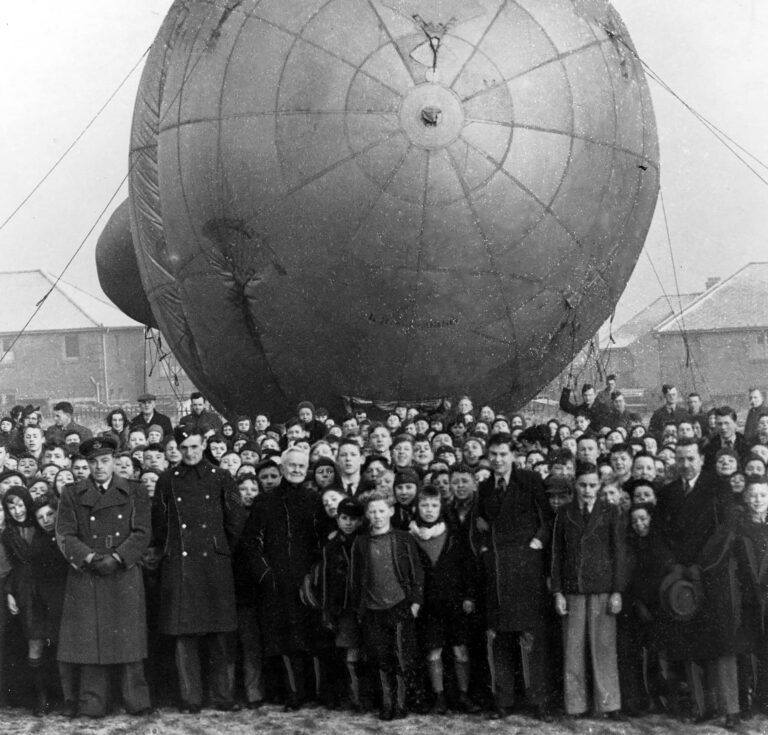
The elephantine barrage balloons were suspended in the skies over many British towns and cities from September 1939 until late in the war. They were looked upon with some affection by the civilian population and the crews who operated them, even to the point where ‘their’ local balloon was christened with names such as Barry the Barrage Balloon, or Matilda, Annie, Susie and Romeo.
The balloon and its operation
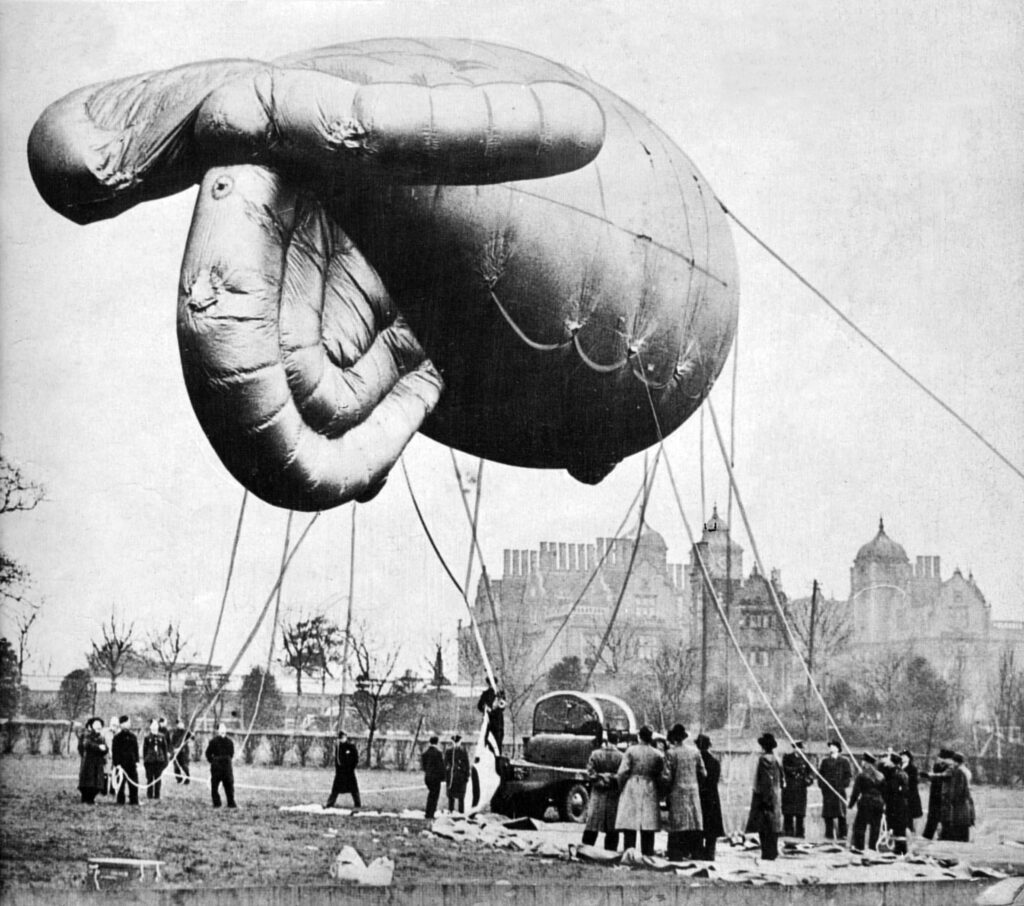
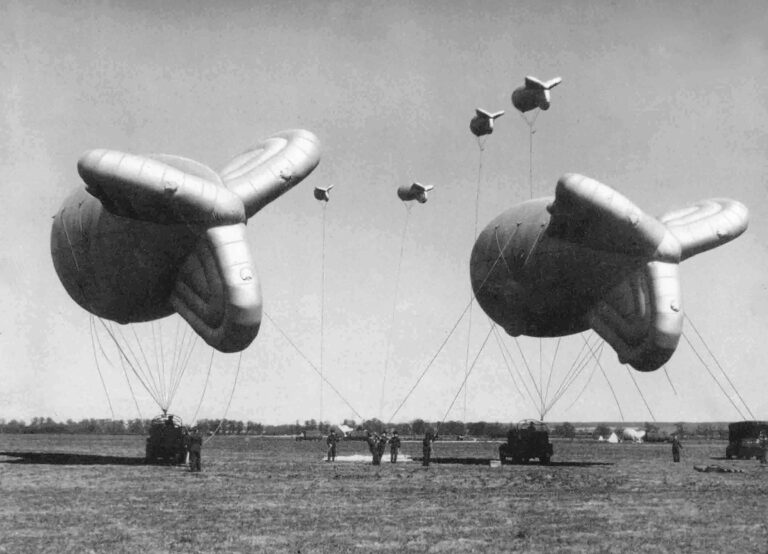
The streamlined balloons were large, 63 feet long and 31 feet high, and made of specially treated, rubber-proofed cotton fabric. The gas bag had a capacity of 19,150 cu ft and weighed 550 pounds. The balloon was flown on a flexible steel cable of 0.31 inch diameter and it was this cable, rather than the balloon itself, that deterred aircraft from flying in the vicinity of balloons. A collision with the cable almost invariably meant that the aircraft would not make it back to base.
As barrage balloons were inflated with hydrogen gas, which is much lighter than air, the balloons were able to rise thousands of feet skywards, tethered by their lethal cables. As the balloon gained altitude, the atmospheric pressure diminished and, as a result, the hydrogen gas expanded. For this reason the balloon was designed to make allowances for the expansion of the gas. A false bottom permitted the lower cavity to be filled with air which, as the hydrogen gas expanded, was expelled. This false bottom was called the ballonet and the flexible wall which separated it from the upper (gas) chamber was referred to as the diaphragm.
When the balloon was inflated the upper compartment was not filled to capacity with the hydrogen gas. The ballonet was filled with air through its wind scoop. As the balloon ascended, the atmospheric pressure dropped, the hydrogen gas expanded pushing down on the diaphragm and so expelled the air. When the balloon descended, the ballonet scooped in air as the gas contracted, so that the shape of the balloon remained constant. Three air-inflated stabilisers ensured that the balloon flew at an even keel always head towards the wind.
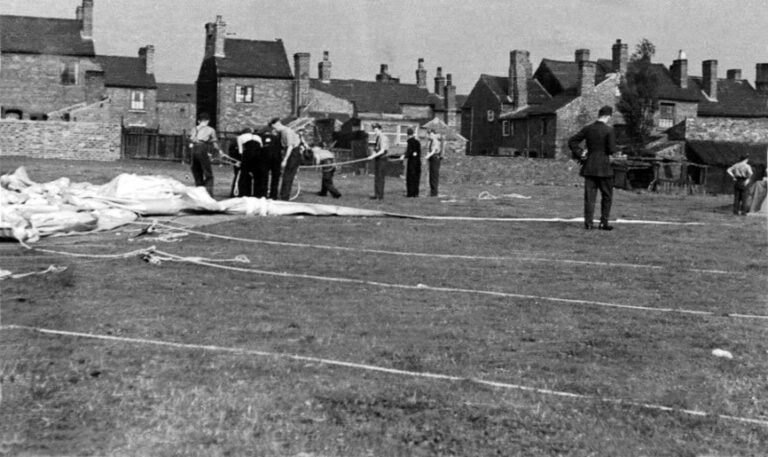
Maintaining and flying a barrage balloon was heavy and demanding work. Normally a balloon site was manned by two corporals and eight men. From 1941, personnel from the Women’s Auxiliary Air Force (WAAF) were also actively employed in operating the balloons. At first, the women were formed into mixed crews with the men. Later, exclusively WAAF crews were used; these numbered 16 to a crew because of the nature of the heavy workload.
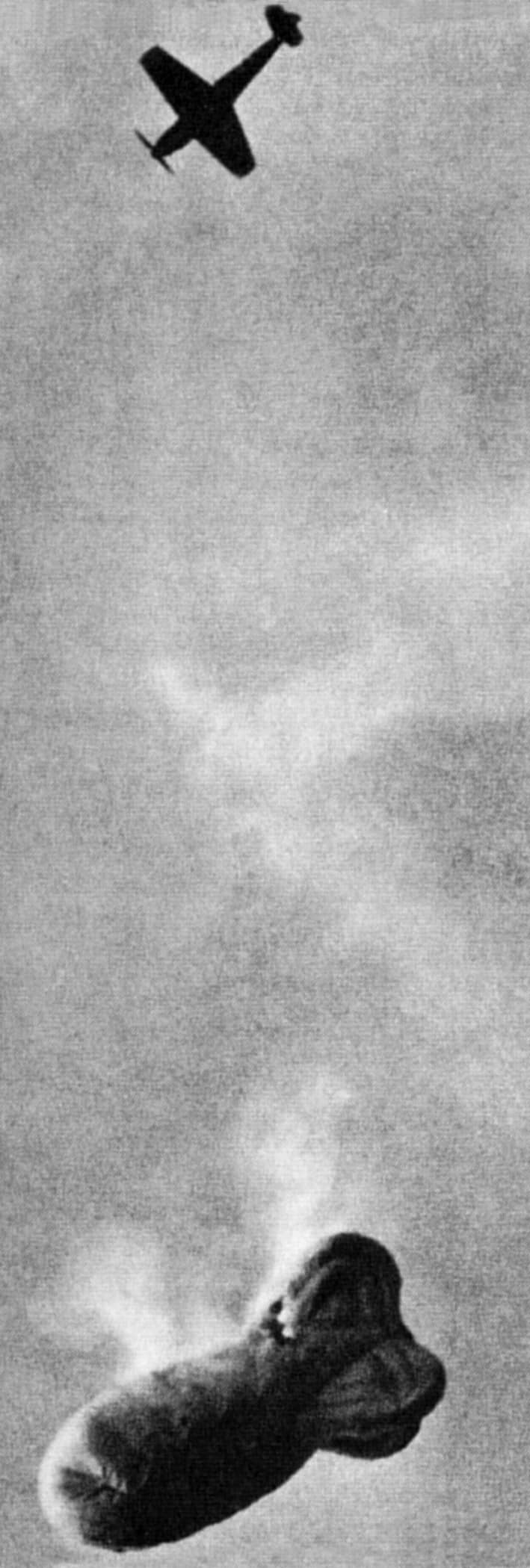
When in flight, balloons were vulnerable to lightning strikes, as the steel cable acted as a conductor. The hydrogen gas with which the balloon was filled was particularly inflammable; a lightning strike generally meant it was impressively destroyed by fire. During autumn 1939, lightning strikes on balloons in the London area saw a massive 80 balloons destroyed in a single afternoon. Snow and ice were also a problem, making the balloon heavy. Wind was the biggest challenge, especially when trying to bed the balloon down. As the war progressed, new equipment and techniques ensured a more efficient operation. Gusty conditions could cause a balloon to break loose from its mooring site and float off trailing its steel cable which wrought havoc upon chimneypots, roof tiles, tram wires, lamp standards etc! Balloons were also vulnerable to attacks by enemy aircraft and shrapnel damage from exploding anti-aircraft shells.
Heinkel down
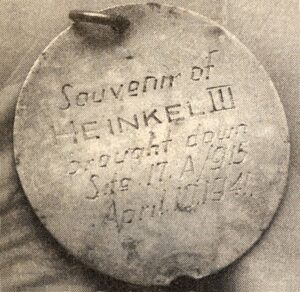
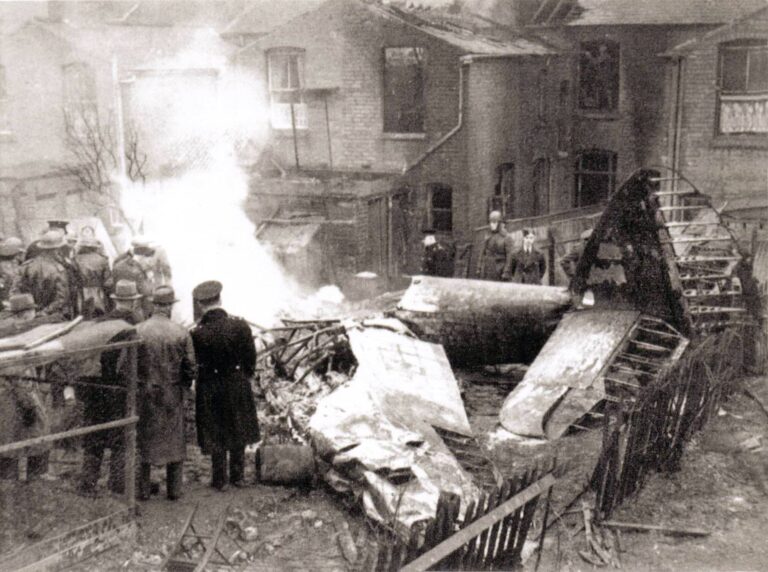
Soon after midnight on 10th April 1941, a German Heinkel He 111P was critically damaged by an RAF nightfighter of 151 Sqn. As it lost height over the suburb of Quinton, it struck a balloon. The bomber crashed onto houses in nearby Warley, killing all seven occupants. The incident was, however, a morale boost for the 915 Squadron balloon crew. The reality is that the aircraft was doomed already. Each member of the barrage balloon crew was issued with a commemorative medallion made from metal taken from the wrecked Heinkel.
Although some German aircraft fell victim to balloons, the primary purpose of the balloons was to discourage low flying by the enemy. The passive role of the balloons meant that the operating crews had little to encourage them, despite much hard work.
RAF Balloon Command
Whilst anti-aircraft guns and searchlights were the responsibility of the Army, barrage balloons were a part of the Royal Air Force. Following the establishment of a balloon barrage over London during 1936-1938, the Air Staff became convinced of the value of such barrages as a means of keeping enemy aircraft at reasonably high altitudes. It was therefore decided that key provincial towns and cities would have their own barrages and so was born RAF Balloon Command.
Balloon Command was divided into five groups (numbered)30-34)and these were subdivided into Balloon Centres. These centres governed the squadrons in the field, providing supply, maintenance and administration (including sick quarters). In the beginning units were established on a skeleton basis with a small force of regular personnel which was supplemented by local part-time auxiliaries.
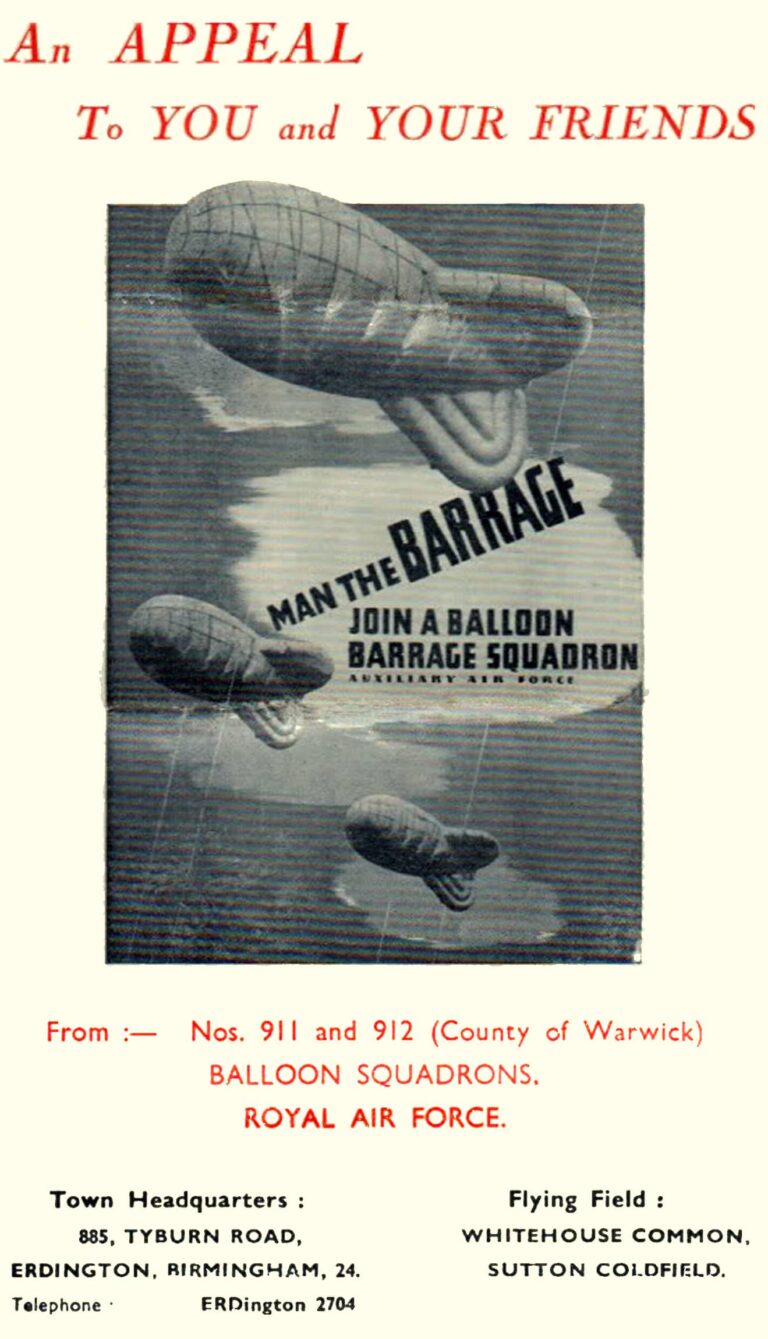
Recruiting for the Auxiliary Air Force barrage balloon squadrons began in the first weeks of 1939. Typically, the Territorial Association (TA) volunteers were aged between 25 and 50. They trained during the evenings and at weekends throughout the summer months, receiving instruction from regular serving RAF instructors.
Mobilisation took place in August 1939 and in April 1940, a number of balloon squadrons were obliged to provide mobile units for service with the British forces in France. These units were sent to RAF Cardington, Bedfordshire, and were then dispatched to their port of embarkation. Just weeks later their equipment was abandoned in the face of the German onslaught but personnel were evacuated safely in late May. After disembarkation leave, they re-mustered at RAF Cardington for training and re-equipment.
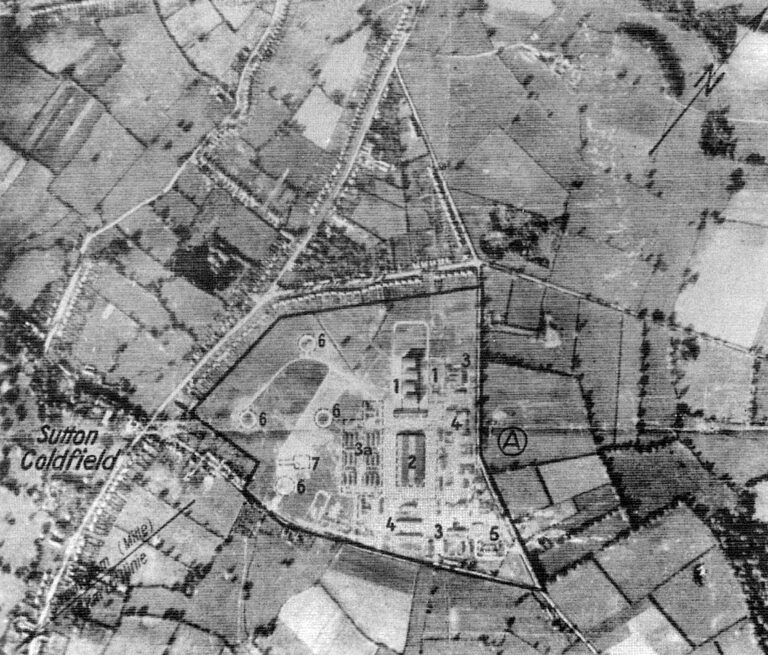
By the summer of 1940, with the exception of London, Birmingham had more barrage balloons than any other defended area in the country. This was a total of 168 balloons and they were flown by four squadrons viz 911, 913, 914 and 915. The first two of these came under 5 Balloon Centre at RAF Sutton Coldfield and the last two under 6 Balloon Centre at RAF Wythall. All were a part of 31 Barrage Balloon (BB) Group.
RAF barrage balloon personnel often shared in the civil defence role during and immediately after air raids. As the threat of invasion grew, a number of industrial cities and towns were divided up into various defensive sectors and in some of these it was the balloon squadrons which took on command and control. Personnel were given regular weapons training and, together with the Home Guard, were given specific responsibilities for defence in the face of enemy infiltrations on the ground. This meant close liaison not only with the Garrison Commander, but also commanders of the Home Guard, both Field Force and Factory Units.
Another role given to the RAF balloon squadrons was that of organising and operating decoy fires. Carefully laid out trench systems containing petrol could be ignited to simulate a town on fire when viewed from the air. These Special Fires were first tried in late 1940. Subsequently they became known by the codename ‘Starfish’ sites. In January 1941, all Starfish sites became the responsibility of Balloon Command.
As the war progressed and the threat of air raids over the Midlands greatly diminished, the Birmingham balloon squadrons were firstly merged and then disbanded; so their hard-working personnel played no part in the victory parades of May 1945.
Aircraft which fell victim to Birmingham’s balloons
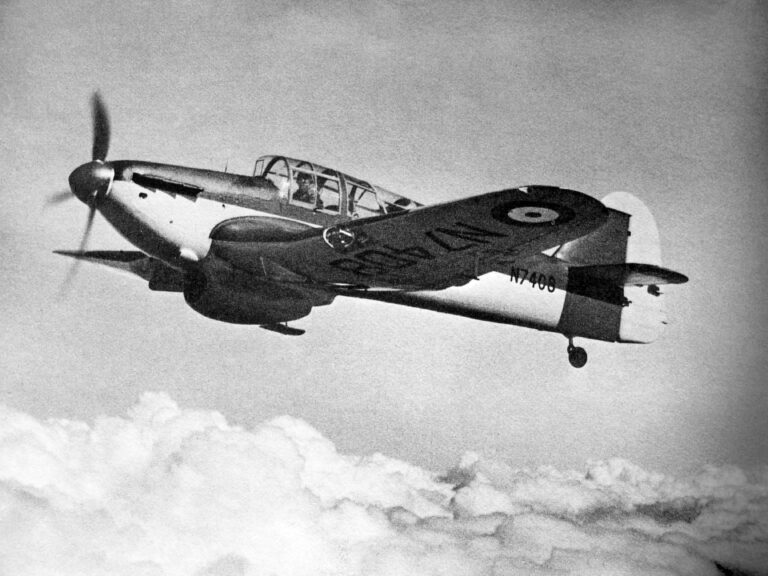
28th August 1940 At 11:30 hours Miles Master I N7408 en-route from Sealand to Brize Norton struck a balloon cable (site Pri 22 of 911 Sqn) at West Bromwich. The aircraft crashed onto the roof of W & T Avery’s factory, Smethwick. The pilot was killed but there were no serious civilian casualties.
28th October 1940 Bristol Blenheim IV R3840 struck a balloon cable (site Pri 24 of 911 Sqn) at 15:30, severing a wing. The aircraft crashed near the Warley Odeon. The machine was being ferried by the Aircraft Transport Auxiliary (ATA) which was based at White Waltham, Berkshire. The pilot was killed.
9th November 1940 Avro Anson I N9945 of the Wireless Intelligence Development Unit (WIDU), based at Wyton, Huntingdonshire, hit a balloon cable (site 3 of 913 Sqn) at Stechford and crashed onto the LMS railway track. The accident occurred at 00:15. The crew of five were killed.
12th December 1940 Hawker Audax I K7445 of 9 FTS crashed at 16:30, after hitting a balloon cable (site 61 of 915 Sqn) at Longbridge. The pilot was killed.
12th February 1941 Handley Page Hampden I AD734 of 83 Sqn, based at Scampton, Lincolnshire, returning from an operational mission to Bremen, hit a balloon cable (site 67 of 914 Sqn) at 02:06. All of the crew bailed out safely.
21st/22nd March 1941 Bristol Blenheim IV T1892 of 105 Sqn, based at Swanton Morley, Norfolk, whilst returning from an operational mission, hit a balloon cable (site 61 of 915 Sqn) shortly before midnight. It crashed soon afterwards at Cofton Hackett. All of the crew were killed.
10th April 1941 Heinkel He 111P (w/n 1555) 1G+KM of 4/KG27 was attacked by a Defiant and then collided with a balloon cable (site 17 of 915 Sqn). The aircraft crashed onto two adjacent houses in Smethwick at 01:40, killing seven civilians. Two of the crew were killed and two were taken prisoner.
7th July 1941 Armstrong Whitworth Whitley V Z6476 of 10 Operational Training Unit (OTU), based at Abingdon, Oxfordshire, hit a balloon cable (site 51 of 915 Sqn) at Quinton at 01:55. The aircraft was on a cross-country exercise. The Polish crew of six were killed when the aircraft crashed on open ground at Quinton.
10th October 1941 De Havilland Tiger Moth DH 82A T8199 of 19 EFTS, based at Sealand, Flintshire, hit a balloon cable, stalled and crashed near Bartley Green at 12:40. The pilot was injured.
12th October 1941 Westland Lysander IIIA V9612 of 7 AACU hit a balloon cable (site 5 of 913 Sqn) at 12:13. It crashed at Erdington.
8th November 1941 De Havilland Tiger Moth II N9156 of 14 EFTS hit a balloon cable (site 29 of 913 Sqn) at Castle Bromwich at 15:44. The aircraft broke in two and crashed a few hundred yards from the balloon site, both of the airmen having bailed out successfully.
20th February 1942 At 10:38 a Bristol Blenheim IV Z5899 of 17 OTU, based at Upwood, Cambridgeshire, hit one of 911 Sqn’s balloon cables which was tethered at Avery’s sports ground in Edgbaston. It fell onto houses in Bearwood. There were no civilian casualties but the crew of three were killed.
7th August 1942 Vickers Wellington IC R1075 of 16 OTU, based at Upper Heyford, Oxfordshire, hit two balloon cables in succession, site 12 at 01:37 and site 38 at 01:41 (both sites part of 911 Sqn). The aircraft crashed at Erdington. Four of the crew were killed and two bailed out safely.
The author wishes to thank Delwyn Griffith and Mark Evans
(www.aviationarchaeology.org.uk/marg/crashes.htm) who supplied much of the information for this listing.
© Steve Richards
Click to see full BMMHS event listing pages.
Contact us at [email protected]
Copyright © 2026 bmmhs.org – All Rights Reserved
Images © IWM & NAM