Biafra, The Bush War That Killed Millions

by Nick Brazil

The Royal Niger Company - gun in one hand, a bible and company ledger in the other

In 1851, Britain intervened in Nigeria’s affairs by deposing Oba Kosoko an ardent supporter of the slave trade. Whilst ridding  Nigeria of this particular scourge, it also enabled her to make this part of west africa a colony. This was at the height of Britain’s campaign to rid the world of slavery. As such, deposing Kosoko must have seemed an undeniably good and Christian action.  However, events over the next eighty years would lead to a much less happy outcome in the  catastrophic Biafran War, also known as The Nigerian Civil war.

Between 1885 and the early part of the twentieth century Britain entrenched her rule over Nigeria, often using force of arms against various ruling tribes. Until 1900 this rule was conducted by The Royal Niger Company with a gun in one hand and a bible and company ledger in the other. By 1906, Nigeria was pacified and split into The Northern and Southern Nigerian protectorates.

Protectorates merged to form Nigeria

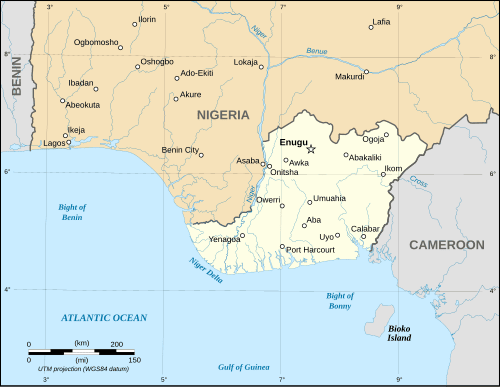
Map of the secessionist state of the Republic of Biafra (1967 – 1970) as in May 1967. Source: Wiki

In 1914, the British Government through the Governor General Lord Frederick Lugard merged these protectorates into one large entity known as Nigeria. This would be ruled at arms length through a structure of local chiefs. Within this structure would be regions with a degree of self government. In 1946, the British split what had been the Southern protectorate  into two smaller regions, the Western region and the Eastern Region.

In doing this, the British Government was jostling together three mutually antagonistic tribes. The northern part of the country was dominated by the mainly muslim Hausa and Fulani, the Yoruba dominated the west and the Igbo (pronounced Eebow) were the majority in the east.  The British were blissfully unaware they had laid the foundations for a bloody future of conflict.

A violent political struggle breaks out

First signs of this were some extremely nasty riots that broke out in 1945. These erupted in the northern city of Jos where Hausas and Fulanis turned on the minority of Igbos leaving three hundred  dead. In 1954, there were more violent anti igbo riots in  Kano another northern city. Throughout the country, intertribal hatred rippled violently just beneath the surface.

On 1st October 1960, the independent federal state of Nigeria was born into this chaotic firmament.  As the country’s white and green flag replaced the Union Jack, Britain’s representatives expressed warm hopes of a stable and prosperous future for this new member of The Commonwealth.

Just how vain these hopes were was exposed by a violent political power struggle that broke out in Western Nigeria four years  later. Allegations of corruption and power grabbing by northerners helped spread the deadly virus of violence across the country.

The first government of independent Nigeria was one based on the Westminster style of democracy. However it was tainted by wide-scale corruption and patronage by Northern politicians. This, linked closely with incompetence, led to a great deal of labour unrest and strikes throughout the country in 1964. The root causes of this unrest were low wages, poor working conditions and a hatred for the corrupt political class. Ultimately, the unrest led to a marginal improvement in wages an conditions. However, the 1964 elections merely brought in another corrupt civilian government dominated by politicians from the north.

Army discontent triggers a coup

The power and influence of the Nigerian army grew steadily throughout this period. On January 15th 1966, discontent with this Northern dominated Government exploded in a coup by mainly Northern army officers. However, the plotters behind the scenes were Igbos. The rebel officers killed the government’s two main northern figureheads, the Prime Minister Sir Abubakar Tafawa Balewa and the Premiere of the Northern Region Sir Ahmadu Bello, his wife and some army officers from the North. Other major fatalaties in the Government elite included prominent Yoruba politicians like Ladoke Akintola, the Western Region Premiere.

The President Sir Nnamdi Azikiwe had the good fortune to be on holiday in the West Indies at the time. Or was it good fortune? He came from the Igbo tribal group. Because of this, many believed that he, along with other Igbo members of the government had been tipped off about the coup.

Subsequently known as “The Coup of The Five Majors”, it  was one of the watershed events that led to The Biafran War just over a year and a half later. The intention of the Coup had been to break the hold over power enjoyed by northern politicians. Instead, the head of The Nigerian Army the hardline Johnson Aguiyi-Ironsi stepped in and, halting the coup took over leadership of Nigeria.

Parliament is suspended

Under him Parliament was suspended as was the constitution. Nigeria also changed from a federal to a unitary state with power centred on the Lagos Government. His failure to bring the perpetrators of the coup to trial led to suspicions that his accession to power was all a stitch up job by the Igbos.

Feelings were now running very high with a great deal of pro and anti Igbo sentiments amongst the various tribal groupings. As a reaction to what they considered provocation from the Igbo media, military officers from the North mounted a counter coup. This happened on 29th July 1966 and was exclusively planned by Northern military.

General Ironsi who was visiting the Western Nigerian city of Ibadan, was killed along with his host, the premiere of the Western Province. Ironsi was replaced by the head of the Nigerian armed forces, a well respected officer by the name of Lt General Yakubu Gowon. Although a Christian, he was from the North and had broad support throughout much of the Army. One of his first acts was to restore the system of federal states. 

Shell finds large deposits of oil in the Niger Delta

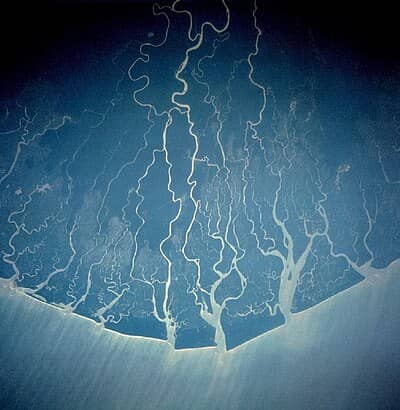
At this stage, one of the crucial ingredients of the future war would play an increasingly important role. In 1956, Shell had found large deposits of oil in the Niger Delta area of Nigeria. This was exclusively in the Igbo Eastern Region and by the 1960s was an important part of the economy.

With secessionary pressures building in more than one region, Gowon sought to hold Nigeria together as one country. To do this, he divided up the Eastern and Western regions into smaller regions. When it came to the East, the Igbos found that the oilfields that previously lay in their territory had been snatched from them by the Federal Government.

Biafra War
Control over petroleum in the Niger Delta was a paramount military objective during the war. Source: NASA Space Shuttle Overflight

The independent Republic of Biafra

One of many pressing problems facing Gowon on taking power was severe inter ethnic violence. Between June and October 1966 the Igbo minority in the North were attacked by their mainly muslim neighbours who killed between 10,000 and 30,000 of them. Whether they were young or old, women or children, none were spared. This caused a massive migration of one to two million Igbos fleeing to the safety of their native Eastern Region. Without doubt, the anti Igbo massacres and pressure created by this influx of refugees was one of the main causes of the Biafran War. 

In early January 1967, The Federal Government headed by Gowon and the Governor of the Eastern Region, an army officer called Odumegwu Ojukwu met in the Ghanaian city of Aburi. This neutral ground was insisted on by Ojukwu who feared for his safety if the meeting was held on Nigerian soil. 

Biafra War
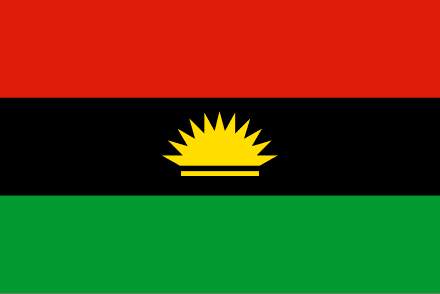
The new republic adopted the Flag of Biafra which was unveiled on 30 May 1967. Source Wiki
Biafra War
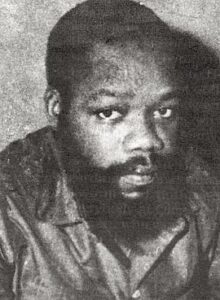
Chukwuemeka Odumegwu Ojukwu. First President of Biafra. Source Wiki

Hostilities commence

The resultant Aburi Accord supposedly gave greater autonomy to the Nigerian regions, particularly the East. However, although it was signed by both sides, Gowon reneged on the deal soon after arriving back in Lagos. As a result, Ojukwu made the fateful decision  to take  the Eastern region out of The  Nigerian Federation. On 27th May 1967, he declared the Eastern State to be the independent Republic of Biafra.

The reaction of the Federal government was to blockade the new state. Initially this excluded oil shipments. However, when it was discovered Shell were paying the Biafrans royalties, oil was included in the blockade.  

When this did not bring the secessionists to heel, the Federal Government moved to reclaim this Region by force and crush the new country of Biafra. Hostilities between the Lagos Government and Biafra started on 6th July 1967 when Federal troops advanced across the border of the former Eastern Region.

Biafra forces advance towards Lagos

Although both armies were small, poorly led and ill equipped, the Biafrans put up a stiff fight. Despite suffering high casualties, the Nigerian Federal force managed to capture the Biafran towns of Nsukka and Garkem. 

The Biafran forces responded with their own offensive between 9th and 21st August. This took their forces deep into Federal Nigerian territory. Although their advance was stopped 130 miles from Lagos, this Biafran strike into the Federal heartland shocked the Nigerian military command.  It was now clear  that defeating the Biafrans would be a more difficult task than initially thought.

From then on Gowon and his government turned what was initially termed a police action into all out war. By the end of 1967 the armies of both sides had grown to 150,000 Nigerian federal troops and 100,000 Biafran soldiers. 

Enugu the prime target for Federal forces

Under the command of Brigadier “Black Scorpion” Adekunle Federal forces conducted a successful offensive into Biaran territory. By this time, as the capital hub of Biafran operations, the city of  Enugu  became a prime target for Federal forces. They captured it  on 4th October. Ojukwu, who had been asleep in the city’s State House narrowly escaped capture disguised as a servant.

The Nigerians hoped the capture of Enugu would end the war. Had Ojukwu been taken prisoner this might well have been the case. As it was, he “lived to fight another day” setting up his headquarters in the city of Umuahia.

Unlike other regional conflicts during the Cold War, The Biafran War did not turn into a proxy war between The Soviets and the US and its allies. In fact both sides of the Nigerian conflict had a profusion of backers who crossed  the ideological divide.

The Nigerian Federal Government was supported not only by the US and UK but also the the Soviet Union. They also had support from smaller nations such as Egypt that they could well have done without. In the latter case, Nasser’s Government loaned the Nigerians six Illyshin bombers. Unfortunately, the Egyptian air crews had a tendency to bomb schools and hospitals rather than military targets.

The United Kingdom supported the Federal Government throughout the war. This was largely down to the extensive interests British companies, particularly Shell BP had in the Nigerian oil industry. Believing rightly that Biafra could never win this war, Britain did not want to jeopardise her investment in the Nigerian oilfields  by backing the losing side. Many in Britain disagreed with this stance where sympathy with Biafra as the underdog was strong.

Support for the Federal Government

Biafra War
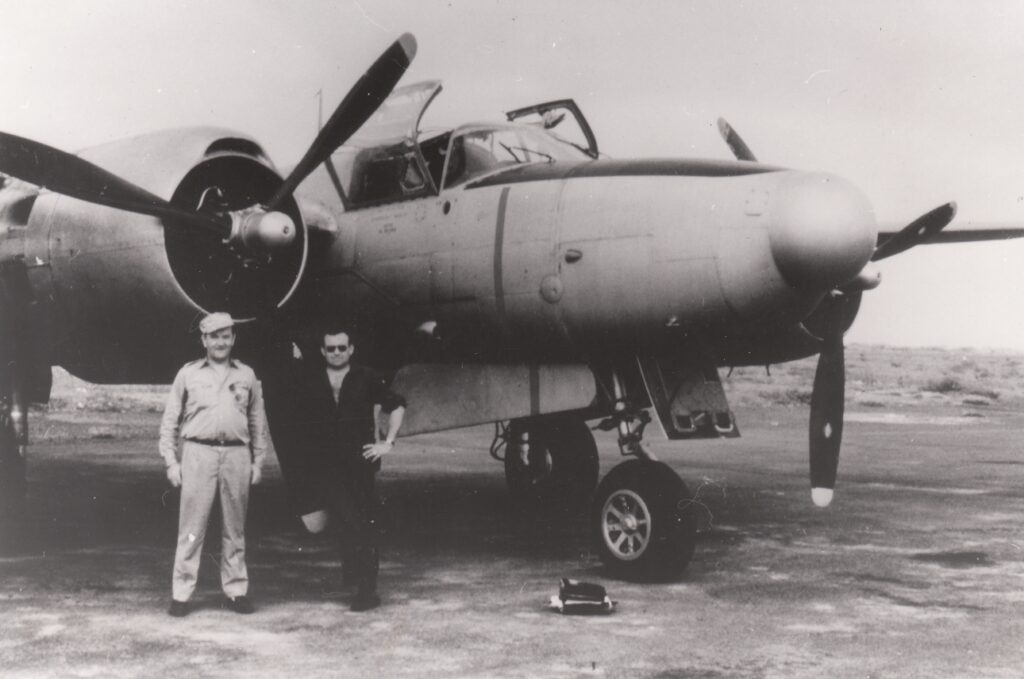
A Douglas B-26 Invader used in the Nigerian civil war, on arrival at Enugu in June 1967. Source Michael Robson, an aviation enthusiast and writer for Model Aircraft Monthly.
Biafra War
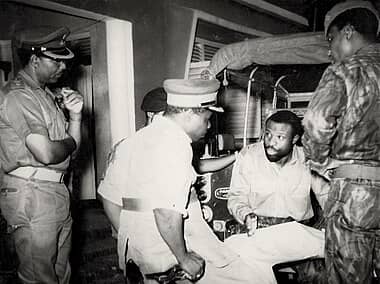
Alabi-Isama (second right) led forces against the Biafran Republic. Seen here briefing Col. Obasanjo (third right), Col. (Rev Father) Pedro Martins during the Nigerian civil war. Source Wiki: Godwin Alabi-Isama

The other big supporter of the Federal side was the Soviet Union. It is generally believed that the supply of 47 Mig 15 and Mig 17 jet fighters by Russia helped turn the war in the Federal Government’s favour. This was done in defiance of an international arms embargo. As well as wanting to draw Federal Nigeria into the Soviet sphere of influence, Russia also wished to gain a bigger foothold in West Africa at Britain and America’s expense. The supply of Russian aircraft acted as a catalyst for the British who increased their arms supplies to Lagos following that Soviet intervention.

Under the Lyndon Johnson administration, the United States involvement was neutral but friendly towards Gowon’s Government. This was strongly influenced by Gulf Oil’s $800 million  stake in oilfields held by the Federal Government.

As in Britain, there was a large and vocal pro Biafra lobby in the US who wanted their Government to be more closely involved on the secessionist side. In this they were backed by Presidential hopeful Richard Nixon. However, when he gained power in 1968 Nixon found that there was little he could actually do to help the Biafrans.

The Biafran War occurred at the height of the Sino-Soviet split when relations between Mao’s China and the Soviets were at a very low ebb. As a result, the Chinese heavily backed the Biafran side. From 1968-69 they gave the Biafrans $2 million which is worth about $20 million today.

The breakaway state’s main backer in the War was France. Describing Biafra’s struggle for freedom from the rest of Nigeria as ”noble and just” French leader Charles De Gaulle supplied Ojukwu’s side with two B26 bombers, two Alouette helicopters, arms and ammunition. These aircraft would augment the small and colourfully eccentric Biafran Air Force.

Initially, this consisted of two B-25 Mitchell bombers, a DC-3 also converted to a bomber and a De Havilland Dove passenger plane converted for action during the war. In 1969 Four Malmö MFI-9 single engined aircraft were assembled in neighbouring Gabon with the addition of anti-armour rocket launchers under their wings. Later in the war the Air Force was increased in size with four North American prop fighters of Second World War Vintage.

Commanded by a Polish Swiss pilot called Jan Zumbach its pilots were Biafrans, Swedes and Portuguese. In the history of air warfare, there may never have been a stranger air force. But it punched above its weight throughout the War.

The French gamble on oil drilling rights

French aid was largely supplied through a humanitarian front organisation in Paris channelling it through the former French colony of The Ivory Coast.  However, French support for the rebel side was not entirely altruistic. The French were also gambling on a large share of oil drilling rights in the event of  a Biafran  victory.

During the War, Biafra also received logistical support from Portugal, South Africa, Rhodesia and Israel. However, lack of international support and embargoes increasingly hobbled the beleagured state. Ojukwu appealed to the Organisation of African Unity but in vain. The policy of its members forbade support of any secessionist state.

As time went on, Biafra’s situation became steadily more desperate with the better armed Nigerian Federal forces steadily whittling away their territory. In spite of this, the Biafrans proved to be gritty and brave soldiers.  Proof of this was the number of times they fought Nigerian Federal Forces to a standstill.  Taffy Williams a Welsh born South African  mercenary who fought on the Biafran side had this to say about them:

   “Give me 10,000 Biafrans for six months, and we’ll build an army that would be invincible on this continent.”

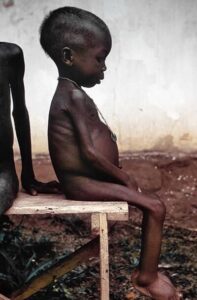
On 19th May 1967, Nigerian Federal Forces captured the important Biafran city of Port Harcourt. Throughout the latter part of 1967 to 1969, they imposed a total blockade on Biafra. This included all food and medical supplies. The blockade was the darkest period of the war and is estimated to have caused three to four million civilian deaths from starvation. It was, without doubt, a major war crime for whom nobody has ever been brought to book.
The Biafran famine labelled as genocide

Initially, information about this deliberate famine was spread across the rest of the world by the charities and NGOs working in Biafra. This led to increased media interest in the war. The rapidly swelling numbers of photographs and newsreels of Biafran children dying of malnutrition further engaged the attention of the outside world to this horror. Extensive coverage in the world’s electronic media turned this into one of the first “television wars”. In world capitals the war was also fought by public relations companies hired by both sides. Without doubt, the Biafran famine which many labelled as genocide had a powerful effect but not enough to win the War.

Throughout the summer of 1968 and well into 1969 the number of aid flights and missions by charities increased. Flights carrying arms into Biafra often shadowed these humanitarian flights as a shield against attack by Federal Forces who also would attack humanitarian convoys  and kill aid workers.

Towards the end of 1969, the War had turned irresistibly in favour of the Nigerian Federal Forces. Since 25th July 1967, the British Government led by Harold Wilson had openly backed the Federal Government in Lagos with supplies of arms. This was based on Britain’s concern for its considerable investment in Nigeria’s petroleum industry. The realpolitik belief was that Gowon’s side was always likely to win as the stronger force.

Biafa War
A child suffering the effects of kwashiorkor, a disease brought on due to a severe dietary protein deficiency. Pictures of the famine caused by the Nigerian blockade garnered worldwide sympathy for the Biafrans. It was regarded in the Western press as the genocide of two million people, half of them children. Source Wiki/Dr Lyle Conrad
Biafra War
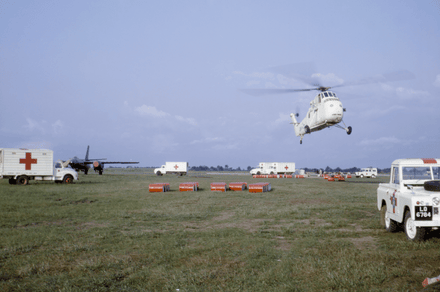
This late 1960s photograph depicts a field that had been converted into a make-shift airport in Calabar, Nigeria, where relief efforts were aided by a helicopter team. These helicopters could move one ton of crated, dry fish quickly to refugee camps in the Nigerian-Biafran war zone. In 1967, the CDC was asked to assist the International Committee of the Red Cross (ICRC) in its disease control and death prevention efforts during the Nigerian-Biafran war. A large number of relief camps were established for purposes of nutrition assessment, and feeding operations for the local villagers around the war zone. Source: Wiki/Dr Lyle Conrad

The final surrender

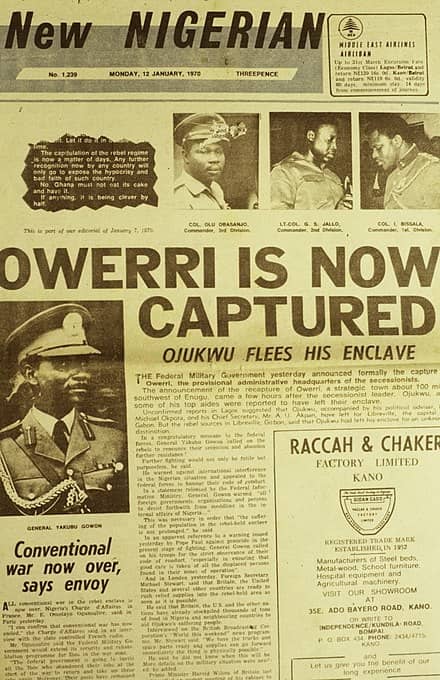
On 23rd December 1969, Nigerian Federal Forces commanded by General Olusegan Obasanjo began a decisive operation that would see Biafra split in two by the end of the year. The Coup de Grace was delivered by an additional Federal offensive dubbed Operation Tail-Wind on 7th January 1970. The Nigerians took the Biafran City of Owerri on 9th January and the city of Ulli two days later.

By this time, Ojukwu, realising all was lost, flew out to The Ivory Coast where he was granted political asylum. Before doing so, he handed over power to his deputy Major-General Philip Effiong. It would be his unenviable task to negotiate surrender terms with the victorious Federal Government. On 14th January 1970 the final surrender was signed in Lagos ending one of Africa’s ugliest and most destructive Wars.

The violent trauma of The Biafra War has bitten deeply into the Nigerian psyche. It has left a legacy of instability and tribal enmity that has survived over the intervening years. Today, there are threats to Nigeria’s  stability throughout the whole country. In addition to the Islamist insurgency spearheaded by Boko Haram in the North there is political violence in the oil producing eastern regions. Armed insurgents from smaller tribes began seriously disrupting oil production in 2004. They are driven by a wide variety of grievances from mistreatment by the oil companies, security forces and armed Fulani tribesmen to careless pollution of their lands by oil spills.

Biafra War
New Nigerian newspaper page 7 January 1970. End of the Nigerian civil war with Biafra. "Owerri is now captured. Ojukwu flees his enclave." Photographs of the military Obasanjo, Jallo, Bissalo, Gowon. Source: Wiki/Aart Rietveld collection

The underling danger of a new civil war

The Indigenous Peoples of Biafra movement has been pitted against the central government since 2021. Basically, their chief aim is to have an independent state of Biafra. Like all the other protesting movements, IPOB have attacked oil drilling facilities and kidnapped foreign workers. All this unrest has seriously disrupted oil production and made Nigeria a no-go country for all but essential travel.

After 55 years, the danger of a new Nigerian civil war breaking out still hangs over the country’s future like a dark storm cloud.

©  Nick Brazil 2024

Photos: Wiki

About The Author

Nick Brazil is an author, film maker and photographer. He has made eight documentaries and numerous shorter videos for the internet. He has also published three books including “Cheating Death – The Story of a PoW” and “Billy Biscuit – The Colourful Life & Times of Sir William Curtis” which is the story of the man who coined the phrase “The Three Rs”. 
Nick Brazil self portrait
Nick Brazil

To purchase this book please contact the author on [email protected]

Price £12

Available on Amazon

Click above to purchase

Click to see full BMMHS event listing pages.

Contact us at [email protected]

Copyright © 2024 bmmhs.org – All Rights Reserved

Images © Nick Brazil