Book Review
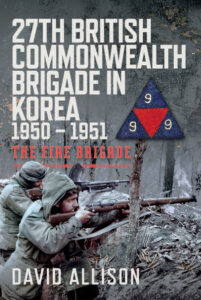
27th British Commonwealth Brigade in Korea 1950-1951: The Fire Brigade
Review by James Goulty
The Fire Brigade
by David Allison
Publisher: Pen & Sword (Hardback, 231 pages, 35 bw photographs, 6 maps)
The invasion of South Korea by North Korea in 1950 prompted a response, and the American led United Nations Command (UNC) was established to co-ordinate the international military effort to assist South Korea. Consequently, the Korean War (25 June 1950-27 July 1953), was the first UN action against aggression, and eventually drew on the resources of 21 countries. It was brutal, with over 118,000 UN troops killed, over 260,000 wounded, and around 92,000 captured. Total Communist casualties are harder to quantify, but 1,600,000 is probably a conservative estimate. Equally, around 3 million Korean civilians perished, many owing to American bombing. The war was fought over difficult terrain, and in an unforgiving climate, something the author graphically illustrates, especially with regard to how soldiers coped with sub-arctic conditions during the savage Korean winter. Both sides experienced stunning successes and equally dramatic reversals during 1950-1951, the period covered by this book, which concentrates on the experience of 27th British Commonwealth Brigade. As the author explains, 27th Brigade was part of the UK’s strategic reserve, and had been despatched to Hong Kong to shore up its defences prior to the outbreak of the Korean War. Accordingly, it fulfilled a ‘fire brigade’ role, something reinforced by its blue and red triangular formation sign, which incorporated three nines, as in the 999 telephone number for the emergency services in the UK.
Initially, during August-September 1950, the Brigade comprised the understrength 1st Battalions of the Middlesex Regiment and Argyll and Sutherland Highlanders, with very little in the way of supporting services, artillery, armoured support, and transport having to be begged or borrowed from the Americans. This improved when the full strength 3rdBattalion Royal Australian Regiment (RAR) was attached to the Brigade in October 1950, leading its then commander, Brigadier Basil Coad, to re-designate the formation 27th British Commonwealth Infantry Brigade. In January 1951 it received 16th New Zealand Field Regiment (NZFR), established specially for Korean service that provided much needed organic artillery support with its 25-pounder guns. Subsequently, 2nd Battalion Princess Patricia’s Canadian Light Infantry (PPCLI) served with the Brigade during spring 1951, and it was joined by the widely respected 60 (Parachute) Field Ambulance, ‘a Regular Army unit of the Indian Army Medical Service,’ that constituted India’s contribution to the UNC.
Research is based on consultation of a range of archives and published secondary sources, such as Official Histories, general histories, and personal memoirs. Notably, official documents from the National Archives at Kew, and oral history interviews, particularly those held by the Imperial War Museum and Australian War Memorial, are employed. An additional boon is the author’s incorporation of material from diaries and personal papers, such as those from his own collection regarding David Harrop, a young subaltern in the Middlesex Regiment, whose experiences might not have been revealed before. Similarly, throughout the book there is material based on the recommendations or citations for honours and awards granted to members of the Brigade. Not only does this provide a valuable human touch, it reminds us of the service and dedication shown by British and Commonwealth soldiers in Korea, an event that has frequently been dubbed the ‘Forgotten War.’ Reference to individual soldiers also provides the reader with a visceral sense of their experiences as members of the Brigade. For example, during operations in North Korea, Private Gurr of the Argylls was severely wounded by multiple gun shots. Yet, after being evacuated, he survived, and eventually returned to Korea to complete his service guarding POWs near Pusan. Another issue the author does well to flag up, is the sheer strain personnel were under, particularly senior officers.
The book commences with the North Korean invasion, and the desperate fighting during the initial phases of the war. A timeline at the start of the book, and map showing the extent of 27th British Commonwealth Brigade’s operations, are an asset, especially for anyone unfamiliar with the subject. Discussion continues with coverage of the Middlesex and Argylls, including a useful section on their weaponry and equipment. Chapters three and four detail the Brigade’s operations in breaking out from the Pusan Perimeter in September 1950, and crossing the Naktong, while simultaneously General MacArthur launched his audacious amphibious landings at Inchon. A lengthy section covers the tragic friendly fire incident at Hill 282, and its aftermath. It was here on 23 September 1950, that the Argylls were accidentally napalmed by the American air force, adding to casualties already suffered during intense combat with the North Koreans. For his leadership and actions that day, the Battalion’s second in command, Major Kenneth Muir, was awarded a posthumous Victoria Cross.
Chapters 5-12 cover the raising of 3 RAR, and its subsequent deployment during October 1950. It had only a few months in which to be able to adapt from being part of British Commonwealth Occupation Forces (BCOF) in Japan, to becoming a unit capable of active service. This included absorbing numerous K-Force volunteers, men often with prior military experience, who re-enlisted especially for Korea. Relying in part on War Diaries, the author neatly details the actions at Sariwon, Pakchon, and the advance towards Pyongyang, during which 3 RAR performed admirably, sometimes against stiff North Korean opposition. Subsequently, at Chonju, the combat ‘demonstrated once again the cool and lethal professionalism of the 3 RAR commanders and men.’ After a twelve hour engagement it had inflicted at least 150 casualties on the enemy and knocked out a number of T-34 tanks. Shortly afterwards, its commanding officer, the much admired Lt Col. Charles Green, was mortally wounded by shrapnel from a random North Korean barrage, while resting in his tent, an event described in the book, including a moving reference to his late widow who was eventually buried with him at Pusan. Communist China’s entry into the war is then described, with a brief section on Chinese capabilities, before discussing the heavy fighting experienced by the Brigade around Pakchon in November 1950. The next chapter is devoted to the horrendous winter conditions of 1950-1951, aptly entitled: ‘The Third Enemy-General Winter,’ a reminder that soldiers had to combat the cold as much as their Communist foes.
What has sometimes been described as the ‘Great Bug Out,’ the withdrawal of the UNC from North Korea during November-December 1950 in the face of the Chinese Second Offensive, is then discussed. This was a highly dispiriting time, not helped by the weather, during which British and Commonwealth troops frequently found that they had to act as rear guards, never an easy task, albeit a sign of the esteem with which they were held by American commanders. An excellent chapter then outlines the raising of Kayforce, as the New Zealand contribution was known, with emphasis on the mobilisation from scratch of 16 NZFR, a decided technical challenge given the nature of artillery. As the book demonstrates, one of the reasons for the successful outcome of the Battle at Hill 112 during February 1951 was that by then, the Brigade benefited from the terrific support of the New Zealand gunners.
Background on the mobilisation, training, and deployment of 2 PPCLI is then covered. Again, volunteers had to be sought, who in Canada’s case formed the Canadian Army Special Force (CASF) that would later become 25th Canadian Infantry Brigade. Attention also focuses on 60 (Parachute) Field Ambulance, which as the author points out, not only enhanced Commonwealth capabilities in Korea, but was reflective of India’s political aspirations, given that although she strongly supported the UN action, she wanted to remain ‘non-aligned and neutral.’
Readers are then treated to discussion on the Chinese Spring Offensive of 1951, and the epic clash of arms at the Battle of Kapyong in late April, where the Brigade faced an onslaught by numerically superior and determined Chinese attackers. Particularly interesting here is the assessment, which supports the preceding narrative of the battle, including discussion on ammunition expenditure and casualties. Drawing on material from Canadian and Australian officers who participated in the battle, the author intelligently and thought provokingly outlines areas of controversy, including reasons why Lt Col. Bruce Fergusson (then OC 3 RAR), apparently failed to establish a Tactical HQ in a forward location early in the battle, and initially did not ‘place himself in close co-operation with his rifle companies.’ Finally, the book ends with a ‘Summing Up’ chapter, that reflects on the bravery and skill of the members of 27th Brigade. Especially moving is page 206, which outlines the Brigade’s total casualties of 800 by the time it ceased operations in April/May 1951, effectively ‘an entire battalion’s worth of soldiers’ had been ‘either killed or wounded’ in support of the UN effort to save South Korea.
This book is highly recommended, especially for anyone interested in modern warfare, and the Korean War in particular.
James Goulty
(Author of Eyewitness Korea: The Experience of British and American Soldiers in the Korean War 1950-1953)

Click to see full BMMHS event listing pages.
Contact us at [email protected]
Copyright © 2026 bmmhs.org – All Rights Reserved
Images © IWM & NAM