
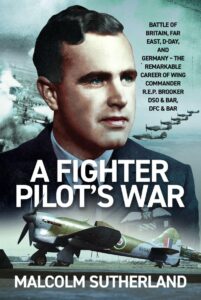
A Fighter Pilot’s War
Review by Geoff Simpson
Author: Malcolm Sutherland
Air World (2026)
253 pages, illustrated
Peter Brooker was an exceptional RAF fighter pilot in the Second World War. His service took in the Battle of Britain, the defence of Singapore and D-Day. He was awarded the DSO and bar, DFC and bar. As a Wing Leader on the cusp of surviving the war he died, fighting over Germany, in circumstances still not explained.
“Boy” Brooker did not become a celebrity as some of his peers did. Not before time he has been given some public recognition through this account of his RAF career written by his nephew.
I congratulate Malcolm Sutherland on his achievement but I also congratulate Air World, an imprint of Pen and Sword, on publishing the book. There were gaps in the information that Mr Sutherland had before him, leading to long, unexpanded, quotations from documents such as squadron ORBs. I suspect that some publishers would have said “no”, perhaps they did. Because Air World said “yes” we have a useful and interesting addition to the literature of the RAF in wartime.
The paucity of the acknowledgements and the lack of a bibliography make me wonder whether there were some avenues that the author left unexplored. Possibly publication will tease out more information.
Though Mr Sutherland explores the circumstances of his subject’s loss on 16 April 1945 he reaches no conclusion as to exact fate and where remains might lie. Most unusually Brooker was not wearing his dog tags that day and perhaps that is a factor in the mystery.
Wing Commander Brooker was one of those pilots – Guy Gibson and “Sawn-off” Lock come to mind as other examples – who died because they continued on operations when they could have settled for a less dangerous life.
The book quotes a letter written to Brooker’s mother, after his death, by his fellow member of the Few, Air Commodore (later Air Vice-Marshal) Stanley Vincent, which contains the judgement, “He was such a grand chap, and I always had the very highest opinion of him. I do miss him – and will continue to miss him, very much indeed. He was an instinctive leader – which quality he achieved by sheer strength of character.”