Book Review: Fighter Boy
Review by Geoff Simpson
Book Review: Fighter Boy
By John Willis
Mensch Publishing, 2024, 289 pages, illustrated, no index
John Willis has written some very good books with Battle of Britain themes. This time he has produced an absorbing account of the life of Wing Commander Geoffrey Page, who, in August 1940, baled out of a burning Hurricane, considerably roasted.
Page, nephew of the aircraft manufacturer, Sir Frederick Handley Page (with whom he did not get on), was picked up by a small boat, after his foul language convinced the crew that he was not German. He found that the formally attired mayor of Margate was on hand to greet him as he was brought ashore from that town’s lifeboat.
Eventually he became a Guinea Pig at East Grinstead, enduring much knifework from the plastic surgeon, Archie McIndoe and his team. Page defied McIndoe’s expectations and flew again. He became a wing leader and eventually was forced to return to Sussex and qualify as a Guinea Pig for the second time.
Much later he founded the Battle of Britain Memorial Trust, as a result of which, the National Memorial to the Few has stood for over 30 years on the Kentish cliffs at Capel-le-Ferne.
John Willis, as one might expect, has done an excellent job of recording a life marked by adversity (not just in respect of Page’s awful injuries), absolute determination to overcome tribulations and a level of reticence and modesty not shared by some of the Battle of Britain pilots who became more famous.
I Knew Geoffrey, though not for long, before he died in 2000, and I have read the book he wrote about his life, but I certainly feel I have come much nearer to an all round picture now.
Willis also delves more deeply than most authors into the way things ran under McIndoe at the Queen Victoria Hospital, and the role of the people of the town of East Grinstead in the recovery of the disfigured airmen (not all of them burned) who had landed in their midst. In East Grinstead they did not stare. A lady who was a schoolgirl there during the war told me that she and her fellow pupils were under instructions, not to stare, but to wave at McIndoe patients. On the other hand, two Guinea Pigs who made the short journey to Tunbridge Wells to do some shopping, created hysterics and a demand that they not be let out again in that state.
Some wives and girlfriends do not come well out of this study, though an awful lot was being asked of them. It would seem that far more than I had realised decided that the relationship could not continue now that their partner had been transformed from the dashing young man in RAF uniform they had been romanced by.
Geoffrey Page witnessed the first visit of the wife of a man in a proximate bed. She sat unable to look at her husband. They were soon divorced.
On the other hand, there was the initial visit of the wife of the horribly burned Hurricane pilot, Squadron Leader Tom Gleave. “I don’t know! Playing with matches again,” was her opening remark. With encouragement like that, Gleave returned to active service as, for example, Officer Commanding, RAF Manston.
I retain my enthusiasm for this book despite the fact that the author does not seem to be quite at the top of his form. There are mistakes, often minor, but, for instance, to suggest that Page’s No 56 Squadron lost 41 pilots in the Battle of Britain is to venture well away from the truth.
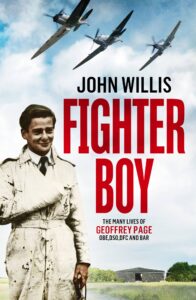
Unfortunately, there is an error on the front cover, where Geoffrey Page’s post nominals are in the wrong order. The DSO should come before the OBE. Surely there is a battered copy of Debrett’s Correct Form on a shelf somewhere at the publisher.
However, do read Fighter Boy and be inspired by the great courage and tenacity of Geoffrey Page.

Click to see full BMMHS event listing pages.
Contact us at [email protected]
Copyright © 2026 bmmhs.org – All Rights Reserved
Images © IWM & NAM