Book Review
Review by James Goulty
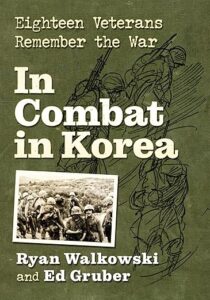
In Combat in Korea: Eighteen Veterans Remember the Korean War
Authors: Ryan Walkowski & Ed Gruber
Publisher: McFarland & Company, Inc.
(208 pages, 80 bw photographs, 2 newspaper cuttings, 1 sketch map)
An Allied agreement in August 1945 stipulated that Japanese forces north of the 38th Parallel in Korea were to surrender to the Russians, whereas, those in the south would be handled by American troops. Consequently, the 38thParallel became a political boundary, as following failures at re-unification the Republic of Korea (ROK) was founded in 1947 in the south, shortly to be followed by the Russians establishing the Democratic People’s Republic of Korea (DPRK) in the north. Thus, with the onset of the Cold War globally, an uneasy situation existed on the Korean peninsula. Tensions ran high between the North and South, characterised by political unrest and a series of cross border clashes during the late 1940s. On 25 June 1950 the Russian backed North Korean People’s Army (NKPA) invaded the ROK, deploying seven infantry divisions and one armoured brigade, commanded by Marshal Choe Yong Gun. This caught the West off balance, and led to the Korean War of 25 June 1950-27 July 1953, commonly dubbed the ‘Forgotten War.’
When the invasion commenced, the UN Security Council asked member states to assist in compelling the NKPA to withdraw, aided by the Russians having no representative present to object because at that time they were boycotting proceedings over the UN’s stance of not recognising Communist China and giving her a seat rather than the Nationalist Chinese in Formosa (Taiwan). Ultimately, a number of countries, including Britain, committed forces to the Korean War. However, the bulk of the burden was still undertaken by the Americans and ROK. As this book states, total American losses were: 33,651 killed, 103,284 wounded, and over 8,000 personnel registered as missing. For both sides the first year of the war was characterised by stunning successes followed by equally dramatic reversals, as warfare ebbed and flowed up and down Korea. Contrastingly, by late 1951 fighting had bogged down in static mode, broadly along the line of the 38th Parallel.
Most of the veterans covered by this book experienced combat first-hand at some stage during the war-hence the title. In this regard, military enthusiast Ryan Walkowski, from Hatley, Wisconsin, has done a phenomenal job tracing and interviewing these noble old warriors, and travelled extensively across America to do so. The material he gathered at interview has then been lovingly crafted into a readable narrative with assistance from his buddy Ed Gruber, a Korean War veteran who appears in the book. Very sensibly the book is arranged chronologically, so as to follow the course of the war, and a chapter is devoted to each of the eighteen veterans chosen.
The book commences with descriptions of the hectic conditions experienced on the frontline by veterans from the 24thInfantry Division and 1st Cavalry Division respectively. These were the first American formations to be deployed to Korea, and the second chapter also outlines Charles Ross’s harrowing ordeal as a POW at the hands of the Communists during November 1950-September 1953.
There follows a chapter on Glenn Galtere who served with Baker Company, 1st Battalion, 7th Marine Regiment, 1stMarine Division, during the epic Chosin Reservoir campaign in late 1950. He graphically describes the harsh reality of facing Chinese infantry in close combat: ‘I looked right into their eyes. It seemed like when I pulled the trigger of my BAR [Browning Automatic-Rifle], I cut them right in half. You either get rid of all your ethics about killing, or you crack up and die. So the… thing to do is adjust and accept it for what it is. If you can’t deal with it now, you’ll deal with it later.’ Another ex-Marine, Bob O’Keefe experienced action during Operation Chromite (the Inchon Landing), Battle for Seoul, and Chosin Reservoir. A particularly good section discusses the problems posed by the so-called ‘Mickey-Mouse’ winter issue boots, in which troop’s feet would sweat on the march and this would freeze when they halted or ceased fighting, resulting in numerous casualties who eventually suffered amputations. Yet another ex-Marine covered by the book was part of Fox Company, 2nd Battalion, of the above Regiment, which famously held the crucial Toktong Pass during the Chosin Reservoir campaign. Like other veterans in the book, he later suffered from PTSD, which makes for moving reading.
The battles for the Punchbowl and Heartbreak Ridge in late 1951, are well covered by the ten pages devoted to Elroy ‘Sonny’ Roeder, a former corporal with 2nd Infantry Division, that notably include comments on the French troops assigned to his Division, a salutary reminder that Korea was a UN war, albeit one led by America. Another veteran from 2nd Infantry Division, details how he was the only member of his squad to survive being attacked by enemy armour, and as a result suffered a sense of survivors guilt. A nice touch is the inclusion of a contemporary photograph showing him being awarded the Purple Heart. Similarly, the chapter on Gruber incorporates a number of contemporary photographs, including one of him preparing to go on patrol with a Marine unit near Munsan-ni in 1952. He served as a U. S. Navy Combat Correspondent, including a stint in Korea. Like so many of the veterans covered, the reader gains an appreciation of the man, as well as his Korean War service. This reviewer especially enjoyed the description of Gruber’s years growing up in the Bronx, New York City.
William Cybula, another veteran from 1st Cavalry Division, outlines how he was bullied by an NCO who resented his Polish heritage. His chapter contains some graphic detail on the food troops endured, C-rations: ‘not fit even for a dog.’ Unsurprisingly, human wave or mass attacks feature in these veteran’s memories. For example, recounting one attack, Cybula, states: ‘They were really coming at us, and we were firing like crazy. They couldn’t match our firepower, so we just wiped them right out. The next morning all I saw were dead Chinese lying everywhere…’ Likewise, the human cost of the war emerges, as in the words of Joseph Barna, a Marine who experienced heavy fighting during summer 1952. ‘I will never forget the cemetery where they buried these poor Marines. It was the size of a football field and covered with white crosses.’
Another chapter on army veteran, Vincent Salceto, of Italian heritage, makes for colourful reading, not least owing to his usage of the F word. Among other topics, he provides a visceral sense of how troops often suffered sea sickness on the transports used to get them to Korea. Remaining chapters cover a soldier with 5th Regimental Combat Team, who became a bootlegger, and a survivor of 7th Infantry Division’s struggle during the mammoth Battle of Pork Chop Hill, in which he was badly wounded by a Chinese grenade, including losing an eye. The ‘Outpost War’ of 1952-1953, is extremely well covered via the reminiscences of five surviving Marine veterans: Frank English a black NCO who served with How Company, 3rd Battalion, 1st Marine Regiment, 1st Marine Division; machine-gunner Bert Ruechel; and former NCOs Salvatore Scarlato and Paul Marsa; plus John Breske, who became an avid Green Bay Packers fan, something that helped him cope with his Korean War experiences. Subjects discussed include: racism; comradeship; alcohol usage; small arms; patrolling; rations; coping with mass attacks; and personal experiences of the July 1953 Ceasefire. Again a good feature of the book is that the reader not only gains an impression of these men’s Korean War service, but also learns something about their lives both before and after the military-an invaluable human touch.
Anyone interested in learning about the Korean War, the American military, and/or oral history will especially enjoy this book-Recommended.
James Goulty (Author of Eyewitness Korea: The Experience of British and American Soldiers in the Korean War 1950-1953).

Click to see full BMMHS event listing pages.
Contact us at [email protected]
Copyright © 2026 bmmhs.org – All Rights Reserved
Images © IWM & NAM