Korea War Without End
Richard Dannatt & Robert Lyman
A Review by James Goulty
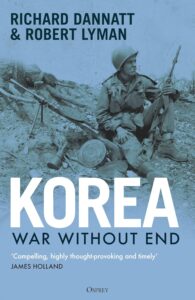
Publisher: Osprey (Hardback, 352 pages, 31 bw photographs, 7 maps)
The Korean War (25 June 1950-27 July 1953) is often dubbed the ‘Forgotten War,’ particularly in the West. Indeed the authors stress that, ‘in the UK it was such an insignificant war in social memory’ that it typically struggled to appear on village war memorials. That said, the war has not been forgotten by the participants. The book outlines the United Nations commitment, which incorporated ground forces from 14 countries, including the UK, alongside troops from the USA and Republic of Korea (South Korea), while other UN member states provided logistical and medical support. This will be of particular value to any reader unfamiliar with the subject. Similarly, the inclusion of a chronology of the war, and the Order of Battle, US Eighth Army, are an excellent addition, sandwiching the main text.
The war was brutal, with over 118,000 UN troops killed, over 260,000 wounded, and around 92,000 captured. Total Communist casualties are harder to quantify, but 1,600,000 is probably a conservative estimate. Equally, around 3 million Korean civilians perished. It was fought over difficult terrain, and in an unforgiving climate. A moving passage outlines how British troops were initially ill prepared for sub-arctic conditions. Both sides experienced stunning successes and equally dramatic reversals, a point well made. However, given the myriad of complexities involved, no one volume can truly offer a definitive account of the Korean War, something these authors freely admit. Instead they chart the course of the ground war, and do not deal, except in passing, with issues such as POWs, naval operations, or logistics and training. Research is based on consultation of Official Histories, UK and USA archives, and a range of secondary sources, many of which will be familiar to scholars, but probably less well known to general readers. Accordingly, the book does not offer any new evidence. Rather it provides what the authors describe as a ‘fresh perspective’ from the viewpoint ‘of professional practitioners of the military art three generations removed from the decision-makers and soldiers who fought in Korea between 1950 and 1953.’
The narrative commences with the initial response by the USA and ROK to the North Korean invasion; then the desperate fighting in the Pusan Perimeter; before going on to discuss the landings at Inchon, widely considered a ‘master stroke,’ that altered the cause of the war. The next part of the book covers the decision by the American led United Nations Command to advance into North Korea and drive towards the Yalu River; the resulting Communist Chinese intervention; and subsequent dismissal of General MacArthur by President Truman. Along the way much is made of the positive characteristics of General Ridgway, who took command of Eighth Army in late December 1950, before later replacing MacArthur. Part three of the book covers the Battle of the Imjin, including reproducing an extract from: One Road to Imjin: A National Service Experience by D. E. Whatmore, a junior officer with the Gloucestershire Regiment, who later obtained a Regular Commission. This might bring this notable memoir to a wider audience. Yet, other actions during 1951-1953, receive little coverage, including the battles for the Hook, a key feature in the Sami-chon Valley that was held at various times by the Americans, British and Commonwealth forces. The book continues by discussing warfare along the Jamestown Line, although no mention is made of the patrolling and raiding that was such a feature for the troops on the ground. Instead a convincing argument is advanced that this period of static warfare, what the military termed an ‘active defence,’ in which artillery became increasingly dominant, did not as is often stated represent a stalemate, but was rather a strategy of ‘strategic perseverance’ on the part of the Americans, designed to keep the communists locked into a war of attrition, and force them into accepting that peace could only come via some form of negotiated settlement, something that eventually occurred with the ceasefire of July 1953, although there has never been a formal peace treaty.
Central to the book, is the argument that rather than being ‘forgotten,’ Korea is perhaps more accurately characterised as a war that has been ‘misunderstood,’ both at the time and up to the present day. To explore this idea, the authors examine what they term ‘the particular circumstances’ of the Korean War. In doing so, they make telling comparisons between Korea and other conflicts, including the current war in Ukraine. They powerfully argue that the first phase of the Korean War (June-October 1950), was necessary, as the North’s invasion of the South demanded an international response, and was a test for the recently formed UN, established as an international body in the wake of the Second World War, which it was hoped could avert future conflicts. Conversely, the American decision to cross the 38thParallel during October 1950, and take the war into North Korea, is viewed as a grave strategic error. It missed an opportunity of re-establishing the status quo after the territorial integrity of South Korean had been successfully restored. Blame for this is apportioned between Truman and MacArthur. Not only did it lengthen the war by leading to the involvement of Communist China, ultimately it caused the widespread and indiscriminate killing of innocent North Korean civilians, largely as a result of American area bombing against defenceless cities. Although the book does not discuss the air campaign in detail, it does graphically illustrate this, plus the challenge faced by the USAF in attempting to interdict communist supply lines.
Finally, the book ends with a series of highly thought provoking reflections, based around the above arguments, plus sets out the view that culpability for the war lay with the North Korean leadership.
For anyone interested in the role of decision-makers in modern warfare, and the Korean War in particular, this book is heartily recommended.
James Goulty (Author of Eyewitness Korea: The Experience of British and American Soldiers in the Korean War 1950-1953)