Book Review: The Army That Never Was
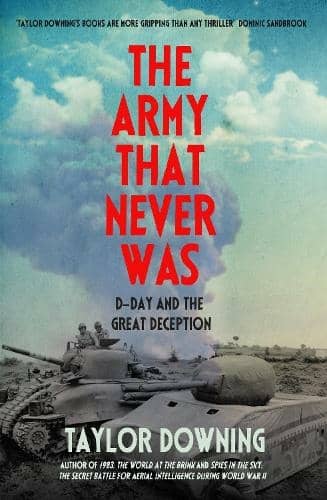
by Taylor Downing
Icon Books, 2024. 320 pages. Price £25
Review by Linda Parker
There have been many books written about the deceptions employed by the allies to cast a fog of doubt on the day and place of allied invasions in the Second World War. Perhaps the first was Ewan Montagu’s The Man Who Never Was. Taylor Downing has used this title cleverly for his book on the deceptions before D-Day, The Army That Never Was. His book, instead of concentrating on a single aspect like Operation Mincemeat or the Double XX committee, gives a detailed and overarching description of all the ways in which the German High Command was left in confusion. If you, the reader, think you know all about Operation Fortitude and related deceptions, you may reconsider after reading this fast paced and detailed account.
At the Casablanca conference in January 1943 the fateful and famous decision was made that the Allies would endeavour to begin the task of liberating Europe in 1944. From the beginning, Downing explains, camouflage and deception were part of the central plan for Operation Overlord as by 1944 the had achieved successes in deception schemes in North Africa, involving false information about armies that did not exist, and the success of Operation Mincemeat. The activities of the London Controlling Section, the use of such now famous double agents such as Tricycle and Garbo and the Double XX Committee meant that, as Downing explains, that by July 1942 “It had taken two and a half years but deception had now been placed at the very centre of military planning.” in 1943 most of the double XX agents were use in Operation Cockade. It was a great help that Bletchley Park through decrypts was able to provide information on which misinformation had been believed by German intelligence. By late 1943 German intelligence efforts were being concentrated on South East England as a possible launching ground for invasion.
Having set the scene for the events of Operation Fortitude and the preparations for D-Day the book then goes on to describe the fictitious FUSAG, First US Army Group under General Patton, but also details the other ways of diverting attention from the real location of the D-Day landing Including whole camps and harbours conjured up by former staff at Shepperton Studios using dummy vehicles and lighting techniques. False messages and phoney information greatly inflated the size of the order of battle. This made General Von Ronne believe that there were enough troops assembled that there might in fact be multiple landings, with one landing being a diversion from a main one. Hitler, Jodl and Von Rundstedt came to believe that any invasion from Scotland, or to Normandy would be a feint to distract from the main invasion in the Pas de Calais. After D-Day further deception discouraged The German command from moving troops to Normandy.
During the course of the narrative, Downing introduces and conjures up vividly the characters who achieved what has been called “the great deception”, some household names and some that have remained relatively unknown. He gives a clear analysis of what was achieved and how far Operation Fortitude contributed to the success of D-Day. The book is a lively and useful addition to studies of the Second World War.
Want to know more about this fascinating topic?. Taylor Downing will be giving BMMHS a Zoom talk in February 2025.
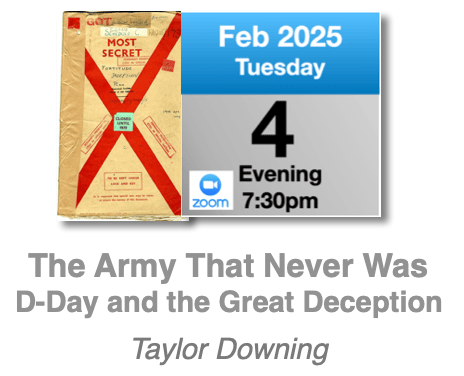

Click to see full BMMHS event listing pages.
Contact us at [email protected]
Copyright © 2026 bmmhs.org – All Rights Reserved
Images © IWM & NAM