Book Review
The British Soldier: Training for War 1939-1945
Review by James Goulty
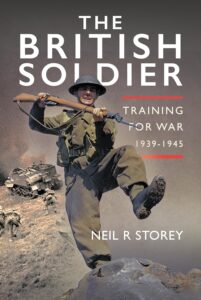
The British Soldier: Training for War 1939-1945
Author: Neil R. Storey
Publisher: Pen and Sword (2025), 219 pages, approx. 105 BW photos & 40+ illustrations from training manuals, wartime cartoons, posters etc.
Eventually the wartime British Army expanded to over three million men and 300,000 women, around three-quarters of whom were conscripts. Thus, by 1944 the army was effectively a ‘citizen’s force,’ albeit one reliant on a core of Regular and Territorial Army personnel. Forty-eight divisions were formed: thirty-five infantry, eleven armoured and two airborne, the division being considered the ideal-sized fighting formation, as although War Establishments varied, they comprised not only combat units but all the necessary support elements as well. Clearly the training of this force, so that it was moulded into an effective fighting machine was vital, and that forms the subject of this book. However, the title is misleading, as this book is not about the ‘British Soldier’ but rather solely concentrates on the British infantryman (including Commandos and Paratroopers), as the author makes abundantly clear in the introduction. Consequently, anyone who wishes to read about the training and experiences of the vast numbers of soldiers who were not infantrymen, plus women of the Auxiliary Territorial Service or army nurses will have to look elsewhere.
Another point to keep in mind was that training is a more nuanced and complex subject than might be supposed. As leading military historian Hew Strachan demonstrates, training was a multi-functional process that exceeded merely ‘imparting the basic grammar of military service.’ It has been employed by armies to counter boredom within the ranks, instil a sense of professional pride, and generate unit cohesion, particularly when groups of soldiers trained together and were led into battle by officers responsible for that process. Training also enabled soldiers to assimilate changes in tactics and master new technologies. In this regard, the book contains a lavishly illustrated chapter on ‘Training for Battle,’ that highlights the rise of battle drill and the battle schools employed to provide instruction in the UK, before going on to cover some of the major exercises held c. 1941-1943. Battle drill was not a tactical panacea as this chapter suggests, but did provide an effective method of imparting knowledge of minor tactics that were essential for infantry to appreciate, while the battle schools offered a tough and realistic training environment for troops ultimately destined to take on the might of the Axis armies.
In his introduction the author intimates that it was his intention to describe the training given to his grandfather’s generation of soldiers, a laudable aim, and one he achieves well via a readable narrative packed with detail. However, the book is based heavily around the author’s considerable personal collection of wartime photographs, training manuals/pamphlets and related documents. Not necessarily a bad thing, but by acting as a showcase for all this splendid material, little space is left for much analytical commentary. To be fair to the author, Pen and Sword are probably aiming this book at the general reader rather than military history specialists, and it does include a ‘Select Bibliography and Recommended Reading’ section for anyone desiring more insight on the topic, plus chapter notes are available at the end of the book that attribute quoted sources.
After the introduction, the book commences with a chapter on ‘Recruitment and Conscription’ on the expansion and eventual mobilisation in 1939 of the Territorial Army is particularly well explained. A chapter then follows on basic training, simply and aptly entitled: ‘Square Bashing.’ This was most soldiers’ first contact with the army and a considerable shock to some, depending on their social background. As with so much of the book, the chapter is based around extensive quotations from some excellent and appropriate source material. The experience narrated by Jimmy Leasor, a new recruit with The Buffs (The East Kent Regiment) in 1942, is particularly eye-catching concerning his excruciatingly vulgar induction into army life. Likewise, towards the end of the chapter there is an especially good description of military prisons and punishments. The next chapter deals with ‘Skill at Arms’ and covers the rifle and bayonet; grenades; Tommy Gun; Sten Gun; Vickers Medium Machine Gun; Bren Gun; infantry mortars; Boys Anti-Tank rifle; PIAT (Projector Infantry, Anti-Tank); and light anti-tank guns. In short all the main types of weapons wartime infantry could expect to have to deploy. While filled with detail on the characteristics and capabilities of these weapons, which is interesting, the chapter perhaps could have benefited from some additional comment on what soldiers who used them actually thought about them. The next chapter similarly tackles the subject of ‘Uniform and Equipment’ in some detail, and this reviewer found the material reproduced from War Office, Gas Training (HMSO 1942) particularly thought provoking.
The following chapter outlines the training of officers, largely by quoting Anon, Britain’s Modern Army (Odhams 1946). At the end of the chapter, is an interesting section highlighting the importance attached to officers’ outfits and related military tailoring, showing that the cost of becoming commissioned were considerable, even in wartime. The next two chapters provide an impression on the formation, training and equipping of the ‘Commandos’ and ‘Paratroopers’ respectively, and keep in mind that both types of elite troops were, entirely novel to the British Army of 1939. The sections reproduced from Information, Ministry of By Air to Battle: The Official Account of the British First and Sixth Airborne Divisions (HMSO 1945) make for evocative reading, especially concerning Captain (later Lieutenant-Colonel) Martin Lindsay, who describes his first parachute jump. Again bear in mind that in the 1940s parachuting was still a relatively new phenomenon, especially within the British Army. There follows, the aforementioned chapter on ‘Training for Battle,’ with its good selection of photographs, particularly of soldiers undergoing brutal looking assault courses or having Universal carriers attack their positions. The last chapter discusses some of the preparations that were undertaken by the army ahead of Operation Overlord or D-Day, the cross Channel invasion of June 1944. Notably, this includes descriptions of Exercise SMASH, where troops from 50th (Northumbrian) Division saw flail tanks for clearing mines, and Duplex Drive tanks equipped to ‘swim’ ashore, deployed for the first time. A later Exercise FABIUS, comprising British, Canadian and American troops, is further outlined, largely based on a selection of regimental histories. Finally, there is Appendix 1 British Guards and Line Infantry Regimental Depots, 1939 (by Regimental seniority); Appendix 2 Infantry Training Centres (ITCs); Appendix 3 Army Number Allocations for Guards and Infantry Battalions; and Appendix 4 Do’s and Dont’s for Troops Going Overseas (1942). These might form an extremely useful tool of reference for readers interested in the subject or anyone who wants to research a relative who was a wartime infantryman.
James Goulty (Author of The Second World War Through Soldiers’ Eyes: British Army Life 1939-1945)

Click to see full BMMHS event listing pages.
Contact us at [email protected]
Copyright © 2026 bmmhs.org – All Rights Reserved
Images © IWM & NAM