
Book Review by James Goulty
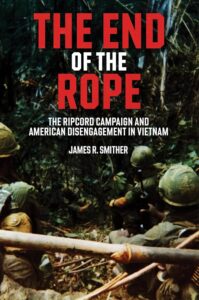
The End of the Rope: The Ripcord Campaign and American Disengagement in Vietnam
Author: James R. Smither
Publisher: Casemate
(277 pages, 13 colour photographs, 12 bw photographs, 3 maps, 1 diagram of Firebase Ripcord)
By the late 1960s, the fighting in the Vietnam War (1954-1975) had broadly evolved into three main forms: a conventional war in the north of South Vietnam, largely conducted by U.S. Marines against North Vietnamese regular forces; sustained guerrilla activity to control the highlands around Pleiku, and so split the country in two; plus low-level guerrilla activity throughout many other parts of Vietnam. When President Richard Nixon was elected on 5 November 1968, the understanding was that this would lead to de-escalation in Vietnam, and the following year American troops started to be steadily withdrawn, with the last combat units being pulled out on 11 August 1972.
Actions during 1970 around Firebase Ripcord (the subject of this book), represented the last significant American offensive attempt of the Vietnam War, when elements of 101st Airborne Division sought to re-enter and dominate the area where the vicious Hamburger Hill battles had occurred the previous year. Ultimately, these operations were unsuccessful as a result of stubborn North Vietnamese resistance, and the limited resources available owing to the policy of Vietnamization, which had reduced troop numbers, and because serious issues arose around command. As the author outlines, broadly speaking: ‘the U.S. Army in Vietnam was using a personnel and promotion system shaped in peacetime, one in which politics and networking enabled officers to build careers without concern for consequences on the battlefield.’ This ensured that the potential was ever present to, ‘put the wrong men in key positions, disrupt continuity of leadership, and prevent the most capable officers from serving where they could do most good. The officers themselves suffered the consequences. The enlisted men, who incurred the bulk of the casualties and had little or no say in how they were used, suffered even more.’
The Ripcord campaign was intended to give the Americans access to the A Shau Valley, a staging area for the North Vietnamese to mount operations in the north of South Vietnam. However, when the Ripcord base was established, North Vietnamese presence in the area increased so that surrounding units were assaulted, and eventually the base isolated. Not only that, but by then, rather than melt away, the North Vietnamese proved capable of mounting prolonged resistance, eventually compelling the Americans to abandon the campaign altogether.
The author is well placed to narrate the story of the Ripcord campaign set against the wider issue of American disengagement from Vietnam, as he has interviewed over 100 surviving veterans, whose personal testimony form the bedrock of this book. As the Director of Grand Valley State University Veterans History Project, he has also conducted over 1000 interviews with American military veterans more widely, and so is well versed in the handling and employment of oral history. Consequently, throughout the book the reader gains a visceral sense of the unfolding course of the campaign and its character, especially through American eyes, plus an appreciation of the extensive challenges troops faced on the ground. This provides insight on key issues such as, what American troops felt about their situation, equipment, rations, and the enemy’s combat capability.
This reviewer was particularly moved to come across, the dynamic Captain Isabelino Vazquez-Rodrguez, a Korean War veteran from Peuerto Rico, who commanded C/2/506 in early 1970. Echoing the respect with which he was held, one veteran from his company explained: ‘He was not gonna let us get in too big a jam. I mean we might get into a problem, but you could tell this man here, he knew what to do about it. He didn’t have to call for help, he knew what to do, and he can get us out of it. In fact, Captain Vazquez was a soldier’s soldier.’ Likewise, the accounts of medics, who were conscientious objectors and served during the campaign, are illuminating regarding the harsh realities of combat in Vietnam, as well as providing an added emotional or human dimension. According to one veteran, such a medic, set out to assist a wounded soldier without any thought of self-preservation. ‘He walked out there to help the guy and he got killed, ‘‘boom.’’ He lasted 24 hours and it was wrong.’ Unsurprisingly, perhaps, there is some excellent material on air re-supply, and for example, the shear difficultly at times of either getting into or out of Ripcord via helicopter is especially well illustrated.
As the author implies, it is the oral history interviews that really made this book possible, and provide such a vivid impression of what the combat was like during the various phases of the campaign. These were conducted between 2008 and 2024. However, the author draws upon a number of other sources to skilfully supplement the oral histories. Notably, this includes: Keith Nolan, Ripcord Screaming Eagles Under Siege (Ballantine, 2000); Ben Harrison, Hell on a Hilltop: America’s Last Battle in Vietnam (iUniverse, 2004); Chris Brady, Remembering Firebase Ripcord (Outskirts Press, 2014); John Roberts, Operation Texas Star: The Last American Battles of the Vietnam War, April-September 1970 (Self-published, 2017). Likewise, he was able to consult various unpublished works from the Ripcord Association, such as: Robin Graham, An Annotated History of the 2nd (Airmobile) 506th Regiment (1 March 1970-1 August 1970), a collection of reminiscences and unit records compiled in 2010. What emerges is a highly balanced, scholarly view of the campaign, in tandem with the extensive reference to personal experiences from the interviews, which forms a highly readable narrative. Where appropriate the author has sought to amend previous works and/or highlight areas of confusion in the historical record, plus at the back of the book there are extensive chapter notes and notes on sources.
Clearly anyone specifically interested in the Vietnam War will appreciate this book, but it should also appeal to the general reader. I really enjoyed reading this informative account of the Ripcord campaign-highly recommended.
James Goulty

Copyright © 2026 bmmhs.org – All Rights Reserved