
Book Review
The Ministry of Munitions in the First World War
Doing Their Bit
Author Andrew Rawson
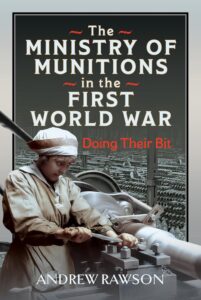
A review by Barbara Taylor
£25.00, Pen & Sword, 2025.
270 pp,
Hardback, 23 ills. Bibliography, Notes and Index
ISBN 978-1-03611-538-8
Andrew Rawson is the author of over forty books, including eight Pen and Sword ‘Battleground Europe’ travel books and three History Press ‘Handbook’ reference books. His catalogue includes much on the Second World War, including Poland’s struggle in the twentieth century, Auschwitz and wartime Krakow. Much of his work is on the Great War, including a ten-part series on the Western Front campaigns between 1914-18.
I have previously reviewed Mr Rawson’s The 1914 Campaign about the first months of the war; basically the battles of the Old Contemptibles’, which is a distillation of information from the Official History (OH), the Pen and Sword Battleground series, Divisional and Regimental histories. The author seems to have made this type of approach a specialism as this current volume is of a similar construction in that the great majority of the Notes listed are from the papers of the Ministry of Munitions official government records.
The necessity for the formation of the ministry became clear, certainly after the ‘shell crisis’ of early 1915, which showed that the existing production of munitions for a war of this sort, was hopelesslyinsufficient and inefficient. As a largely naval power with a small standing army designed as an Imperial ‘police force’, small arms and field gun/howitzer munitions were only produced in numbers to suit those requirements.
During the course of the war, the ministry was in the hands of four men; David Lloyd George, Edwin Montague, Christopher Addison and then Winston Churchill through to the cessation of hostilities.Messrs Montague and Addison both only heading up the ministry for approximately six months each.
The transformation of munitions production during the war was the result of a complex structure, involving labour supply and relations, manpower planning, raw materials, national and internationalfinance. Also included was research and development of new weaponry; here the tank and aeroplane spring readily to mind. The importation of raw materials and therefore the transportation and insurance of the goods to be imported was also included in the ministry’s responsibilities. It was soon discovered that the recruitment campaign had been allowed to draw far too many skilled men needed to make the munitions in the first place and companies that were given contracts to manufacture arms and all other necessities, had to compile lists of key workers that they needed back.
The contents of the book are organised in a largely chronological order, starting as one might expect from the declaration of war, with mobilisation and a brief rundown on the pre-war industrial unrest. The last section is on the preparation for the war’s end, demobilisation and the running down of munitions production.
This is not a book to sit down and read from cover to cover, but for anybody who needs to add information about any aspect of the munitions provision as an adjunct to their own research and work, this is the book for you. I can only think that Mr Rawson must be a very patient and thorough researcher to have distilled a great deal of information from volumes and volumes of official documents into something that has all the relevant facts and figures in an easy to find and digestible form!
Barbara Taylor
Barbara Taylor is Secretary of the Thames Valley Branch of the Western Front Association. Click on the logo or above to see the WFA’s schedule of talks.


Click to see full BMMHS event listing pages.
Contact us at [email protected]
Copyright © 2026 bmmhs.org – All Rights Reserved
Images © IWM & NAM