Book Reviews
The Three Emperors: Three Cousins, Three Empires and the Road to World War One
GARETH RUSSELL
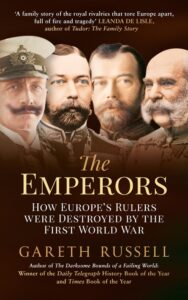
The Emperors: How Europe’s Rulers were destroyed by The First World War
Amberley Publishing, 2015, £9.99, 227pp, soft covers; illustrated plus notes, bibliography and index. Also available in hardback.
ISBN 978-1-4456-5020-0
MIRANDA CARTER
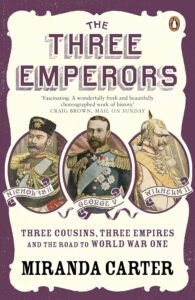
The Three Emperors: Three Cousins, Three Empires and the road to World War One
Penguin Books, 2010, £10.99, 498pp, soft covers; illustrated plus notes, bibliography and index. Also available as an Ebook.
ISBN 978-0-141-01998-7
A review by Barbara Taylor
The Three Emperors: Three Cousins, Three Empires and the road to World War One
To understand how the First World War came about, it is necessary to understand how the regimes in the main empires that were involved operated. This is Mr Russell’s first non-fiction book, which concisely tells us about court protocols and the respective administrations in the three autocratic monarchies involved; Germany, Austria and Russia. I am not entirely sure why there is a picture of George V on the cover, for as far as this book is concerned he is more or less a supporting act; Great Britain being a constitutional monarchy, with the king having very little real power to make a mess of things. On reading both of these books, it becomes abundantly clear that none of the governments had factored in how mass industrialisation over the preceding century was changing urbanisation and the attitudes of the workers that had swapped agricultural life for the cities and demanding rights. None of the three autocrats had any a real clue (or cared, particularly) about the impact of these monumental changes on their subjects. These hereditary monarchs had no kind of training to be kings and emperors. By the dawn of the 20th century, they no longer needed to demonstrate the kind of strength that made a good general; which is why their forbears were made kings in the first place. They required skill sets such as competence, good diplomacy and sound judgement; certainly the Kaiser possessed none of these. Miss Carter describes many of Wilhelm’s unbelievable lapses of tact and diplomacy. Frankly, I was laughing out loud at many. He would have been sacked in the organisation I work for some kind of harassment; a big no-no in today’s PC world!
Nicholas II was weak, totally unfit to be an emperor and was truly horrified when his hearty, huge father Alexander III died unexpectedly (of Bright’s Disease) at the very young age of 49; complaining that he wasn’t ready. He never was ‘ready’ and married to a woman he loved, but who was especially unfit to be Tsarina of all the Russias. To be fair, his parents and courtiers were uneasy about this marriage. Really, all Nicholas and Alexandra wanted to do was play ‘happy families’. Alexandra was crushingly shy; very uncomfortable with court life and so they further alienated their subjects by semi hiding away at Tsarskoe Selo. Their reliance on Rasputin once they had discovered that the tsarevich had haemophilia was a further alienation from both the court and populace. Wilhelm and Nicholas were both way out of touch with any kind of reality in these fast changing worlds.
Franz-Joseph of Austria’s problems were slightly different, with his huge ethnically diverse empire, stultifying court protocol and an heir he didn’t like. Franz-Ferdinand’s assassination freed him of that burden, but his long life had seen too many tragedies and basically he was too old to deal with a war on this scale. I suspect from reading these books he knew the empire could not survive this scale of conflagration.
Miss Carter’s book is written on a far more personal scale and is very much more in depth examining the personal, familial relationship between the three cousins. George V comes across as a simple, rather brusque man who was neither particularly bright nor demonstrative, but was personally crushed by the war and the inevitable alienation of close family members; many of whom never saw each other again. The murder of the tsar and his family was naturally a severe blow, but as George had back-pedalled on providing asylum for the imperial family, one wonders how much this preyed on his mind for the rest of his life. I have always wondered if the Empress Marie (the tsar’s mother, who escaped) knew that this had been the king’s decision.
Once you start reading either of these books, it is so easy to see disaster lurking around the corner, particularly after 1870. Mr Russell asserts that the fall of the monarchies destabilised Europe after ‘centuries of stability’, but it was more like centuries of repression, industrialisation and a more or less inevitable war that did that and I therefore have to disagree with many of Mr Russell’s conclusions. Nevertheless, many of the causes of the Great War writ large.
Overall, I enjoyed these books; both easy to read and enlightening.
Barbara Taylor

Click to see full BMMHS event listing pages.
Contact us at [email protected]
Copyright © 2026 bmmhs.org – All Rights Reserved
Images © IWM & NAM