Book Review
With the Royal Tank Regiment in Korea
Review by James Goulty
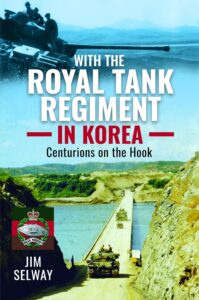
With the Royal Tank Regiment in Korea: Centurions on the Hook
Author: Jim Selway
Publisher: Pen & Sword (2025) (Hardback, 289 pages, over 300 bw photographs, plus additional illustrations, including a panoramic sketch and map)
For regular soldiers the immediate post-war years were a difficult period as the army downsized dramatically, and opportunities for professional advancement, especially among officers were limited. Yet, within many units a hard core of officers and NCOs remained with extensive experience of active service during the Second World War. This was just as well, given that the army soon faced a host of global commitments, and would be tasked with absorbing and training large numbers of National Servicemen. In his initial chapter, the author, who joined the Royal Tank Regiment (RTR) as a junior regular officer in 1949, makes much of the valuable presence of wartime veterans. For example, with reference to a photograph of officers from 1 RTR in Germany during 1950, he states: ‘They could have made another Centurion tank if they melted down their medals but the experience was worth more than another squadron in the line.’
One of the post-war commitments that emerged was the need to send British troops to a brutal war in Korea during 1950-1953. The invasion of South Korea by North Korea in June 1950 prompted an international response, and the American led United Nations Command (UNC) was established to co-ordinate military aspects, and Korea represented the first time the UN acted to resist aggression. Eventually, the UNC drew on the resources of 21 countries, and over 118,000 UN troops were killed, over 260,000 wounded, and around 92,000 captured. Total Communist casualties are harder to quantify, but 1,600,000 is probably a conservative estimate. Equally, around 3 million Korean civilians perished, many owing to American bombing. The war was fought over difficult terrain, and in an unforgiving climate, something the author graphically illustrates, with regard to how tank crews coped. Sub-arctic conditions during the savage Korean winter ensured that ‘sitting stationary in the tanks on watch for eight hour shifts’ was ‘a challenging and mind numbing experience.’ Not only that, but basic necessities such as cooking became extremely awkward. ‘All normal liquids were solid, eggs had to be peeled off their shells instead of broken and food thawed before it could be fried. Milk was served with a knife.’ Contrastingly, during summer months it proved so hot that, ‘rations could be cooked on the tank’s metal decks,’ plus tank crews had to contend with the monsoon season when heavy rains ‘made watching from open hatches a miserable experience,’ so that they were extremely thankful for rain covers constructed by the unit’s fitters.
As indicated, by the time 1 RTR arrived in Korea during December 1952, the war had bogged down in static mode, broadly along the line of the 38th Parallel, with conditions, superficially at least, resembling those on the Western Front during 1916-1918. The Regiment’s tanks were deployed on infantry support, and as the author describes, in the frontline this entailed that each tank was effectively ‘reduced to a very expensive static steel pill box.’ However, the Centurion Mk. III excelled in this role owing to its thick armour, which gave crews added confidence that they could survive enemy artillery bombardments by staying in their tanks, and the accuracy of its main armament, an Ordnance QF 20-pounder (83.4 mm) gun. This was capable of firing a variety of anti-tank rounds, as well as HE, canister, and smoke shells. According to Selway, it had an ‘uncanny ability to hit a sq. yard target at 1000 yards within 30 seconds of being called on,’ and while the presence of tanks close to infantry localities could bring unwelcome retaliatory fire from the enemy, equally such an impressive performance gave infantry much confidence in tank support.
Notably, the book neatly outlines the ferocious fighting endured during 1952 and 1953 by British and Commonwealth units holding the Hook, a strategic feature dominating the Sami-chon Valley. A nice touch here is the inclusion of an account of an action experienced by John Nolan, a crewman from 3 Troop ‘B’ Squadron 1 RTR, which relays how two of his comrades were wounded. Indeed during the chapters on Korea, readers are given a visceral sense of the dangers and challenges that regularly faced British soldiers, especially tank crews. By the end of the war, 1 RTR had spent five months out of nine in action, and in the process fired over 23,000 rounds from its main armament, suffered 20 casualties and had one fatality. However, the book is about more than just what happened on the frontline, and a salutary reminder that periods in reserve, proved that discipline, morale, and combat readiness were equally as important out of the line as when directly engaging the enemy. Sports and recreation were one means to ensure that morale and fitness were maintained, as the book amply demonstrates with reference to 1 RTR.
Initially the book details the author’s experiences as a young officer in Germany, a major posting for armoured forces during the Cold War. Subsequently, Chapter One outlines the journey to Korea aboard HMT Empire Halladale, and is complimented by a beautiful array of photographs. In the 1950s troopships offered the only practical means of transporting entire units to a distant theatre such as Korea. Life on board is discussed, along with a stop-over at Port Said, travelling down the Suez Canal, and further stops at Aden, Colombo, Singapore, and Hong Kong before arriving in Korea. Chapter Two covers 1 RTR’s arrival in Korea, impressions of the country, and the handover from 5th Royal Inniskiling Dragoon Guards (5 DG), before concentrating on issues relating to organisation, and the performance and capabilities of the Centurion. In this regard, the inclusion of a glossary will be welcomed by anyone unfamiliar with military abbreviations. Likewise, the addition of an Order of Battle 1 RTR, December 1952, and ‘The Korea Journal: First Royal Tank Regiment 1952-53’ are an asset. Again, as with so much of the book, the chapter is lavishly illustrated, and it seems Sergeant Len Thompson was instrumental in providing many of the contemporary photographs that enhance enjoyment of the book.
Chapters 3-5 cover Korea, dealing sequentially with: ‘Life on the Line,’ ‘In Reserve’ and ‘The Battles for the Hook,’ a brief flavour of which are provided above. Chapter 6 describes the Truce of 27 July 1953 that ceased the fighting in Korea, the establishment of the Demilitarized Zone, and new defensive positions in case open warfare should resume. The second part of the book is devoted to the author’s service in the Canal Zone in Egypt immediately after Korea, where contrastingly the desert ‘offered fantastic manoeuvre training’ for 1 RTR’s Centurions. He then spent a couple of ‘glorious years’ in the UK serving with HQ 23rd Armoured Brigade TA, before a posting to 1st (Berlin) Independent Squadron, RTR, 1956-1957, during which it was perhaps fortunate that their aging Comet tanks were not put to the test by the Russians. Afterwards, he was posted to 3 RTR, again in Germany, and made ‘OC the Recce Troop,’ responsible for 12 two-seater Daimler Dingo Scout Cars that acted as the ‘eyes’ of the Regiment, and had to locate the enemy and report on where he might best be engaged by its tanks. The unit attracted high quality manpower, and was something of a ‘plum’ job for Selway, who was by then a senior subaltern. He even led the ‘Recce Troop’ on exercises in Norway, before leaving the army in 1960 to pursue a career in business. Finally, the book ends with reflections on the value of experience and leadership, implications of the Korean War, and some insights on comradeship.
This book is a poignant and highly readable record of soldiering in a bygone era, the author being the last surviving officer from the RTR to see action in Korea. It should appeal to the general reader and anyone with an interest in the Korean War, armoured warfare, and/or the post-war British Army c. 1945-1960-highly recommended.
James Goulty (Author of Eyewitness Korea: The Experience of British and American Soldiers in the Korean War 1950-1953)

Click to see full BMMHS event listing pages.
Contact us at [email protected]
Copyright © 2026 bmmhs.org – All Rights Reserved
Images © IWM & NAM