
Book: Love, Duty & Sacrifice
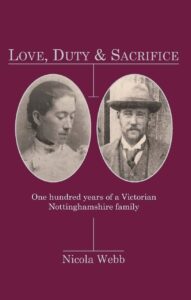
Love, Duty & Sacrifice
by Nicola Webb
“A family of heroes” – the Chaworth-Musters’ story”
“If ever the history of the Great War is written from a local viewpoint, a place of honour must be accorded in its pages to the noble part played by the family of Mr and Mrs J. P. Chaworth-Musters of Annesley Park.”
So reported the Hucknall Dispatch on 2nd August 1917 under the headline “A family of heroes.” The story of Patrick Chaworth-Musters and his wife, Mary Anne is heroic indeed, and covered in my book “Love, Duty and Sacrifice”. But before I outline their duty and sacrifice, I’ll give some background to this remarkable family.
The Chaworth-Musters’ history can be traced back to 1063 or so – Viscounts and Peers included – and its main residence, Annesley Hall, in Northwest Nottinghamshire had its origins in a 13th Century medieval hall. Though no longer aristocratic, the Chaworth-Musters were classed as ‘greater gentry’ in the Victorian era, owning nearly 8,000 acres in the county, as well as a coal mine.
The Victorian family flourishes
Patrick (JP) Chaworth-Musters was born at Annesley in 1860. Mary Anne Sharpe was born into a family of Bedfordshire straw plaiters in 1863 and joined the household as a junior nursery housemaid in 1881. Less than two years later, aged 23, Patrick got Mary Anne pregnant, and failing to part them, his parents sent them to live in Norway, unwed, but away from ‘polite society’.
Four years and four children later, Patrick inherited the family’s estate earlier than expected. Against all odds, he returned to England with Mary Anne and married her in March 1888, thus legitimising their children. Mary Anne reluctantly took on the daunting role of lady of the manor, controlling the very servants she’d so recently reported to. Helped by her husband and her mother-in-law over the years, she succeeded brilliantly, being hailed as the ‘Grande Dame’ of county society.
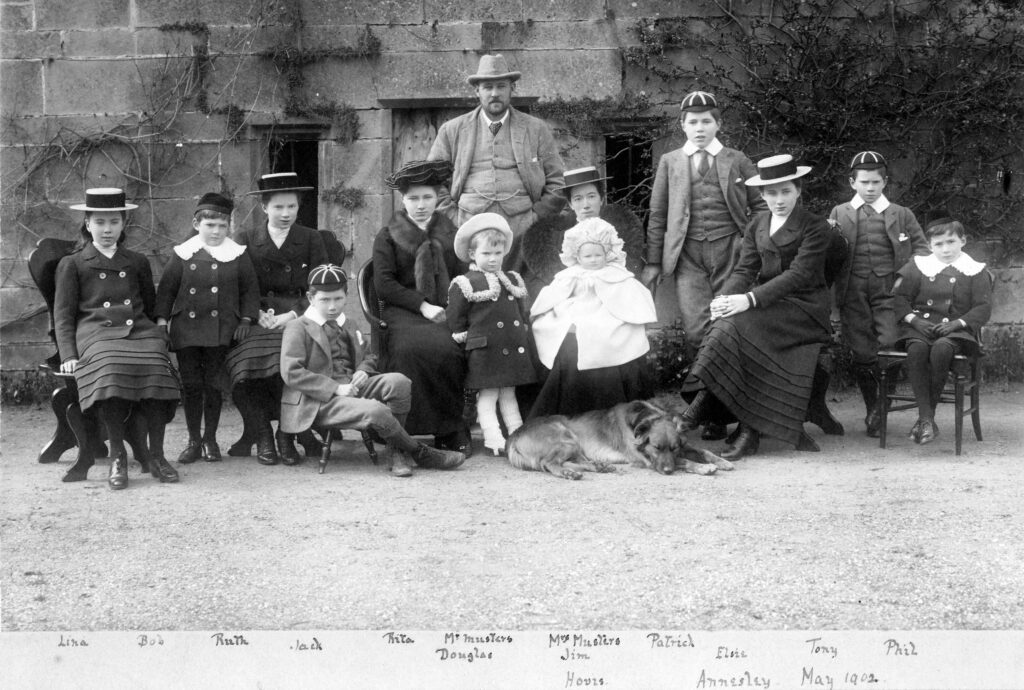
Happily matched, the couple had eleven children – seven boys and four girls. Patrick was made a JP, Deputy Lieutenant of Nottinghamshire, and High Sheriff (a Crown Appointment) and they were invited to the Coronation of King Edward VII in 1902.
Between 1887 and 1914, Patrick had to sell most of the family’s properties and associated lands to stabilise his finances. They weren’t to know it, but the last large party they organised at Annesley Hall was on 2nd July 1914, to celebrate the wedding of their fourth daughter, Lina. A little over a month later, on 4th August 1914, Britain declared war on Germany.
A family at war
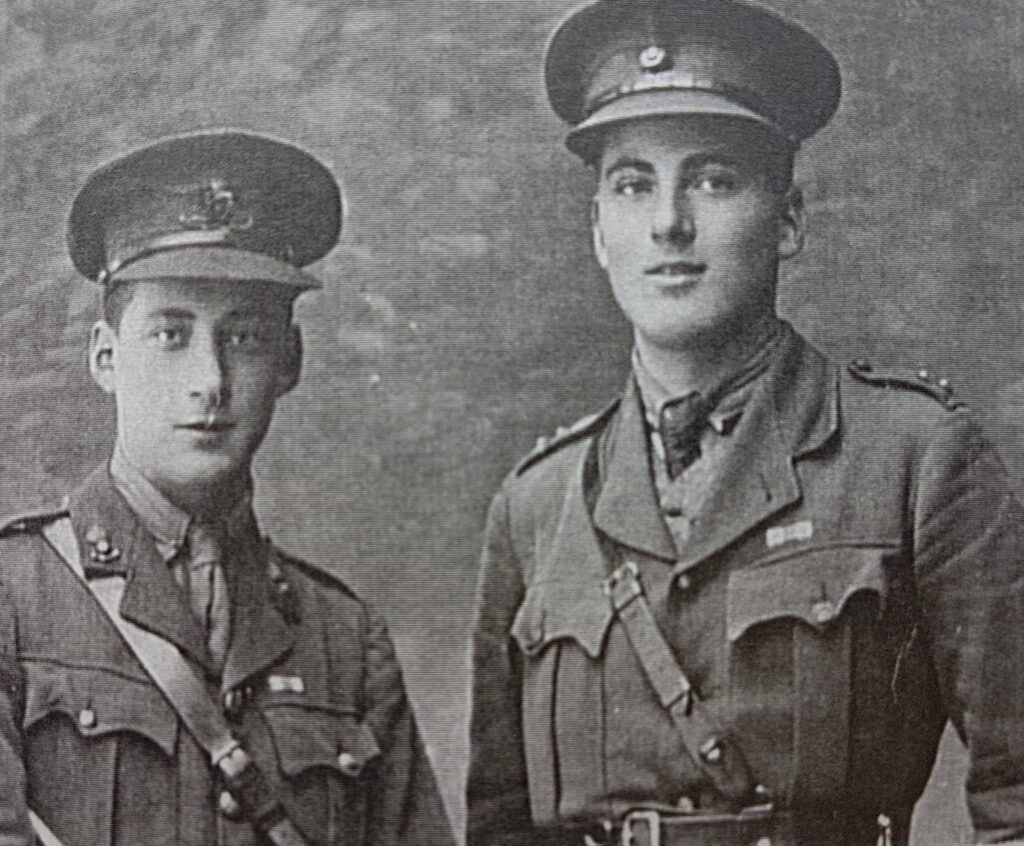
Their eldest son Patrick (Pat) was already a Second Lieutenant in the King’s Royal Rifles. Second son John (Jack) got a commission in the South Notts Hussars. Anthony (Tony) was already Second Lieutenant in the Royal Field Artillery, and his younger brother Philip (Phil) joined him, being commissioned in September 1914. Fifth son Robert (Bob) was commissioned into the King’s Royal Rifles in July 1914.
Sixth son Douglas was at school and was commissioned into the Royal Field Artillery as soon as he could, aged 18, in May 1916. Finally, James (Jim), the youngest, was only 13, and still at Rugby School, and so was fortunate to miss the Great War, although he did serve in WWII from 1940-1945.
On the home front, the family played their part. Patrick was frequently seen driving his Daimler or Humber cars on Red Cross work — collecting or delivering parcels. In total, the couple were responsible for sending around 4,000 ‘comfort’ parcels to the trenches (an average of 20 each week for four years), which was a substantial effort for a small village.
All their sons were prolific letter writers and their letters from the Front are sobering and poignant. For example, Pat, newly arrived in Ypres in August 1914 wrote:
“I have got here to this most Godforsaken place. I’ve never seen anything like it. I don’t know what will happen to me.”
The boys were involved in most of the major battles on the Western Front, including those at Mons, Aisne, Ypres, Loos, the Somme, Cambrai, Amiens and Arras. Jack served in Turkey and Egypt and was involved in the appalling slaughter of Gallipoli. Their letters reveal their differing personalities, some being horrified by the conditions and the killing, whilst others display the typical jingoism and bravura of the time. But all sons were undoubtedly brave: Jack was awarded a DSO, Phil and Bob received Military Crosses, as did Douglas, who was also awarded an MC Bar.
The war took a dreadful toll on the family. Jack was nearly drowned when his ship heading from Alexandria to France was torpedoed and sunk. Tony was critically injured by shrapnel in September 1914 – left with a fractured skull, he was unable to continue active service and suffered from epilepsy for the rest of his life. In January 1915, heir Pat was killed in a ‘friendly fire’ shelling incident. He was conscious for several days and the Sister nursing him wrote to his mother, Mary Anne:
“He took everything very philosophically and the last thing he said to me was ‘This is a queer go isn’t it Sister?’”
Son-in-law Hugh Pattinson was killed by a German sniper in August 1915, leaving a wife (who never remarried) and twin daughters aged four months, who sadly he had not yet met. Son Phil died in July 1917, near Ypres, hit in the chest by another allied shell. Bob was in and out of hospital for two years with TB, returning to the appalling trench conditions each time, without complaint. In October 1918, after another bout of pneumonia, he contracted Spanish flu, writing home to say: “Don’t worry. I expect I’ll be alright by the end of the week.” Tragically, his luck had run out, and he died a month before the Armistice, aged only 22.
The end of an era
The Great War undoubtedly changed everything for the family. Their father, Patrick’s health suffered from the loss of his sons, and he too contracted Spanish flu, which unduly shortened his life. When Jack inherited in 1921, the family’s fortunes were much reduced, helped by the economic uncertainties of the 1930s and 1940s. Annesley Hall was not grand enough to be turned into a visitor attraction, so Jack felt that the only feasible option in 1973 was to sell to The Football Association. Even then, the family home suffered further misfortune.
The FA sold the Hall to developers whose intentions were unclear and after two arson attacks in the last 20 years, the house continues to lie semi-derelict. The desolate house is a sad memorial to a once-great local family whose wealth declined with the changing economy and who were ultimately broken by war and loss.

Click to see full BMMHS event listing pages.
Contact us at [email protected]
Copyright © 2026 bmmhs.org – All Rights Reserved
Images © Nicola Webb