
Cochrane’s Castle – Lord Thomas Cochrane and the siege of Rosas
by Philip K Allan
The French assumed it would fall within days
In 1808 Napoleon Bonaparte made his momentous decision to invade Spain, an ally at the time, and replace its government with one headed by his brother Joseph. It was a disastrous mistake that set-in train the six-year long Peninsula War. The Spanish population rose up against the invaders, tens of thousands of French troops became locked in an endless guerrilla war, and it provided the perfect ground for the British, along with their Portuguese and Spanish allies, to fight the French Army on something approaching equal terms. Worst of all, Napoleon had chosen to fight in a country that was mostly surrounded by sea, and in 1808 that sea was largely controlled by the Royal Navy.
One of the key objectives of the invaders in 1808 was to capture the fortress at Rosas, which stood astride the coast road between France and Barcelona. The French assumed that it would fall within a few days, thanks to its dilapidated state and small garrison. What they failed to factor in was that the defenders would be supported by the British Mediterranean fleet. The fortresses soon had a procession of ships arriving to ferry in supplies and reinforcements from other parts of Spain and to evacuate the wounded and civilians. Royal Navy ships bombarded the French besiegers, forcing them to divert heavy guns that should have been pounding the walls to establish coastal batteries and drive the ships away. Soon more direct help was provided by one of the navy’s most dashing commanders, the Scottish nobleman Captain Lord Thomas Cochrane, 10th Earl of Dundonald.
The bastion called the Castell de la Trinitat
The defenders were looking to consolidate their position, and had decided to abandon a bastion called the Castell de la Trinitat. Originally a medieval castle, it had been modernised into a star-shaped fortification with thick, 20-metre-high walls. It stood perched on top of tall sea cliffs apart from the rest of the fortress, which made it difficult to supply and gave the garrison no obvious line of retreat back to the main citadel. Cochrane, who was in command of the large thirty-eight-gun frigate Imperieuse, argued against abandoning it. He thought that its position, far from being a weakness, made it perfect to be supported from the sea, and offered to take over command of its defence.
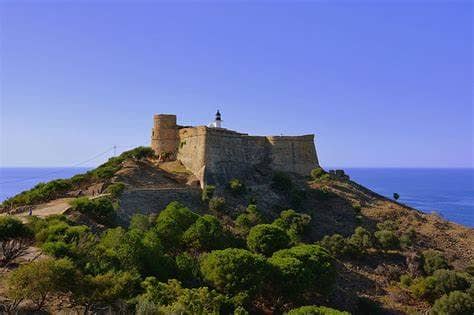
Cochrane's marines and sailors bolster Spanish morale
Cochrane moved in to the fort with a combined party of marines and sailors to bolster the Catalan militia and Spanish regulars already there. He freely mixed his veterans in with the defenders to bolster their morale. One of his midshipmen recalls that “we all pigged in together, dirty straw and fleas for our beds.” The Scotsman was an inspired leader. Tall, with flaming red hair, he commanded through a combination of natural charisma and conspicuous bravery. The Imperieuse moored close to the cliff, where she could supply fire support, and his sailors installed rope ladders and tackles running up to the Castell, allowing men and supplies to be brought from the ship into the fort.
The defence of this stronghold forced the French to divert considerable resources to pounding the little bastion. As the walls crumbled under the remorseless barrage, Cochrane and his sailors seemed to have delighted in sowing the rubble with ever more elaborate boobytraps and barriers. These included ship’s cables covered in fish hooks, powder charges hidden under the ground with fuses leading back to the defenders and a sloping wooden platform covered in grease from the sailors’ pork rations that no attacker could keep his footing on. Attack after murderous attack was repelled as the dwindling band of defenders retreated further into the ruined castle. Cochrane himself was badly wounded when a French cannon ball hit a wall near him. He recorded that he was “struck by a stone splinter in the face; the splinter flattening my nose and then penetrating my mouth. By the skill of our excellent doctor, Mr Guthrie, my nose was after a time rendered serviceable.”
Cochrane and the Royal Navy defy the French
After almost two weeks defending the Castell de la Trinitat, the French finally captured Rosas itself. Realising that the bastion was in a hopeless position, Cochrane, ordered his ship’s boats to assemble beneath the cliff. All the remaining Spanish defenders were then taken off, followed by his sailors and marines. The evacuation was a complete success, with Cochrane and his gunner the last to leave, blowing up the fort’s magazine as they went. Thanks to Cochrane and the Royal Navy, Rosas had defied the French invaders for almost five months.
© Philip K Allan 2025
About The Author

Philip’s books are Available on Amazon
Click above to purchase
Published in March 2025, Lone Wolf, is the 3rd book in Philip’s Battle of the Atlantic series.
Click above to purchase

Click to see full BMMHS event listing pages.
Contact us at [email protected]
Copyright © 2026 bmmhs.org – All Rights Reserved
Images © Nick Brazil