Developing the Database of The Few
By Geoff Simpson
Men of the Battle of Britain
Every Allied airman known to have flown in the Battle of Britain between July 10 and October 31 1940 has a mini biography in the Database of the Few. Qualification for the Battle of Britain Clasp to the 1939-1945 Star required one authorised operational sortie with one of 71 accredited squadrons and other units between the specified dates.
The Database is maintained by the Battle of Britain Memorial Trust, custodian of the National Memorial to the Few at Capel-le-Ferne on the cliffs between Folkestone and Dover. The Database can be inspected there or email application can be made for individual entries. There is more information at the end of this article.
The story starts with the outstanding reference book, Men of the Battle of Britain by Kenneth G Wynn, first published in 1989. Ken Wynn was British born and had served in the RAF but had long settled in New Zealand when he brought out his masterpiece, making for an even bigger achievement.
In 2010 Ken found himself in the position of having produced a third edition but with no publisher. At this point a supporter of the Memorial Trust, who wishes to remain anonymous, tasked me with acquiring all the rights to “Men of” which Ken had previously sold. Once acquired, the rights were immediately donated to the Memorial Trust. I then worked to bring the new edition to publication. A deal was done with Martin Mace, running Frontline Books, part of the Pen and Sword Group, and the expanded work became available in 2015. A supplementary volume was brought out in 2020.
By now very elderly, Ken Wynn had ceased to contribute to the project. He died in 2020 and the Database of the Few was created two years later, with Ken’s work as its basis. This was done in the knowledge that there is not likely to be further publication of the complete work in book form.
For the future, with space no longer an issue, the aim is that the Database will be useful to a wide range of historians, authors and researchers, not just those concerned with the Second World War. As far as possible entries include, as well as air force service, the dates and places of birth and death of the subject, the occupations of parents, venues of primary, secondary and tertiary education, civilian careers and spare time interests. Other members of the family who served in the armed forces are noted.
Thus entries are constantly being expanded and occasionally new ones are needed when the Air Historical Branch (RAF) officially adds someone to the ranks of the Few.
There is close co-operation with Edward McManus who curates the website of the Battle of Britain London Monument, with information and photographs being freely exchanged. Gerry Burke contributes his deep knowledge and extensive collection of images to both ventures. A genealogist, privately funded, works for me on the Database.
Many stories and righting misconceptions
A study of the Database throws up many stories and puts right some misconceptions.
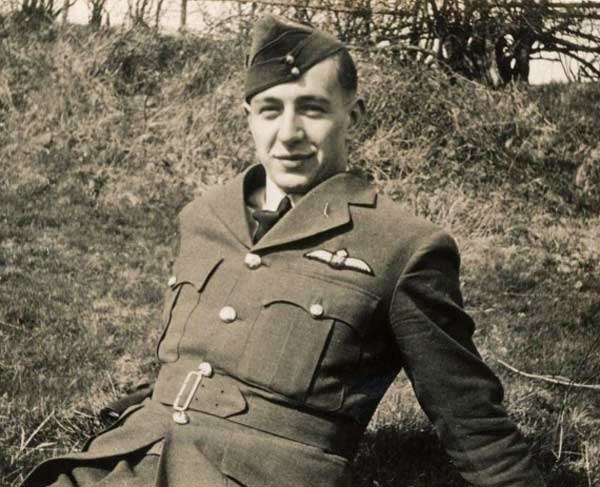
It is often claimed for instance that Pilot Officer Geoffrey Wellum, a Spitfire pilot with No 92 Squadron, was the youngest RAF pilot in the Battle. We do not have proven dates of birth for all of them and some deliberately provided misinformation when joining up but there were at least three more youthful than Wellum. Probably the youngest of all was Pilot Officer (Martyn) Aurel King of No 249 Squadron, a Hurricane squadron. He was still 18 when he was killed on 16 August 1940 in the engagement for which Flight Lieutenant “Nick” Nicolson received the Victoria Cross.
Links to a VC
Another of the Few with a link to a VC is Pilot Officer Richard Chester Lawson of No 601 Squadron (Hurricanes). Why was he given the name “Chester”? It was a common practice for that generation to receive their mother’s maiden name as a middle name but Mrs Lawson was Miss Felton before her marriage.
Her husband, Captain (later Rear Admiral) Robert Lawson, commanded the Town class light cruiser HMS Chester at the Battle of Jutland in 1916. From the Bridge he was able to witness the heroic devotion to duty of 16-year-old Boy First Class “Jack” Cornwell, mortally wounded when Chester suffered multiple hits. Captain Lawson’s report led to the much publicised award of a posthumous VC to Cornwell.
It seems reasonable therefore to assume that Richard Lawson’s middle name was a tribute to a ship his father had commanded in action.
Attack on the Gneisenau
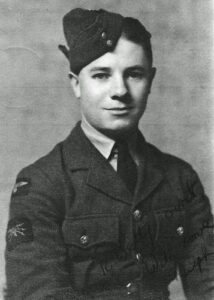
In April 1941 Flying Officer Kenneth Campbell (not one of the Few) of No 22 Squadron earned a posthumous VC when a torpedo from his Bristol Beaufort, delivered under intense anti-aircraft fire, damaged the German battlecruiser, Gneisenau in Brest harbour. One of the men who died with Campbell was air gunner Flight Sergeant Ralph Walter Hillman. In 1940 Sergeant Hillman had qualified for the Battle of Britain Clasp flying in Blenheims of No 235 Squadron.
Connections to James Bond
A recent discovery has been that Sergeant Peter Hillwood, who flew Hurricanes with No 56 Squadron, had the name Adolf Bergholtz at birth. His family originated in Poland and had lived in Germany before coming to the UK. Peter and his brother anglicised their names in the late 1930s.
A number of Battle of Britain aircrew had connections to James Bond. One, Squadron Leader Harry Eeles, who commanded No 263 Squadron, was related to James Bond. A step brother of Eeles, with that name, wrote the book Birds of the West Indies. Bond author Ian Fleming stated that he borrowed the by line from the book for the hero of his novels. When Fleming was at his home in Jamaica, the ornithologist and his wife called without warning and a happy occasion apparently ensued.
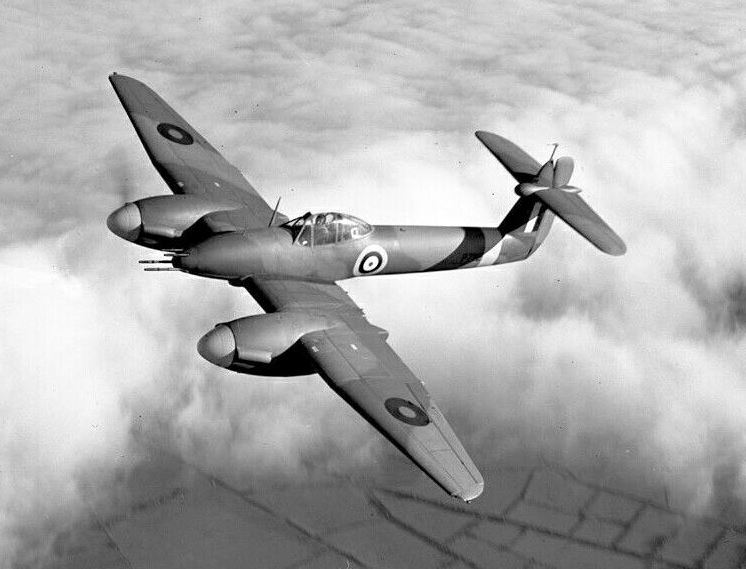
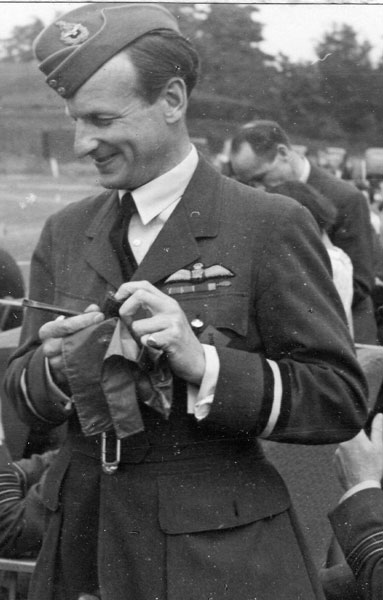
The squadron led by Eeles was equipped with Hurricanes but was also tasked with bringing the Whirlwind into service, although no Whirlwind sorties counted as part of the Battle of Britain.
The varied life of Duart
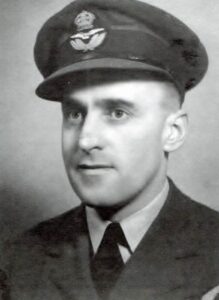
Not many people lead as varied a life as (John) Howard Duart whose entry I recently worked on. He was born in 1905 in the village of Mathon, Herefordshire, in the shadow of the Malvern Hills. He trained as a bookkeeper and typist and spent time working in Chile and Venezuela. On his return to England he farmed in Sussex, then became an articled clerk with a chartered accountant. He gained his pilot’s ‘A’ licence and joined the Civil Air Guard.
Distinctive black overalls from Moss Bros
The story in the Database continues: “After the outbreak of war he volunteered for aircrew duties and was initially told that in view of his age he would be posted to a desk job. He objected and was commissioned as a direct-entry Air Gunner in February 1940. After completing a gunnery course …….. Duart was posted to No 219 Squadron (Blenheims) at Catterick on March 18. He was detached to CGS [in those days Central Gunnery School], Warmwell on May 14, for a Gunnery Leaders’ course, and rejoined the squadron on June 17. Duart served with it during the Battle of Britain. He cut a distinctive figure after buying black flying overalls from Moss Bros.”
Later in the war Duart served in armaments posts in the UK and Canada. After leaving the RAF he qualified as a chartered accountant. He spent some years as honorary secretary and treasurer of the Battle of Britain Fighter Association of which only the Few could be full members.
The entry concludes: “For his 100th birthday celebrations in 2005 he requested the presence of a troupe of dancing girls who were able to sing. His daughter, Pauline, arranged for a group called The Angels to perform outside his bedroom window including the singing of wartime songs. Duart joined in the singing.
“Howard Duart died at the age of 101 on January 24 2007. His funeral took place on February 16 at East Hoathly parish church in East Sussex.”
Fighting the Germans with three different air forces in a year
The accounts of the lives of plenty of the Poles and Czechoslovaks include stories of fighting the Germans with three different air forces in a year, their own, the French and the RAF, as well as of dramatic escapes across Europe to continue the fight. Sadly their wartime service was often followed by persecution at home by the new Communist regimes.
Some of the Few rose very high in the post war world. Three became Chief of the Air Staff for example. Others went to prison, were declared bankrupt or committed suicide. One appeared at the Old Bailey having committed bigamy twice. It is all recorded in the Database. Sometimes it is difficult to avoid the temptation to speculate on what might have been achieved by some of those who died in the fighting in 1940, had they come through, but, of course, it is a pointless exercise.
Enquiries and additional information
To arrange a visit to inspect the Database in detail or to make an enquiry about an individual, please email [email protected].
If you have information on, or photographs of, any of the Few, we would very much like to hear about it at [email protected].
Geoff Simpson is consulting editor to the Database of the Few.

Click to see full BMMHS event listing pages.
Contact us at [email protected]
Copyright © 2026 bmmhs.org – All Rights Reserved
Images © IWM & NAM