How The British Helped Start The Spanish Civil War
by Nick Brazil
The lunch at Simpson's of Piccadilly
It is unlikely that any of the other customers in Simpson’s of Piccadilly, one of London’s great restaurants paid much attention to the two diners at a neighbouring table. If they noticed them at all they probably thought they were just businessmen like themselves. However, this was July 1936 and these were not normal times for Europe and those two diners were certainly not run-of-the-mill businessmen.
The initiator of the lunch was Louis Bolin, the Anglo-Spanish London correspondent for ABC an influential pro-monarchist Spanish newspaper. He was also a lawyer, journalist and tour operator. In his role as a war correspondent in The First World War, he had seen action embedded with the British on the Western Front. In the 1920s he had worked as a Press Attache for the Spanish Embassy in London. In July 1936, he received instructions from his editor, Marque´s de Luca Tena to invite Douglas Francis Jerrold to lunch at Simpson’s.
The plan to charter an aircraft for Franco
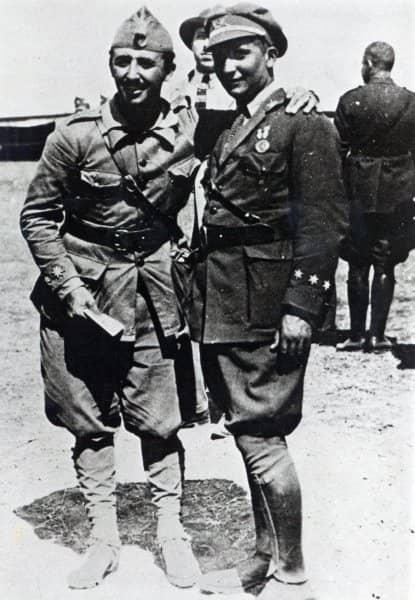
Jerrold, was the editor of a magazine called The English Review. An ardent Roman Catholic, Jerrold held right-wing views which included strong support for fascist movements in both Italy and Spain. A strong monarchist, Bolin also held similar right-wing beliefs to Jerrold. He was aghast at events unfolding in his Spanish homeland. In 1931, King Alphonso XIII had been forced to abdicate to make way for The Spanish Republic. Bolin looked on in horror as the ruling government drifted further and further to the left over the next five years. Like many others, he feared that Spain was in danger of falling into the clutches of the communists. These were only sharpened by The Asturian Miner’s Strike in 1934. This turned into an attempted coup to overthrow the government in 1934.
It seems that Bolin’s bosses not only harboured similar fears of a communist takeover but had a plan to deal with it. Bolin was instructed by his editor Marques Luca Tena to put their plan for the initial part of a Spanish coup to Jerrold over lunch. It was bold and simple. Bolin would charter an aircraft to fly General Francisco Franco from the Canary Islands to Spanish Morocco. Franco would then take command of the substantial Spanish contingent called The Army of Africa which was based there. With such a force, Franco could then travel to mainland Spain and overthrow the leftists in a military coup. Franco was considered to be a right-wing troublemaker by the Madrid Government, so it had made him Governor of The Canaries as a form of exile. In doing so it had unwittingly made it easier for him to seize power with the Spanish colonial troops close at hand.
Major Hugh Pollard... a real life Bulldog Drummond
It was decided to use a British aircraft and crew to take Franco out of The Canaries. If the plane was not Spanish and was disguised as a tourist flight, it would not attract attention or suspicion. For this venture to be a success, it needed the right man at the helm. Discussing it with Bolin over lunch, Jerrold was enthusiastic about the plan. Moreover, he had the ideal candidate for the job, an adventurous and experienced intelligence officer called Major Hugh Pollard.
He was the quintessential man of action in the mould of Bulldog Drummond. In 1908, he had been involved in a successful coup in Morocco. This was the toppling of the ruler Sultan Abdellazziz al Hasan in favour of his brother Abd al-Hafid.
In 1911, Pollard was in action again, this time in Mexico. His job there was to collect rent from remote coffee plantations. Since Pollard’s own description of the locals was that they were “evildoers, murderers and bandits” this was often done at gunpoint. Whilst there, he also found time to spirit future Mexican dictator Porfirio Diaz out of the country.
The Battle of Tralee
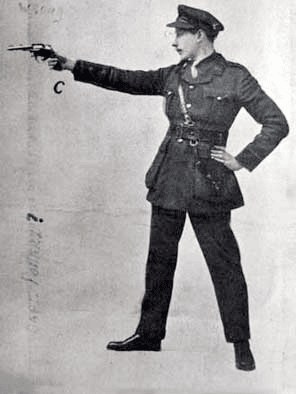
In the First World War, he survived both the First and Second Battles of Ypres as a despatch rider before being blown off his motorbike and injured. Peace really did not suit Pollard and he yearned for another war. In 1921 when most survivors of The Great War sought to forget all about bloodshed and death, Pollard became involved in yet another conflict. Between 1921 and 1922 he was an intelligence officer with the British forces fighting the Irish rebels. However, his activities in that sphere did not exactly cover him in glory.
Firstly, Pollard’s attempt to produce a fake edition of The Irish Bulletin, the official journal of the IRA was soon exposed. Secondly, a more ambitious hoax in which “The Battle of Tralee” was revealed to be a totally fictional engagement. The supposed “battle” was set up in the Dublin suburb of Dalkey by Pollard and a fellow agent. However, this was also exposed as “fake news.”
The "holiday flight" to the Canary Islands
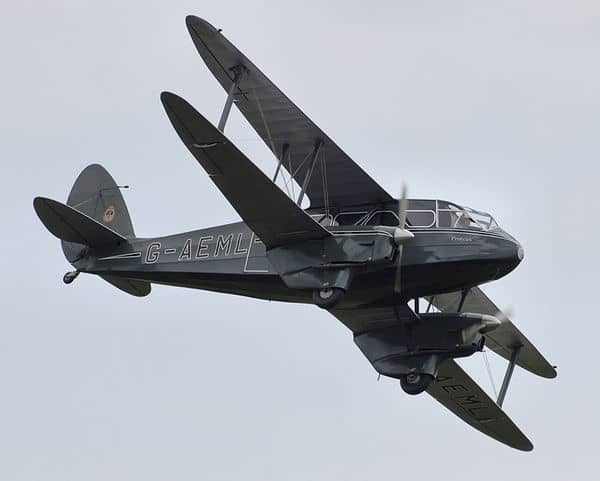
Jerrold lost no time in contacting Pollard with his plan. As a devout Catholic with similar right-wing beliefs, he was all for it. He also informed Jerrold that he had the ideal pilot for the plane. This was his old mate William Bebb, a qualified pilot with a similar love for action and adventure. The aircraft Bolin hired for the journey was a De Havilland Dragon Rapide, one of the great workhorses of civil aviation. This twin-engined, biplane could carry up to eight passengers at a cruising speed of 132 mph. The whole operation was funded by Juan March, a Spanish millionaire.
At 7:15 am on 11th July 1936, a Dragon Rapide rented from Olley Aircraft Services left Croydon Airport and headed towards the Canary Islands off the coast of North Africa. It was piloted by William Bebb and its passengers were Hugh Pollard, his nineteen-year-old daughter Diana and one of her friends. The two girls were posing as tourists for this “holiday flight”.
Franco "Commandeers" the aircraft
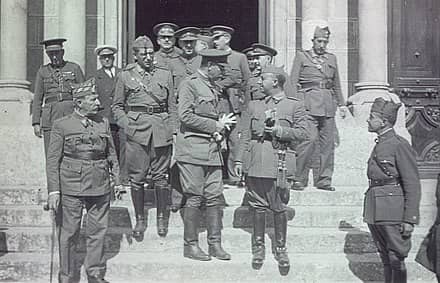
Franco was collected from Teneriffe and taken to Tetuan in Spanish Morrocco arriving without incident on 18th July. From there he went on to initiate the coup that was the beginning of the Spanish Civil War. Although the Foreign Office were aware of this operation, the story was put out that Franco had “commandeered” the British aircraft. This enabled them complete deniability if the Spanish authorities rumbled the plan. However, none of those British subjects involved could possibly have foreseen the catastrophic chain of events that flight would unleash.
At the time, William Bebb regarded the venture as simply part of a minor North African coup. When interviewed about it in a documentary many years later he described it as “a delightful idea, a great adventure.” In 1970, Franco awarded him Order of Civil Merit and the White Cross for Military Merit. He spent the rest of his working life as an executive in civil aviation. He died in March 2002.
Jerrold remained faithful to the Spanish and Italian fascist causes and their rulers. It was partly because of this that his postwar ambitions to become a Conservative Party MP were frustrated. He worked as a publisher and author for the rest of his life.
Pollard and MI6
True to style, Hugh Pollard went on to lead a colourful, dangerous and sometimes controversial life. In 1939, he narrowly avoided being imprisoned as a Nazi sympathiser when the arresting officers found out he was a British intelligence agent.
During the Second World War, he worked for MI6 as head of a shadowy group called Section D based in Madrid. Its task was to conduct sabotage missions in occupied Europe. Probably because it was based in a neutral state, MI6 left it to its own devices. Unfortunately, this gave Pollard free rein to “go off piste”. In this capacity, he was involved in an unsuccessful coup to reinstate Spanish King. Alphonso XIII. Following this, he masterminded the smuggling of three hundred Vickers machine guns stolen from Spanish Republicans from Portugal to England.
By this time, Pollard’s masters in MI6 and the SOE regarded him to be a loose canon and ordered him back to England. Once there, he was given a bureaucratic job at Woolwich Arsenal. However, that did not last long. Towards the end of hostilities, he was seconded to General Patton’s US forces advancing into Germany. His main task was to “hoover up” the vast amounts of small arms abandoned after the fighting before the Red Army advancing from the east could lay its hands on them.
Following that, he was in post-war Vienna conducting a low-level war against criminal gangs who held sway in what was then a lawless city. According to Pollard’s own account, this operation was a short and sharp success. He died in the Sussex village of Midhurst in 1966.
This whole affair is proof that in war fact is often stranger than fiction.
© Nick Brazil 2024
About The Author


Click to see full BMMHS event listing pages.
Contact us at [email protected]
Copyright © 2024 bmmhs.org – All Rights Reserved
Images © Nick Brazil