Private Ron Read – A casualty of Friendly Fire D-Day 6th June 1944
An article kindly supplied by Trevor Hancock - Local Historian

The D-Day Exhibition
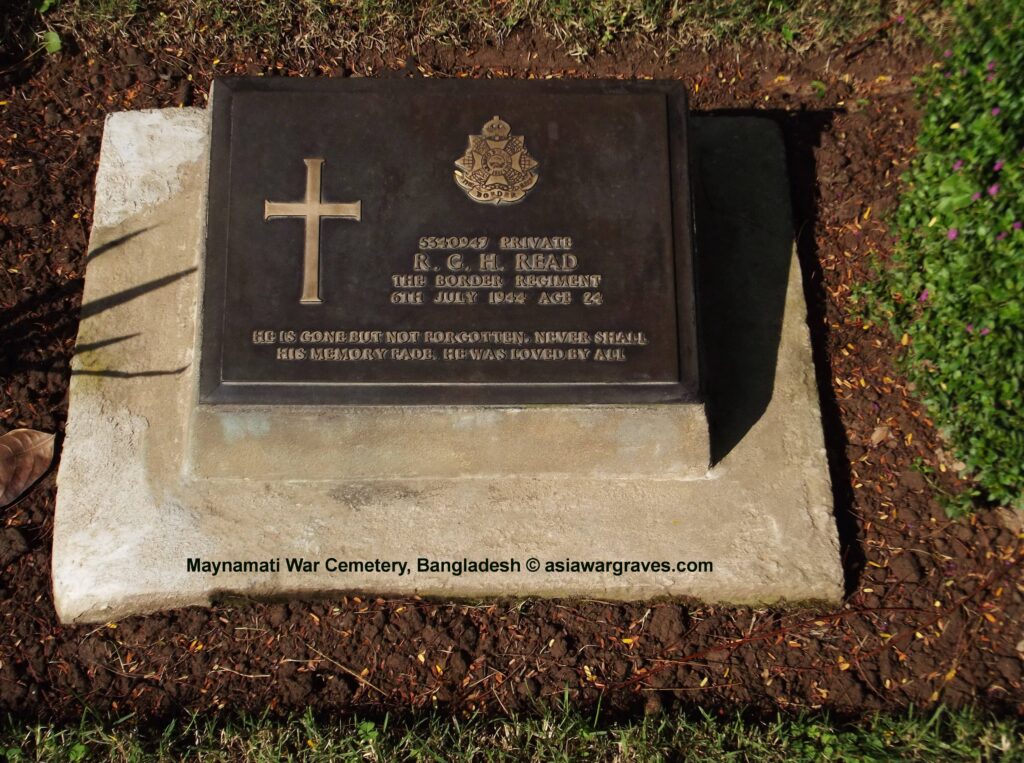
Thirty years ago when the Vale and Downland Museum in Wantage produced a war memorial as part of a 50th Anniversary of D Day exhibition listing all those who died from Wantage in WW2 they included Private Ron Read 2nd Border Regt as dying on 6th June 1944 (nr Imphal in NE India) not 6th July 1944 as commemorated by the Commonwealth War Graves Commission at Maynamati Military Cemetery in present day Bangladesh. See photo of his grave here. This was because his brother (then still with us) insisted that was when he died. In February this year I applied via the Freedom of Information Act for Ron’s service record and received this in April showing his date of death was indeed 6th June 1944 (D Day). Therefore I put a case together for the CWGC to change his date of death from 6th July 1944 to 6th June 1944 and I am pleased to say they have now accepted this and have changed their records. This is his story.
Enlistment and Northern Ireland
Ronald George Harry Read was born on the 30th September 1920 in Wantage, the younger son of William George Read (a policeman) and his wife Ethel (nee’ Pittaway). The family lived at 69 Mill Street Wantage. Ethel’s parents Frederick and Evelyn were the licencees of the Lamb Public House in Mill Street. Ron’s siblings were Bill (born 1916) and Ralph (born 1925). Sadly both parents had died by 1930, so the boys were raised by their grandmother Ethel Pittaway who was living at 53 Springfield Road Wantage by 1939. Also here then was Ron, Bill and Ralph and Ella (nee’Hall), Bill’s new wife. Both Bill and Ron were keen footballers both playing for Grove Rangers and Ron was working as a painter and decorator.
Ron Read enlisted into the army on 18th January 1940 and joined the 6th Battalion Royal Berkshire Regiment. The 6thBattalion Royal Berkshire Regiment was originally formed in April 1939 as part of the expansion of the Territorial Army and remained in the United Kingdom and Northern Ireland throughout the war on home defence and training duties. When the war began, the battalion was dividing its time between Reading, Maidenhead and Abingdon and was involved in guarding the airfields at Harwell and Benson. In January 1940, when Ron joined them they were in Southampton guarding the refinery at Hamble and German POW’s. Following the Dunkirk evacuation they were employed in digging defences around the city. June 1940 found the battalion being posted to Larne in Northern Ireland where their HQ was based at Kilwaughter Castle.
The 6th Battalion Royal Berkshires were in Northern Ireland for the next two years where their time was spent in training and undertaking various army exercises.
The 6th Battalion left Northern Ireland in January 1943 for Colchester where they took part in Exercise Spartan. The exercise was part of series of exercises intended to prepare allied forces for Operation Overlord. Many new capabilities were tried for the first time including the coordination between air and land forces during offensive operations. Then in the Autumn the battalion moved to the south coast near Dover for coastal defence. As time went on during the war, Home defence units such as the 6th Royal Berks were used to provide drafts of men for service overseas and in January 1944 Private Read was sent with a draft of soldiers to India arriving at Deolali on the 15th February 1944.
'Going Doolallay'
Deolali Transit Camp was located around 100 miles north-east of Mumbai (Bombay). The camp was established in 1861 and was used as a transit camp, particularly for training and acclimatisation for soldiers newly arrived in India. New drafts would stay at the camp for up to several weeks carrying out route marches and close order drill to get used to the hot climate. The camp is where the term ‘going Doolallay’ originates from due to the poor conditions there at times and the long periods some soldiers found themselves stationed here.
Ron was here until the 24th February 1944 when he was posted to the 20th Reinforcement Camp near Imphal in North East India. At this time 20 Reinforcement Camp was located at milestone 110 on the main Imphal-Dimapur road at a place called Keithelmanbi twenty miles north of Imphal. The Allied Forces used milestones on the road between Imphal, Kohima and Dimapur as reference points. The camp was responsible for the retraining, re-equipping, holding and dispatch of all reinforcements for 20th Indian Infantry Division as and when required, approximately 1,500 men in all.
The Battle of Imphal
This was during the Battle of Imphal which took place between March-July 1944. From the beginning of April, the Japanese had attacked the Imphal Plain from several directions. To counter this attack ‘defensive boxes’ were formed and manned by mostly Admistrative troops (i.e. clerks storemen, new recruits etc) who had been trained to defend themselves and their installations from enemy attack. Initially there were numerous boxes but as the battle progressed they merged together and grouped more closely around the airfields on the Imphal Plain. Patrols were sent out from each box to seek out the enemy and to help other boxes in need. During the fighting 20th Reinforcement Camp moved to Lion Box Kanglatongbi milestone 118 and were heavily engaged in the battle there as the Japanese were in need of the supplies within this box. There was heavy fighting around Lion Box in April 1944 with constant shelling and mortar fire. After much heavy fighting with the attacking enemy, it was decided to evacuate Lion Box on the 7th April 1944. This took place covered by tanks and infantry plus attacks by air from the RAF. There were over 140 casualties including one soldier from the Reinforcement Camp.
The mortar incident
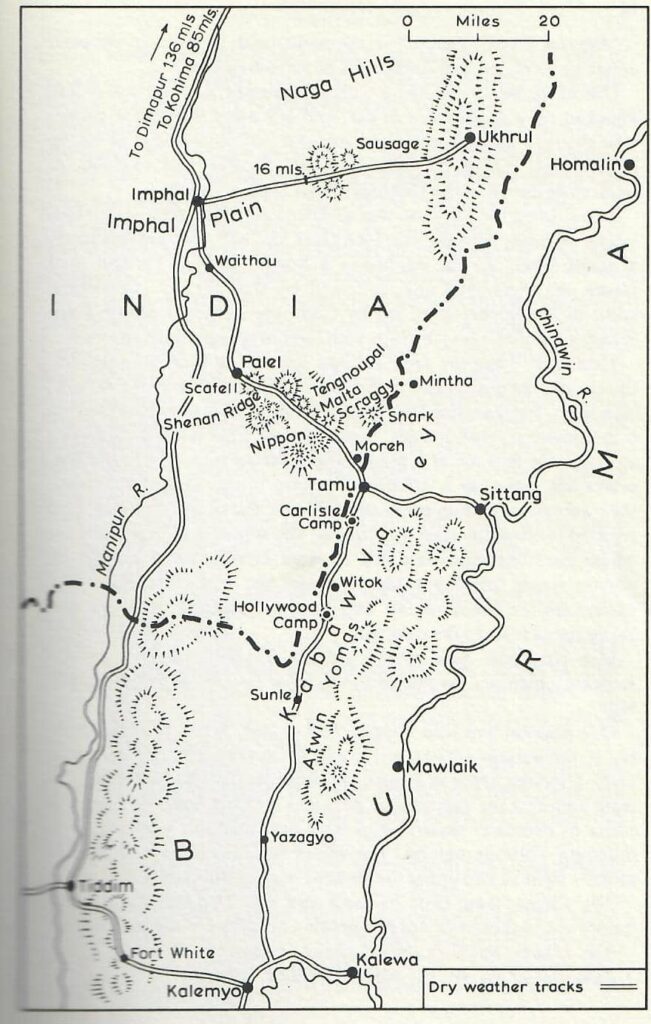
Subsequent to this battle, Private Ron Read was amongst a draft of men who joined the 2nd Battalion Border Regiment on 5th May 1944. Over the next month the 2nd Battalion The Border Regiment was much involved in fighting around positions named as Recce, Gibraltar, Malta and Scraggy Hills.
These were the nicknames for the hills of the 5,000 foot-high Shenam Saddle which was the scene of intense fighting during the Japanese drive along the Patel road towards Imphal in April 1944. The positions were a labyrinth of bunkers; trees were reduced to shattered trunks and the hillsides turned into barren wastes by artillery fire. The result was a field of battle reminiscent of the worst fighting on the Somme during World War One.
On the 5th June 1944, there was an accident in this area, that resulted in the deaths of eight soldiers and the wounding of eleven others when a 2” mortar bomb fell short..
The Court of Inquiry delivers the verdict
A subsequent Court of Inquiry was very thorough, interviewing all those involved including the mortar team, Captain Morley (the officer in charge) the medical officer, and visiting the site.
The verdict of the court was that the accident was not due to negligence or misjudgement on the part of the mortar team or the observer but was caused by a faulty 3” mortar bomb which fell short, so nobody was responsible for the accident. However there was criticism of Sgt Cassells the platoon commander, saying he should have personally ensured all the men working on the hill were adequately dispersed and under cover.
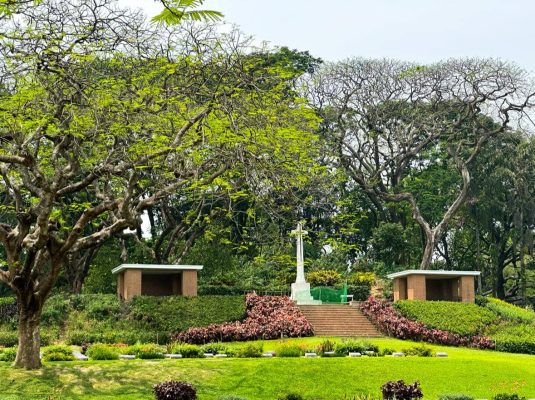
Amongst the wounded was Ron Read who sadly died whilst he was being evacuated to hospital at Comillia on 6th June 1944. He was subsequently buried at Maynamati Military Cemetery by Chaplain W A Buckley.
References
Service Record for Private Ronald George Harry Read
War Diaries for 6th Battalion Royal Berkshire Regiment and 2nd Battalion Border Regiment at the National Archives Kew
The History of The Royal Berkshire Regiment 1920-1947 by Gordon Blight
Tried and Valiant : The Story of The Border Regiment 1702-1959 by Douglas Sutherland
The Forgotten Army’s Box of Lions by C D Johnson
About The Author - Trevor Hancock
Trevor is a genealogist and local historian offering a research service in the UK both online and at various record offices. He has been involved in family and local history for many years.
White Horse Ancestors is a Local, Family and Military History Research Service based in Wantage Oxfordshire.
White Horse Ancestors specialises in three areas of research:
-
The local history of the Vale of the White Horse, now in Oxfordshire but pre 1974 in Berkshire
-
Genealogical research about people from the Vale of the White Horse
-
Military and Naval Research of any period, but especially the Great War 1914-1918

Click to see full BMMHS event listing pages.
Contact us at [email protected]
Copyright © 2026 bmmhs.org – All Rights Reserved
Images © IWM & NAM