
Soldiers of France or Desperate Mercenaries:
The French Foreign Legion and the Second World War
by James Goulty
Shrouded in mystique
The Second World War was a dark time for the French Army, as after the May 1940 Armistice, officers and soldiers had to choose between obedience to the Vichy regime or General de Gaulle’s Free French, which effectively cast them as rebels. The French Foreign Legion was no exception. Some units fought on behalf of Vichy and the Axis powers, while others were stalwarts of the Free French, or even chose to remain neutral. Similarly, in some cases Legion units loyal to Vichy offered stiff resistance such as in Syria, whereas in other theatres, notably during Operation Torch, the Allied invasion of French North Africa November-December 1942, resistance was more of a token nature. Consequently, as Douglas Porch intimates in his history of the Legion, at the end of the war, there was almost a palpable sense within the Legion that it was pleased to return to colonial warfare and consign to the past the bitter political divisions of the Second World War, and difficulties that had arisen in terms of recruitment, training and equipping units.
Traditionally, the French Foreign Legion has been shrouded in mystique, as widely encapsulated in literature and films. This has tended to give the impression that it is comprised of soldiers of fortune motivated by service in far flung exotic lands and the potential for earning decorations and perhaps promotion. Coupled with this the Legion has popularly been characterised by feats of human endurance and the ability to mount epic last stands. Notably, P. C. Wren’s adventure novel Beau Geste first published in 1924 provides a romantic view of the pre-1914 Legion, possibly based around the author’s own service as a legionnaire, although whether he actually served remains a matter of conjecture. Nonetheless, it sheds some light on the ethos of the Legion, which might have had significance in later years as well, such as there being ‘no punishment too severe for infliction upon any man who acted contrary to the interests of his comrades.’ Likewise, Beau Geste highlighted the value of marching songs to legionnaires, which would have resonated far beyond the period in which it is set. These included: Violà du Boudin; La casquette de Père Bougeaud; Pan, pan, l’Arbi; Des marches d’Afrique; Père Brabaçon; and Soldats de la Légion.
A French mercenary force
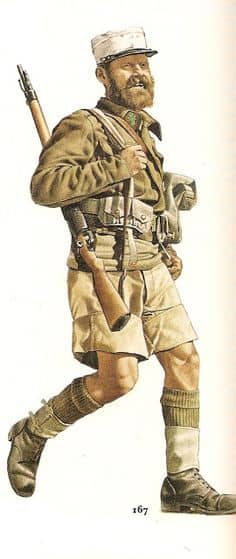
Established on 9th March 1831 to absorb unemployed veteran foreign soldiers in the recently French acquired territory of Algeria, the Legion has since been used as a mercenary force by France during the world wars and in a number of colonial wars and ventures overseas. Typically, men enlisted in the ‘old Legion’ for a five year engagement in the first instance, and were entitled to French citizenship at the end of their service. However, the demands of the Second World War, ensured that many recruits signed on for the ‘duration only’ and keep in mind that in the early 1940s few probably realised how long the war would last or even exactly what its outcome might be. Neither did they necessarily know where they might serve, as by 1945 elements of the Legion eventually experienced action in areas as diverse as France, Norway, North and East Africa, the Middle East, Italy, North-West Europe and Indochina (Vietnam).
Like many airmen from occupied Europe, the Czech pilot Jo Czapaka, who had escaped to France, was compelled to join the Legion as a route into the French Air Force. During his basic training at Sidi-bel-Abbès, then the Legion’s HQ in Algeria, he discovered that the veterans were tough ‘mental cases’ who regarded him with contempt and it was impossible to connect with such ‘crude’ men. Typically, training in North Africa was extremely tough and it was no easy task becoming a legionnaire. It entailed ‘firing exercises, drill, marches in which the pack loads and the distances were increased each week, classes of ‘‘theory’’ in the shade of the eucalyptus trees beside the Wadi Saïda,’ plus gruelling assaults on the Marabout or Sergeant mountain features, perhaps as vital to the Legion’s combat performance ‘as Eton’s playing fields were to Wellington.’
Likewise, discipline was typically harsh. Englishman Edmund Murray joined the Legion in 1937 and saw extensive war service in Indochina, before in later life becoming Winston Churchill’s bodyguard. He described a punishment termed le tombeau (the grave) employed in extremis whereby a recalcitrant legionnaire ‘had to dig a hole in the ground, in the sun, just the right size for him to lie down, covered by a groundsheet, or occasionally barbed-wire.’ He then had to stay there for a day and night. Usually this worked, and as Murray stated, ‘it adhered to the theory of ‘‘rough justice’’ and prepared legionnaires well for warfare and conflict.
Jewish volunteers faced many barriers
As the war progressed, ‘old timers’ such as those alluded to above, would be joined by volunteers from a variety of backgrounds, and it was not always possible to split nationalities up in accordance with the Legion’s standard procedure. There were many Jews fleeing Nazi persecution; Spanish Republicans seeking refuge from Franco’s regime; and even German anti-Nazis. Contrastingly, in August 1944 an entire Waffen SS unit of 650 Ukrainians, including its officers that had surrendered, was absorbed into the Legion, an indication of how difficult wartime recruiting could be. The taking on of new blood threatened to alter the character of the Legion. Some officers feared that Spaniards and Eastern Europeans were liable to be Communists at a time when the French Communist party was banned and the Communist International that controlled non-Soviet Communist parties was pro-German until the Nazi invasion of Russia in June 1941. Thus anyone with Communist sympathies was deeply suspect in the Legion’s eyes, and for understandable reasons, particularly during the first twenty months of the war. Another problem with ‘political’ volunteers was highlighted by the experience of an ex-Communist Polish legionnaire who lay wounded during the French campaign in 1940, only to be ignored by comrades who ‘were ‘‘loyal’’ Party members and deliberately left him to die.’
Jewish volunteers faced many other barriers. Not only was there anti-Semitism (reflective of wider French society) to contend with, but compared with say their Iberian counter-parts who had served in the Spanish Civil War (1936-39), they tended to lack soldierly attributes such as physical fitness which did not endear them to their NCOs. It was perhaps fortunate for most of them that they did not tend to have to endure being inducted into the Legion in North Africa as traditionally occurred, but instead were trained in Europe. One unit was even dubbed ‘la troupe des intellectuels’ on account of it comprising large numbers of university educated Eastern European Jews, and from a Legion perspective this was not implied as a compliment.
Legion units during the Battle of France
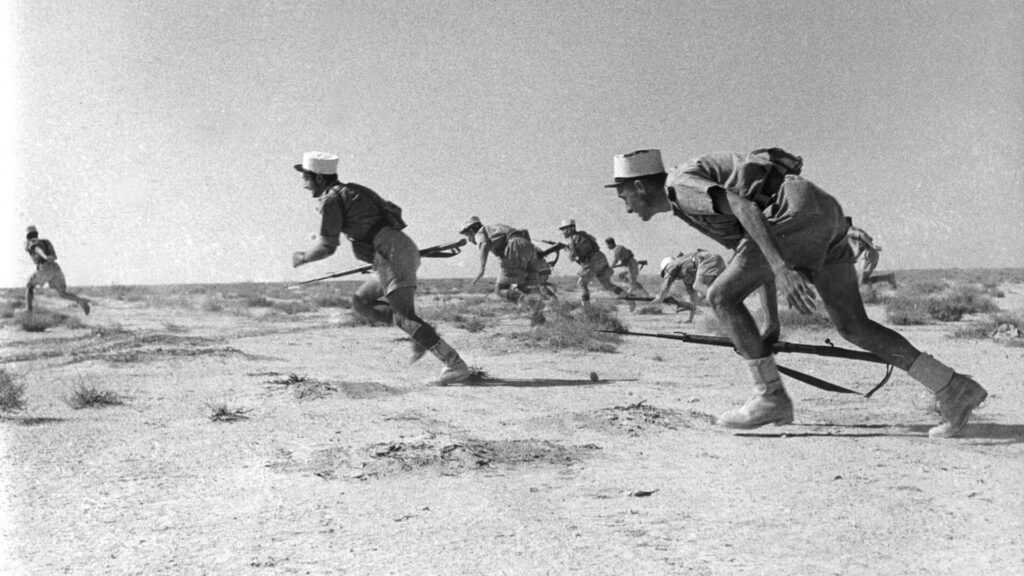
In 1939 the Legion comprised six régiments étrangers (infantry) and two régiments étrangers de cavalerie or REC (armoured). ‘Marching regiments’ or Régiment de marche de volontaires étrangers were soon added to the establishment. Although technically not Foreign Legion, it appears to all intents and purposes that these were considered part of the Legion, not least by the men that joined them, and were where large numbers of wartime volunteers were posted. In October 1939 21st and 22nd RMVE were established, to be followed in May 1940 by 23rdRMVE. During 1939-40 the 11th and 12th REI or Régiment étranger d’infanterie were also raised from volunteers and veterans of service in Africa, along with GERD 97, a light armoured reconnaissance battalion attached to 7th North African Division. Typically, these units were poorly equipped, relying on items such as Lebel rifles of First World War vintage, and in training many troops never even saw, let alone learned how to handle modern weapons such as 25 mm anti-tank guns. Support weapons such as mortars also lacked components in many instances, leading to a desperate degree of improvisation in their deployment in order to get them to work. Additionally, leadership was sometimes suspect and created disciplinary problems. Despite these drawbacks, the consensus among historians of the Legion seems to be that overall these units acquitted themselves well during the French campaign of 1940. However, casualties were high, for example at Soissons on 6th June 12th REI was reduced to only 300 men, and ceased to be an effective fighting force as it battled its way out of encirclement.
The Axis powers extract their own nationionals
Another challenge was that during the war the Axis powers sought to extract their own nationals from the ranks of the Legion. For example, 2000 German legionnaires were forced to ‘volunteer’ with Infantry Regiment 361 that fought with the Afrika Korps. Conversely, there were also German, Italian and Austrian legionnaires who willingly left to fight for their own countries. Regarding the above the Service d’ordre legionnaire (effectively the Legion’s secret service) was complicit, as it was a collaborationist militia of the Vichy regime, later to become the Milice française, infamous for its interrogation techniques. One way around this drain on its manpower, was for the Legion to post men who were affected to distant outposts, notably Indochina, where they could remain free, even from the clutches of the Nazis. The experience of Johannes Bonk provides a case in point. He was a committed anti-Nazi born in Germany but of dual French-German nationality as his parents had moved to work in France. In 1939 he volunteered for the French Army but was turned down. This brought him to the attention of the Gestapo, so he fled to Poland, ultimately desperate to make it somehow to Britain. There followed a period of internment in a labour camp for foreign prisoners when he re-entered Germany, before escaping and eventually making it to Free France, where he volunteered for the Legion. Having been sent to North Africa, owing to the war, an announcement was made that, German legionnaires could ask for a discharge. Having done so, he underwent brutal interrogation at the hands of the Service d’ordre legionnaire: ‘I was made to undress, and in the nude they tied me to a chair. Two of them then tipped a bucket of water over me and then proceeded to use electricity over my private parts. I shit myself and nearly went out my head. It was as if they were ripping out my testicles.’ Further imprisonment and interrogation followed, this time back in Germany under the Nazis, notably at Konzentrationslager Kislau in Bad Schönbornand, which was employed to ‘re-educate’ former legionnaires of German nationality and other political prisoners. Subsequently, he was called-up into the German military, and served with the Afrika Korps. After being captured by the Allies, he discreetly made his story known to his captors, highlighted his dual nationality and ability to speak a number of languages. As a result he was later shipped to Britain, and eventually able to volunteer for the Polish Navy.
The Norwegian campaign
Arguably, the most famous wartime unit was 13th DBLE or Demi-Brigade de la Légion Etrangére established in early 1940, and it is worth outlining its contribution towards Allied victory here. It was to be deployed in Finland as part of the Allied intervention but this did not happen. Instead it completed Arctic warfare training in France, before being shipped to Norway and made an opposed landing at Narvik in May 1940 where it distinguished itself. Captain Pierre Lapie was attached to the Legion and observed how well Spanish legionnaires coped with the mountainous terrain: ‘They leapt from point to point like tigers, and never seemed to tire,’ some even tackling a German machine gun nest and putting it out of action. Although the Norwegian campaign has widely been regarded as disastrous from an Allied perspective, Narvik was a victory, 13th DBLE having advanced close to the Swedish frontier, despite suffering total casualties of seven officers and sixty other ranks. Subsequently, it returned to France, landing at Brest before engaging the Germans near Rennes, and after the Armistice men were given the option of staying in France or joining the Free French in England. Further ructions occurred while the unit was based at Trentham Park, Staffordshire, as 636 of the 1,619 officers and men present opted to return to French North Africa rather than stay in England. In an example of the bitterness that existed within the Legion during the war years, the guard of honour refused to present arms to those leaving as they marched past. Briefly to ‘erase the shame’ it was re-designated 14th DBLE. One British legionnaire caught in the confusion, was James Williamson, who was advised to ditch his French uniform and join the British Army, but according to the Legion this classed him as a deserter, something only ‘rectified when he was officially discharged on 5th April 1966!’
Subsequently, 13th DBLE was deployed in West Africa during Operation Menace, an effort by de Gaulle to persuade French colonies in that region to revoke their allegiance to Vichy. It then saw service in Eritrea in an attempt to drive Italian forces from the region, then in the confusion of Syria, where it was unenviably pitted against 6th REI that was loyal to Vichy, thus breaking the principal that a Legion unit never fights another Legion unit. In the aftermath large numbers of men who had fought with 6th REI chose to join 13th DBLE, although officers from the former tended to view their opposite numbers as ‘traitors who had jumped the promotion queue’ in order to fill positions with de Gaulle’s forces.
The defence of Bir Hacheim
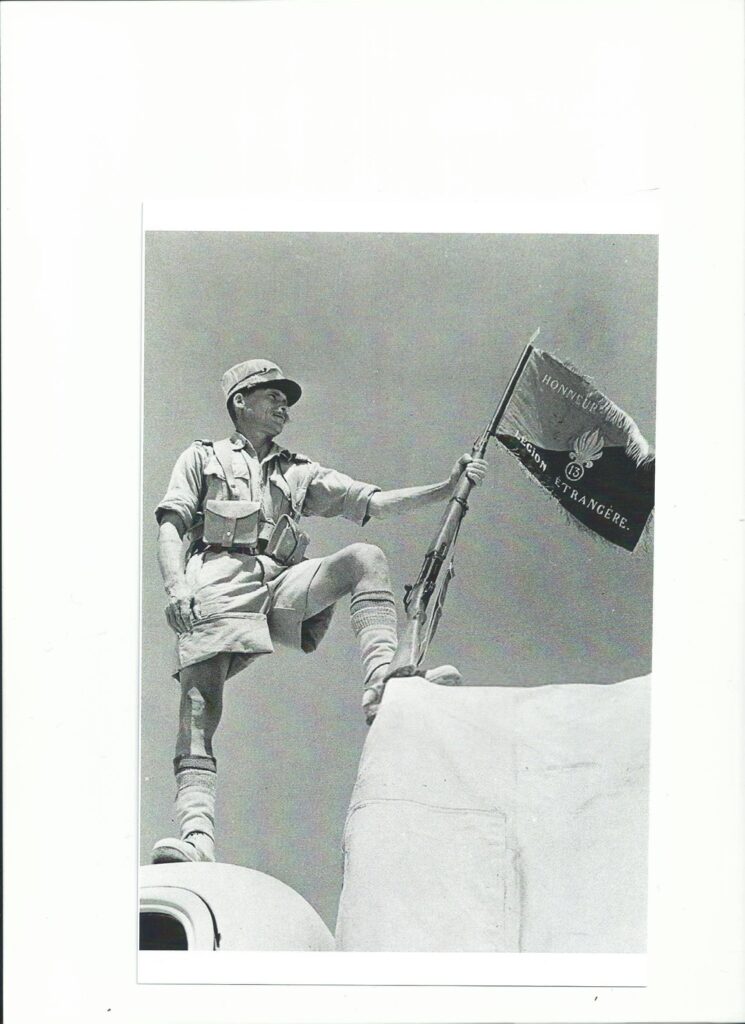
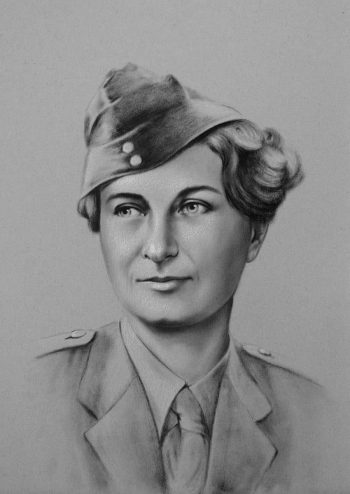
After Syria, 13th DBLE was posted to the Western Desert, where it cemented its legendary reputation under the dynamic leadership of officers such as Lieutenant Colonel Dimitri Amilakvari, a Georgian prince who often wore a cloak and eschewed a steel helmet in favour of his képi, a habit that would eventually cost him his life when while leading his men in battle he was mortally wounded in the head by a shell splinter. Notably, it was the defence of Bir Hacheim by 13thDBLE, and other French units, supported by a unit of British anti-aircraft gunners, and a handful of female personnel who had been ordered to leave but stayed on, that emboldened the cause of the Free French so immensely boosting de Gaulle’s political standing. The heroines present included redoubtable nurses from the ‘Spearettes,’ a nursing organisation established by Lady Spears, and Susan Travers, the French commander’s driver, who uniquely for a woman was later officially inducted into the Legion, and wrote an account of her experiences entitled: Tomorrow to be Brave (London: Bantam Press, 2000).
Bir Hacheim formed the southernmost point of the Gazala Line, a series of defensive ‘boxes’ that ran from roughly near Tobruk in the north, covering around 60 kilometres of territory, and were intended to withstand serious attack. Essentially it was a road junction, covered by the remains of a pre-war Italian fort in ‘Beau Geste style,’ replete with a pair of stone cisterns sunk into the ground to gather rain water, dubbed les mamelles (the breasts) by legionnaires. Otherwise Bir Hacheim appeared to be surrounded by miles of inhospitable, barren looking desert. It was here in June 1942 that the garrison held out for fifteen days enduring almost non-stop combat as the Germans and Italians sought to batter the position into submission, before a hair-raising break out was successfully launched by the survivors. As an example of the ferocity of the bombardments to which the defenders were subjected, on one day (10th June) an air raid by 110 aircraft dropped at least 130 tons of bombs on Bir Hacheim. One of the major reasons the defenders held out so long was because they employed a skilfully constructed and planned ‘system of field positions and small defence works-slit trenches, small pill boxes, machine-gun and anti-tank gun nests-all surrounded by dense minefields.’ These were relatively ‘impervious to artillery fire or air attack’ as at best a direct hit would only eradicate one slit trench at a time. The Axis forces therefore had to expend large amounts of ammunition to achieve any lasting damage. Another distinct challenge for the attackers was the clearing of ‘lanes through the minefields in face of the French fire.’
The Legion and the Liberation of France
13th DBLE continued fighting in North Africa during 1942-43, although at times its morale suffered dips, such as when the unit was held in reserve towards the backend of the Tunisian campaign. It was briefly employed in the awkward terrain of Italy, by which stage (spring 1944) Allied forces were slowed down by the Gustav Line, German defences that ran from the mouth of the Garigliano River in the west all the way to the Adriatic in the east near the River Sangro. Italy cost 13th DBLE 466 casualties, around a quarter of its strength, which as Porch states was a hindrance given that it could be hard to find replacements. Subsequently, 13th DBLE deployed to southern France and fought in the North-West Europe campaign, 1944-45. This had particular resonance as it entailed the liberation of France, followed by bitter fighting that winter in the Alsace region, prior to the final push into Germany. At least by this stage, 13th DBLE along with other Legion units, benefited from being re-equipped by the Americans with modern weaponry and uniform items in stark contrast to the experiences of many legionnaires earlier in the war. Another feature of the war was that owing to its polyglot nature, the Legion often employed ‘dirty tricks,’ such as when troops were in danger of being cut off by a German attack in Alsace, they ditched their heavy weapons and posed as reinforcements intended to prevent a French break out. With the aid of a German speaking legionnaire, they successfully negotiated a German sentry, and after questioning him about the German dispositions killed him and made it back to their own lines.
Under Japanese occupation
Contrastingly, the three battalions of 5th REI saw service in Indochina, although when Japan launched a surprise attack in September 1940 on French positions near the Chinese border, a treaty ensured that it and other French units had to co-operate with the Japanese. Subsequently, some legionnaires were involved (with Japanese backing) in resisting an attack by Thailand on the colony’s western borders. Under the Japanese occupation, the French garrisons remained, and mainly were involved in countering bandits. However, in March 1945, the Japanese demanded the disarming and internment of all French troops in Indochina. Those that resisted were killed defending their posts or brutally massacred after becoming prisoners. Fortunately for 5th REI it was in the Tong Phu region at the time, up near the Red River, and escaped along with refugees, but only after a dramatic and gruelling 52 day fighting withdrawal of around 800 kilometres through jungle and awkward mountainous terrain, before reaching the safety of the Chinese border. Such an epic feat typified the traditional spirit of the Legion. In a despatch to his troops afterwards, 5th REI’s commander commented: ‘… badly nourished, poorly clad, sadly shod, weary and fatigued by privation and suffering… you marched on your way and fought without respite with only one thing in mind… to remain faithful to your posts.’
Conditions could be tough in all theatres but were especially difficult in extreme climates. Leaches were endemic in Indochina, and ideally had to be dealt with by using a burning cigarette to prize them off safely. Similarly, a host of diseases and the heat posed a threat, plus jungle combat with the Japanese was often hand-to-hand with small arms and bayonets, because mortars could not be fired owing to overhanging branches. In the Western Desert swarms of flies, sun burn (which was a punishable offence), the dust, sandstorms, mirages, and the general bleakness of the landscape, all posed a physical and psychological burden. As Travers noted in the Western Desert, and Murray in Indochina, troops could suffer extreme mental strain under such conditions, ranging from being thoroughly hacked off to a form of madness dubbed le cafard (the cockroach). Wren eloquently described the condition as follows: ‘It crawls round and round, in the brain and the greater the heat, the monotony, the hardship, the overwork, the over-marching, and the drink-the faster goes the beetle, and the more it tickles,’ potentially inducing desertion or even suicide.
List of Sources
P. C. Wren, Beau Geste (Ware: Wordsworth, 1994)
Jo Czapaka quoted in Adrian D. Gilbert, Voices of the Foreign Legion (Edinburgh: Mainstream, 2005), p. 185.
Douglas Porch, The French Foreign Legion (London: Macmillan, 1991), p. 456.
Douglas Boyd, The French Foreign Legion (Hersham: Ian Allan, 2010), p. 338.
Edmund Murray, Churchill’s Legionnaire (London: Unicorn, 2021), pp. 114-15
SWWEC, Testament of Johannes Bonk (2p TS ‘memoir’)
Captain Pierre Lapie quoted in Gilbert, Voices of the Foreign Legion, p. 190.
Boyd, The French Foreign Legion, p. 349.
Ibid, p. 357.
B. H. Liddell Hart (Ed), The Rommel Papers (London: Hamyln, 1984), p. 213.
Gen. Alessandri quoted in Murray, Churchill’s Legionnaire, p. 127.
Thanks to Amanda Herbert-Davies of the SWWEC for her assistance with the article.

About The Author
James Goulty holds a masters degree and doctorate in military history from the University of Leeds, and has a particular interest in the training and combat experience of ordinary soldiers during the world wars and Korean War.
He has published numerous articles and written 5 books for Pen and Sword Ltd, including The Second World War through Soldiers’ Eyes: British Army Life 1939-1945; and Eyewitness Korea: The Experience of British and American Soldiers in the Korean War 1950-1953.


Click to see full BMMHS event listing pages.
Contact us at [email protected]
Copyright © 2024 bmmhs.org – All Rights Reserved
Images © IWM & James Goulty