The 'Dirty War': First Indo China War, 1946-54
An Overview
by James Goulty
Various attempts to resist French rule fail
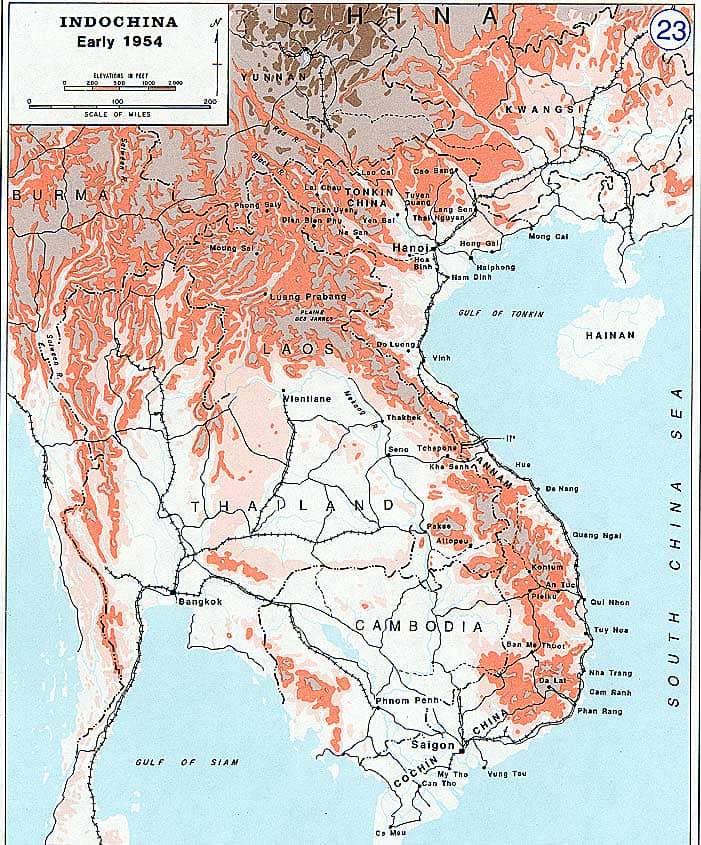
France had a presence in Indochina since at least the eighteenth century, when traders and missionaries established themselves in the region. By 1884, Annan, Tonkin, and Cambodia had become French protectorates, soon to be followed by Laos, which paved the way for French rule. The Indochinese Union of 1887 might have appeared reasonable, but in reality gave the Vietnamese no say over their own affairs. Much of the population was illiterate, and public health and education neglected. Unsurprisingly, nationalistic or revolutionary movements with anti-French sentiments thrived under such conditions. However, various attempts to resist French rule failed, such as when Phan Boi Chan’s League for the Restoration of Vietnam sought to oust the French during the First World War era, and re-establish imperial power with the help of the Japanese. He was captured by the French, and eventually died in prison in 1940.
The OSS arm the Viet Minh
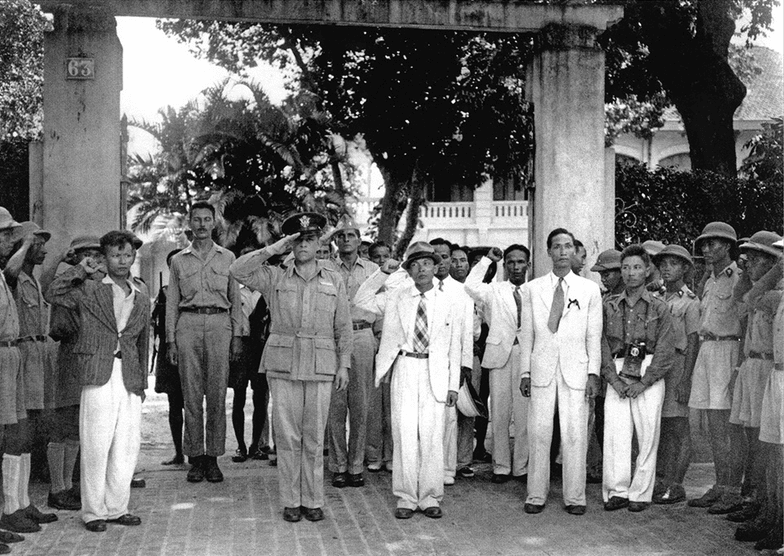
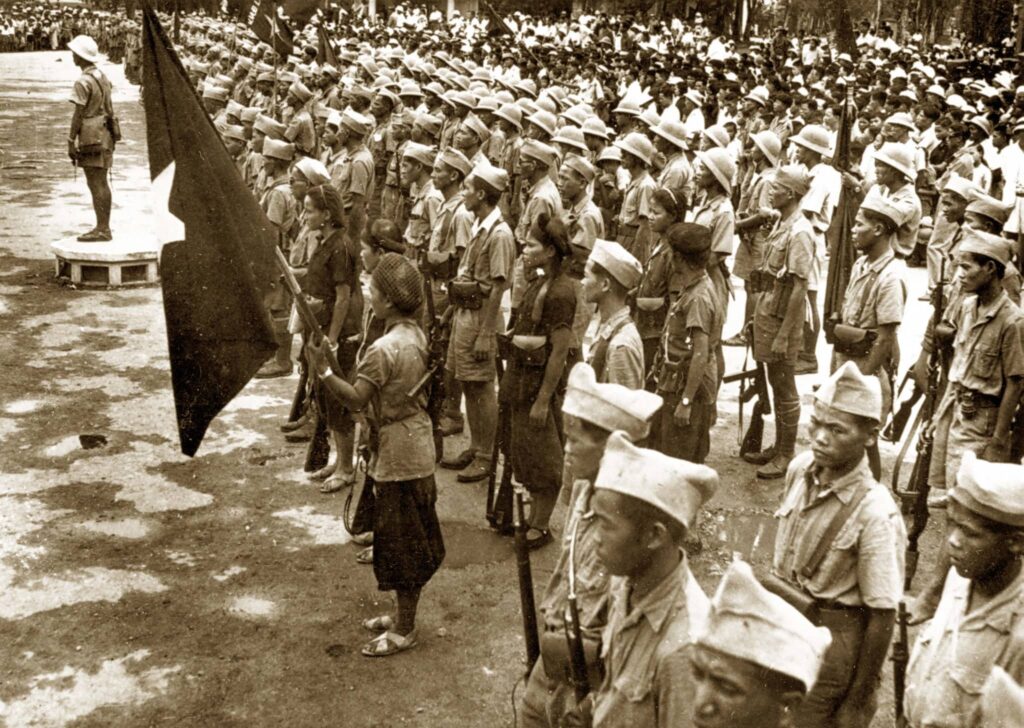
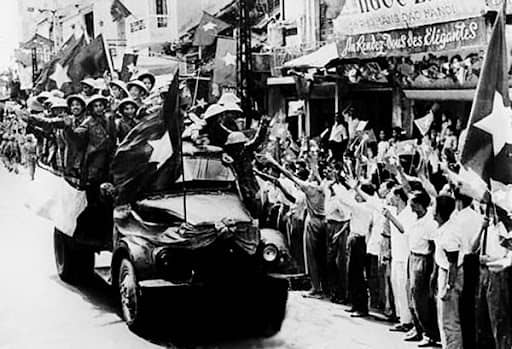
Secret militant organisations opposed to French rule continued to operate during the inter-war years. Notably, the Vietnamese Nationalist Party (Viet Nam Quoc Dan Dang) and Revolutionary League of the Youth of Vietnam (Thanh Nien) led by Nguyen Ai Quoc, better known as Ho Chi Minh. He proved a canny political operator, presenting himself as nationalist, communist, or pro and anti-French, Chinese or Japanese, as the situation demanded. The Thanh Nien acted as the nucleus for the formation of the Indochinese Communist Party, and although repressed by the French, during the Second World War emerged as a credible liberation movement. The fall of metropolitan France, enabled the Japanese to move into Indochina in September 1940, assisted by the Vichy authorities. The following year Ho united communist and nationalist factions to form the League for the Independence of Vietnam or Doc Lap Dong Minh Hoi, abbreviated to Viet Minh. He worked against the Japanese aided by Chinese nationalists, communists and the Americans and British. Faced with a Japanese putsch to remove the Vichy regime in March 1945, the American Office of Strategic Services (OSS) even armed the Viet Minh against the Japanese. With the unconditional surrender of Imperial Japan in August 1945, the Viet Minh seized Hanoi, and on 2 September Ho declared the independent Democratic Republic of Vietnam. The emperor Bao Dai abdicated, and became chief councillor to the government in Hanoi, while in Siagon, the communist dominated Provisional Executive Committee of South Vietnam recognised Ho’s authority in the north.
The Japanese troops are allowed to keep their arms
At Potsdam, it was agreed that the Nationalist Chinese under Chiang Kai-Shek would disarm the Japanese north of the 16th Parallel, and the British would hold responsibility in the south. While the Nationalist Chinese were unsympathetic towards French colonialism, the British were more amenable regarding the restoration of French rule. The 20th Indian Division, comprising around 26,000 men under Major-General Douglas Gracey, was posted to the south to facilitate this. It had air and artillery support and most of its troops were hardened veterans of the wartime Burma campaign. Gracey soon discovered that Japanese troops had to be allowed to keep their arms, in order to assist with internal security. Likewise, French prisoners were released, who in many cases were keen to attack the Provisional Executive Committee. By late September 1945, conditions deteriorated so much that Gracey effectively declared a state of martial law in Saigon. French Gaullist and Vichy troops went on to storm the Viet Minh HQ in Saigon and arrest its members, thus sparking the first Indochina War of 1946-54.
The French move to reassert their authority in the north
Initially, it appeared compromise might be practicable. Ho allowed Chinese nationalists to serve in government, and dissolved the Indochinese Communist Party. French troops replaced the Chinese in the north, and France recognised Democratic Republic of Vietnam as a free state, part of the Indochinese Federation within the French Union. French troops were to be withdrawn during 1952, and a referendum held on Cochin China becoming part of an independent Vietnam. The Viet Minh even assisted the French against non-communist nationalists engaged in anti-French activities. Yet, behind this veneer of solidarity, neither side truly believed in upholding these agreements. On 1 June 1946, Admiral d’Argenlieu, the French High commissioner, proclaimed Cochin China an autonomous republic. Then on 15 October the French moved against Haiphong to reassert their authority in the north, and prevent supplies reaching the Viet Minh. This led to a naval bombardment on 23 November that killed an estimated 6000 Vietnamese civilians. The resulting Viet Minh uprising in Haiphong took a week to subdue. This inspired the Viet Minh to attempt to keep the French bogged down in urban areas and guarding communications, while they mounted guerrilla activity, before seeking to launch a general counter offensive, thereby conforming to Mao’s ideas on revolutionary warfare.
The French underestimate the Viet Minh
In April 1948 Bao Dai was allowed to head a Vietnamese government with the promise of future independence, but this ‘disguised’ the harsh reality that France remained in control of foreign and military affairs. Nonetheless, conditions were increasingly awkward for the French, who by 1949 deployed around 150,000 troops, many of whom were tied down on defensive tasks, such as mounting searches and patrols or escorting convoys. Meanwhile, the Viet Minh were gaining experience, and expanding their military strength, ably assisted by Communist China. For the French it appeared sensible to wait until the French National Assembly sanctioned the use of conscripts, and American aid was forthcoming. Unfortunately, from a French perspective, they underestimated the Viet Minh. On 16 September 1950, Dong Khe, a position held by two companies from the French Foreign Legion (approx. 260 men), was heavily mortared, then attacked by waves of fanatical enemy infantry, albeit the survivors successfully escaped and evaded encircling troops. Then on 9 October Viet Minh troops assaulted a French force withdrawing from Cao Bang, and by the end of that month the French had been forced from the North altogether. The Viet Minh proved adept at moving and concentrating their forces where needed, plus mist had hampered the French deployment of airpower. Cao Bang was a heavy defeat for the French, not just in terms of casualties and equipment lost, but because it fostered the impression amongst the troops that they had been beaten by a supposedly inferior guerrilla force.
The de Lattre Line
In December 1950, the much admired Jean de Lattre de Tassigny, assumed the dual functions of High Commissioner and Commander-in-Chief. Keen to improve the situation, he made increasing use of air power, notably napalm strikes. In January 1951, at Vinh Yen, an outpost about 35 miles NW of Hanoi, around 8000 French troops, faced two Viet Minh divisions. De Lattre assumed personal control, including ordering in air strikes, and the French inflicted severe casualties on the enemy. Despite this, French forces proved too road bound, so were unable to follow up their success by pursuing the Viet Minh. To prevent further incursions from the north, the ‘de Lattre Line’ was established, a line of defensive positions encircling Hanoi and Haiphong, that extended from the sea to Vinh Yen and then south eastwards to the sea. Additionally, effort was made by the French to employ guerrilla warfare, although such tactics sat uneasily with the majority of officers. In March 1951, the Viet Minh sought once more to mount a major battle, this time around Mao Khe, but were thwarted by French defensive tactics and artillery. Contrastingly, at the Day River, the French were able to cut the Viet Minh off from their supply line, plus the local population were unsympathetic towards communism, and the Viet Minh overcommitted without maintaining any reserve.
These victories boosted French morale, and de Lattre anticipated using the rainy season to build up his forces, receive modern American equipment, and improve the Vietnamese National Army, so that French troops were freed up for offensive operations. Unfortunately, many of the VNA were not keen serving outside their home areas and desertion rates were high. The Viet Minh were not idle either, during October 1951, the 312th Division attacked Nghai Lo, but wave after wave were repulsed by French defenders. The action witnessed the French drop paratroopers to seek out and destroy retreating Viet Minh. Although a French defensive victory, it was far from the decisive offensive action de Lattre craved to silence critical politicians back home, and convince the government to provide more financial and military support. Accordingly, Hoa Binh, a Viet Minh staging post 50 miles west of Hanoi, was targeted the following November. Three parachute battalions occupied the town, while other troops opened landward routes towards it. However, the French overextended themselves, and had to establish several outposts to cover these routes. This allowed the Viet Minh to harry French units and inflict heavy casualties. As the French were determined to hold Hoa Binh, this further tied down their troops. Afterwards de Lattre left Indochina, shortly to die of cancer. His replacement, General Raoul Salan, inherited a dire situation. Efforts to open the road to Hoa Binh were halted, and a withdrawal of French posts along the Black River between Hoa Binh and Viet Tri commenced, again providing plenty of scope for Viet Minh ambushes.
Chinese support for the Viet Minh
By the summer of 1952, both sides paused to re-build, while low level guerrilla activity continued. The Viet Minh were now receiving significant training and equipment from the Chinese, including absorbing lessons from the Korean War. Likewise, the French were receiving increasing help from America. In October heavy fighting resumed with the Viet Minh wrestling control of the watershed between the Red and Black rivers, something the French ascribed to being outnumbered and because poor weather hampered air support. Subsequently, the French launched Operation Lorraine, when 30,000 troops fanned out from the Delta to seize a Viet Minh supply centre. Again the French were road bound, which invited ambush, and the logistical challenge of mounting such a lavish operation proved extremely taxing.
During December 1952-March 1953, there was another lull, although minor actions continued, ensuring the casualty count mounted for both sides. Then in April 1953, the Viet Minh appeared poised to invade Laos, and in a war of manoeuvre confounded the French, who lacked enough aircraft to successfully maintain outposts hundreds of miles from Hanoi. In May 1953, General Henri Navarre assumed command, and aspired to construct a French mobile force, again by using the VNA to free up French troops, while simultaneously receiving more arms and equipment. He was to be disappointed, as the French government did not provide as much support as he had wanted, the war being increasingly unpopular domestically. Additionally, the French failed to appreciate how well their adversary had improved during 1952-1953, particularly regarding his training and equipment. The threat to Laos, led the French to hold Dien Bien Phu in an effort to force the Viet Minh to deploy in that area. Accordingly, during November 1953 three parachute battalions occupied the area and established a fortified camp. Operation Atlante was also launched the following January to clear coastal areas of Viet Minh, and continued until March. It showed the poor quality of the VNA, and the Viet Minh melted away.
Dien Bien Phu is overrun
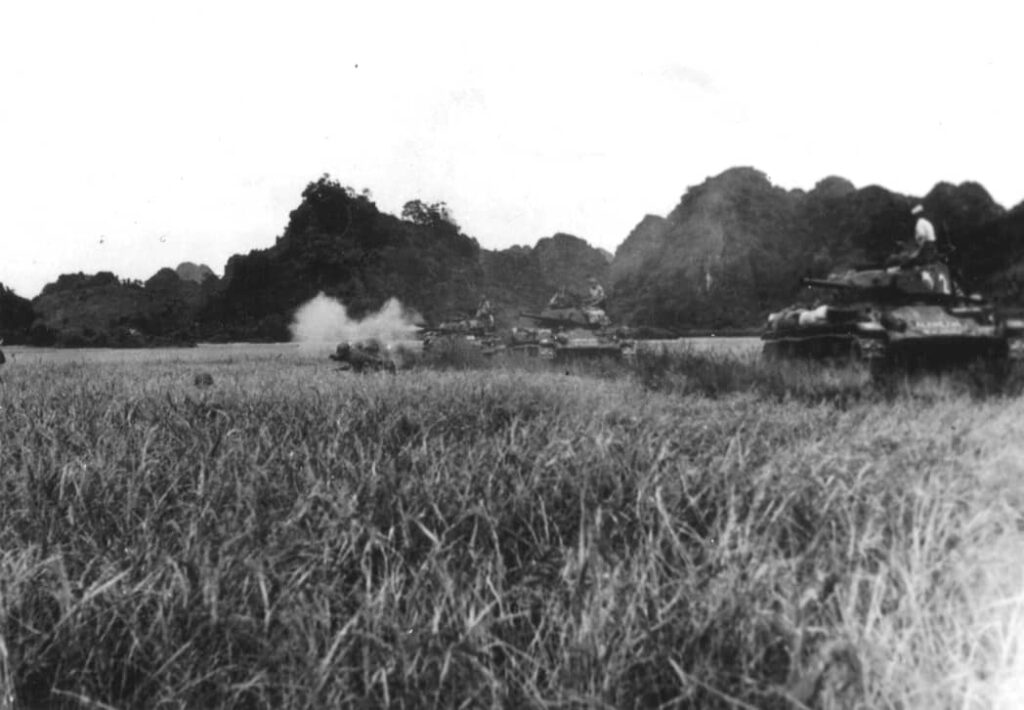
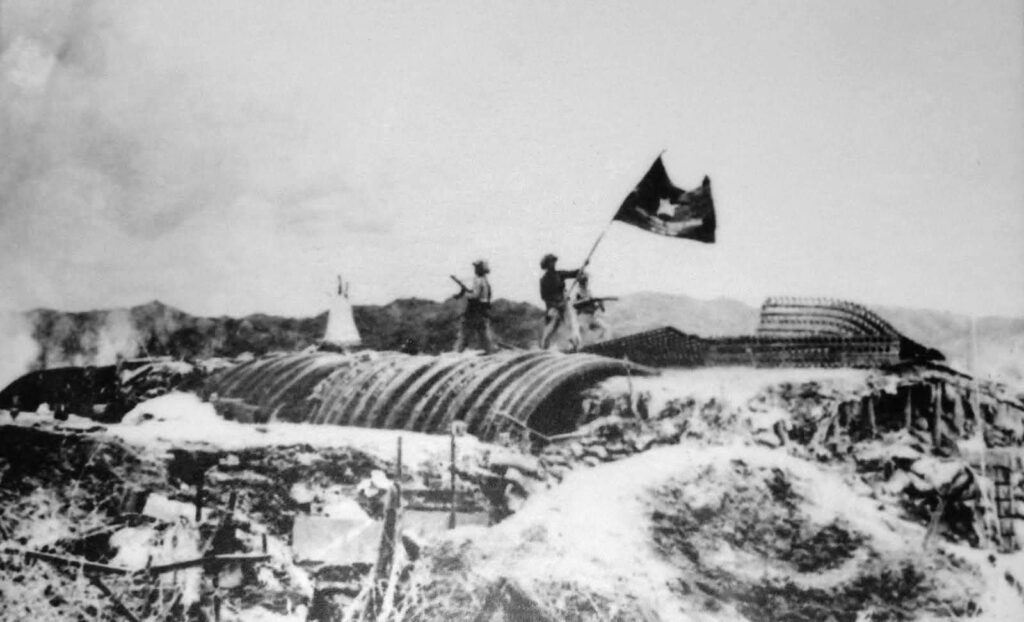
Dien Bien Phu, 170 miles west of Hanoi near the Laotian border, had little strategic significance. The paratroopers built two airstrips, the idea being that the position could be re-supplied and reinforced by air. Bastions surrounded it, reputedly named after the many mistresses of the commander. It was hoped that Viet Minh commander, General Giap would launch his troops against the base, resulting in their destruction. By March 1954, a dozen battalions were entrenched around Dien Bien Phu, together with supporting artillery. Transport aircraft flew in 24 Chaffee tanks that were re-assembled on the base, and at the larger airstrip were six Bearcat fighters, ready to drop napalm.
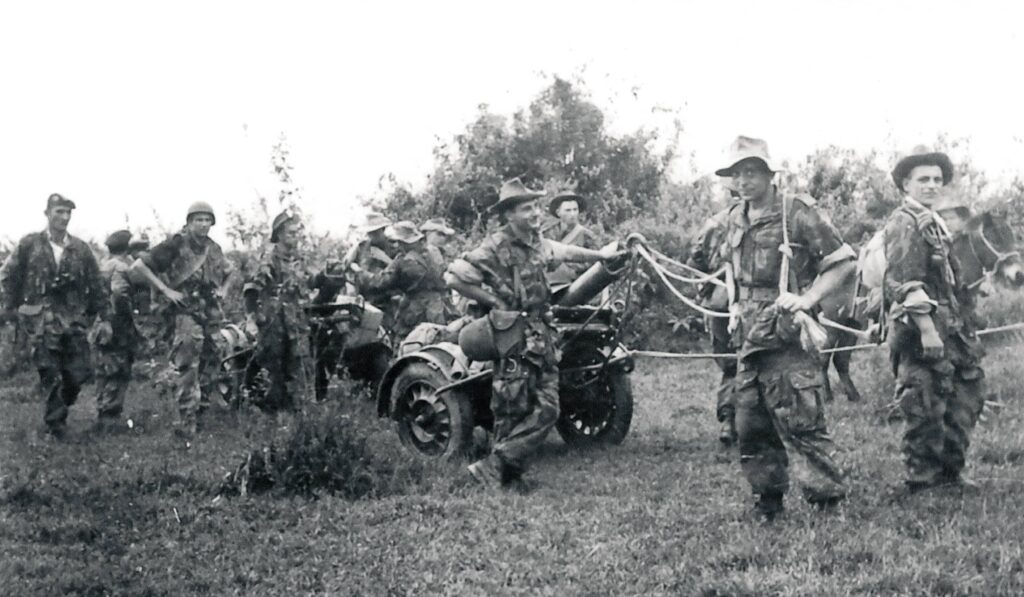
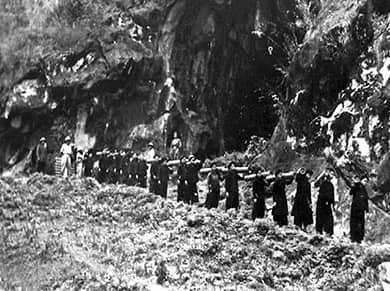
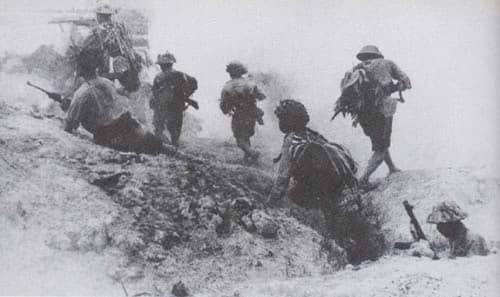
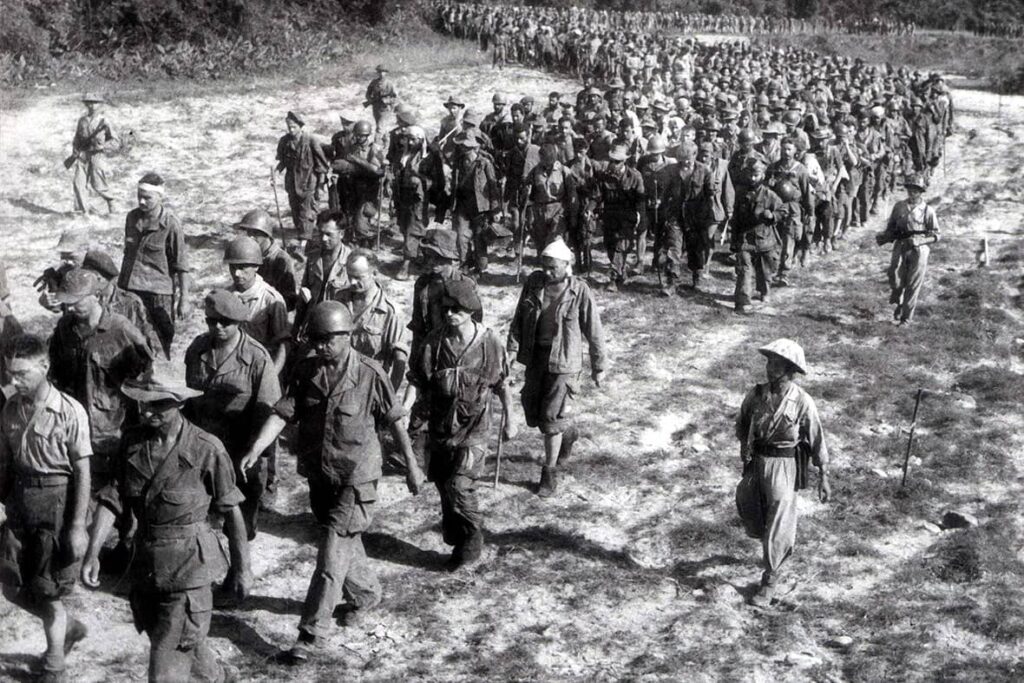
To the amazement of the French, Viet Minh units manhandled their artillery onto the surrounding hills, from where they could launch devastating barrages, followed up with ‘human wave’ infantry assaults. Outlying bastions were taken first, while the Viet Minh continued to bombard the base, plus their skilled deployment of anti-aircraft guns ensured that French troops could no longer rely on air re-supply. Siege warfare effectively developed, until during April and May, the Viet Minh launched a series of assaults, characterised by bitter hand-to-hand fighting. The base was finally overrun on 7 May 1954, when around 11,000 French survivors surrendered. Although the Viet Minh had suffered grievously (around 8,000 killed and 15,000 wounded), they earned a decisive victory, which denied the French any kind of bargaining position at the Geneva Conference that brought the war to a close.
© James Goulty 2025
Further Reading re the French in Indo-China c. 1945-54
Background
Bernard B. Fall, Street Without Joy: The French Debacle in Indochina (Barnsley: Pen & Sword, 2005)
Michael Carver, War Since 1945 (London: Weidenfeld and Nicolson, 1980)
Stephen Rookes, France’s War in Indochina Vol. 1: The Tiger versus the Elephant, 1946-1949 (Warwick: Helion, 2003)
Political & Military Analysis
Bernard B. Fall, The Two Viet-Nams: A Political and Military Analysis (London, Pall Mall Press, 1965)
Simon Dunstan, French Armour in Vietnam 1945-54 (Oxford: Osprey, 2019)
Robert Taber, The War of the Flea: A Study of Guerrilla Warfare Theory & Practice (London: Paladin, 1970)
Dien Bien Phu
Kevin Boylan & Luc Olivier, Valley of the Shadow: The Siege of Dien Bien Phu (Oxford: Osprey, 2018)
Bernard B. Fall, The Siege of Dien Bien Phu: Hell in a Very Small Place (New York: Da Capo, 1966)
Martin Windrow, The Last Valley: Dien Bien Phu and the French Defeat in Vietnam (London: Cassell, 2005)
Martin Windrow, Dien Bien Phu 1954: The French Defeat that Lured America into Vietnam (Oxford: Osprey, 2021)
French Foreign Legion
Tony Geraghty, March or Die: A New History of the French Foreign Legion (New York: Facts on File, 1986)
Douglas Porch, The French Foreign Legion: A Complete History (London: Macmillan, 1993)
Memoirs
Henry Ainley, In Order to Die: with the French Foreign Legion in Indo-China (London: Burke, 1955)
Paul Martelli with Vittorino Dal Cengio, On the Devil’s Tail: In Combat with the Waffen-SS on the Eastern Front 1945, and with the French in Indochina 1951-54 (Warwick: Helion, 2018)
About The Author
James Goulty holds a masters degree and doctorate in military history from the University of Leeds, and has a particular interest in the training and combat experience of ordinary soldiers during the world wars and Korean War.
He has published numerous articles and written 5 books for Pen and Sword Ltd, including The Second World War through Soldiers’ Eyes: British Army Life 1939-1945; and Eyewitness Korea: The Experience of British and American Soldiers in the Korean War 1950-1953.
Click to see full BMMHS event listing pages.
Contact us at [email protected]
Copyright © 2024 bmmhs.org – All Rights Reserved
Images © IWM & James Goulty