



Virtually everyone knows a little about Napoleon Bonaparte. For most people this is limited to the fact that he was the French general who was defeated by Wellington at The Battle of Waterloo. However, delving a little deeper into the story of this complicated man reveals a remarkably colourful and complex life.
Strictly speaking, Napoleon was not even French but the son of an Italian emigre who moved to the Mediterranean island of Corsica in the middle part of the eighteenth century. That was where young Napoleon was born. He remained intensely proud of his Corsican heritage for the whole of his life. He would also speak with a heavy Corsican accent and have difficulty mastering the finer points of the French language. This caused him to be bullied at school for being a country bumpkin and “Corsican short arse”.
An intelligent and ambitious youth, it is likely that Napoleon would always break surface as a remarkable achiever at some stage. However, his career received a sharp boost from the French Governor of Corsica. This was Charles Louis le Marbouef who took quite shine to the whole Bonaparte family, particularly young Napoleon.
It was thanks to him that Napoleon found a place at the elite military school in Brienne on the French mainland. It was here that he was bullied by his classmates causing him to withdraw into himself. He found refuge in arithmetic for which he had a natural ability. From Brienne, Napoleon, who was only fifteen at the time, transferred to the prestigious Ecole Militaire in Paris. There he found a practical outlet for his talent in mathematics by training as an artillery officer.
Some of his teachers had already recognised that Napoleon was a student of rare talent. One had remarked that, with his ability for maths, he could become “an excellent seaman”. In fact, when he graduated from this military school, he was the first Corsican ever to do so.
Between 1786 and 1789, Napoleon spent much of his time in his native Corsica. We think of him mainly as a military man, but he also did not hesitate to enmesh himself in local politics. In the case of Corsica, he supported both the French Revolution and the cause of Corsican independence. All the time, he was also moving up the ladder of military promotions.
However, there would be setbacks on the way. One of these was his involvement in the invasion of Sardinia in 1793. At the time, this strategic island was a self-governing Kingdom that had not come out for or against the revolutionary government in Paris. Since it was ruled by a royal family, the relationship would not have been an easy one. This came to a head when the French sent an expedition to capture the place.
What the French government thought would be an easy conquest turned out to be a complete disaster. The French Government forces were beaten back by the Sardinians and their Habsburg allies at every turn. Ultimately, someone had to take the blame for this disaster and Napoleon was a handy choice.
His close involvement in Corsican politics had earned Napoleon some powerful enemies. These included Pasquale Paoli, the Corsican nationalist who ran the place. He also disliked the Bonaparte clan whom the regarded as French collaborators. Because of this, Napoleon and his family fled to the French mainland for their own safety.
During this turbulent ten year period of the French Revolution France was in a state of near chaos with insurrections breaking out all over the place. In the South and along the Mediterranean seaboard there were plenty of such mini wars. One of these centered on the city of Toulon. As chance would have it, this was where Napoleon found himself. Currently held by the coalition forces opposed to the new revolutionary government in Paris, this would present Napoleon with his first big opportunity for advancement.
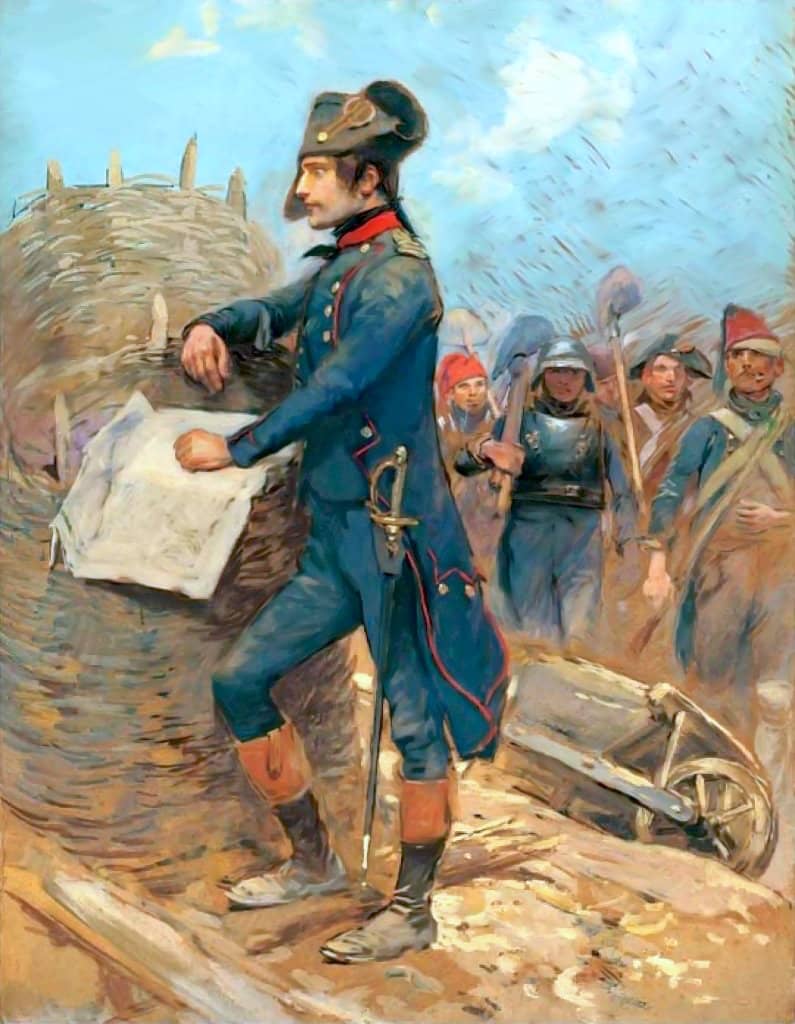
Firmly on the side of the revolutionaries, Napoleon was now employed firstly as the captain of a coastal battery and then as commander of all the republican artillery. It was in this capacity he was ordered to recapture Toulon for the Revolutionary Government. It was largely due to Napoleon’s strategic planning and tactics that he won the seige of the city in December 1793. It is worth bearing in mind that at the age of 34, Napoleon was still a relatively young and inexperienced officer who had just achieved what much older and battle hardened officers would have failed at.
The heads of the revolutionary government had noticed this bright young officer in their army. Augustin and Maximilien Robespierre, leading lights in the Revolutionary Government took note and promoted Napoleon to the rank of Brigadier General. The victory of The Battle of Toulon was an important stepping stone on Napoleon’s path to power but there would still be further setbacks on that route.
In 1794, Maximilien Robespierre was suddenly toppled from his pre-eminent position in the French Government. Whether his colleagues feared his dictatorial tendencies or there was some deeper motivation behind his downfall is open to question Within twenty-four hours he had been beheaded by the same guillotine that he had used on thousands of his countrymen.
Guilty by association, Napoleon was flung into prison. He must have feared that he was facing a similar fate. Whether he was saved by a guardian angel or, more likely because the Revolutionary army was short of good generals, Napoleon was released after two weeks. The official reason was that no hard evidence of his disloyalty to the Revolutionary Government could be found.
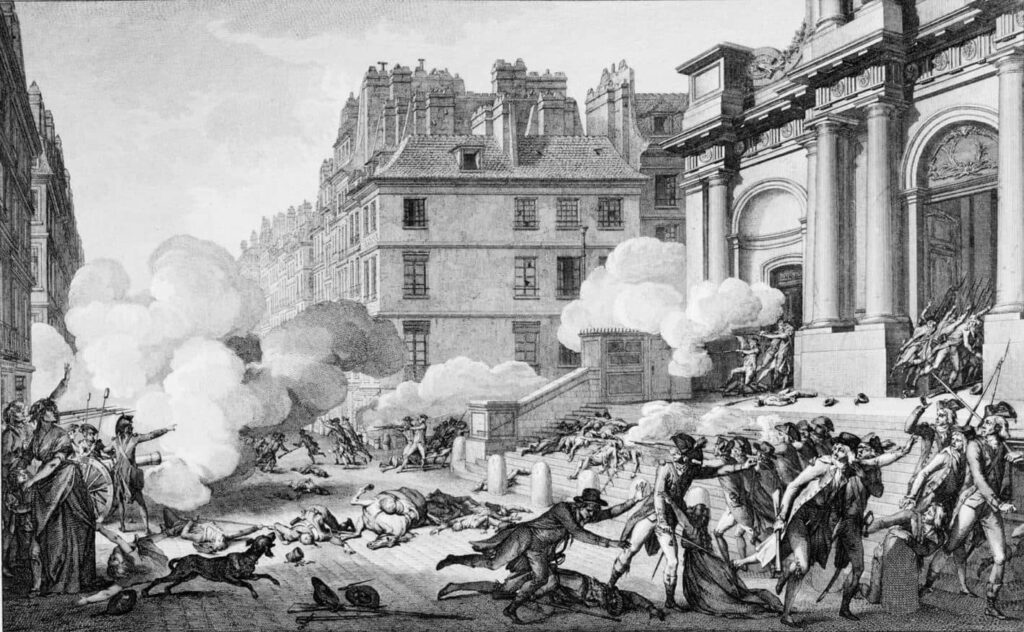
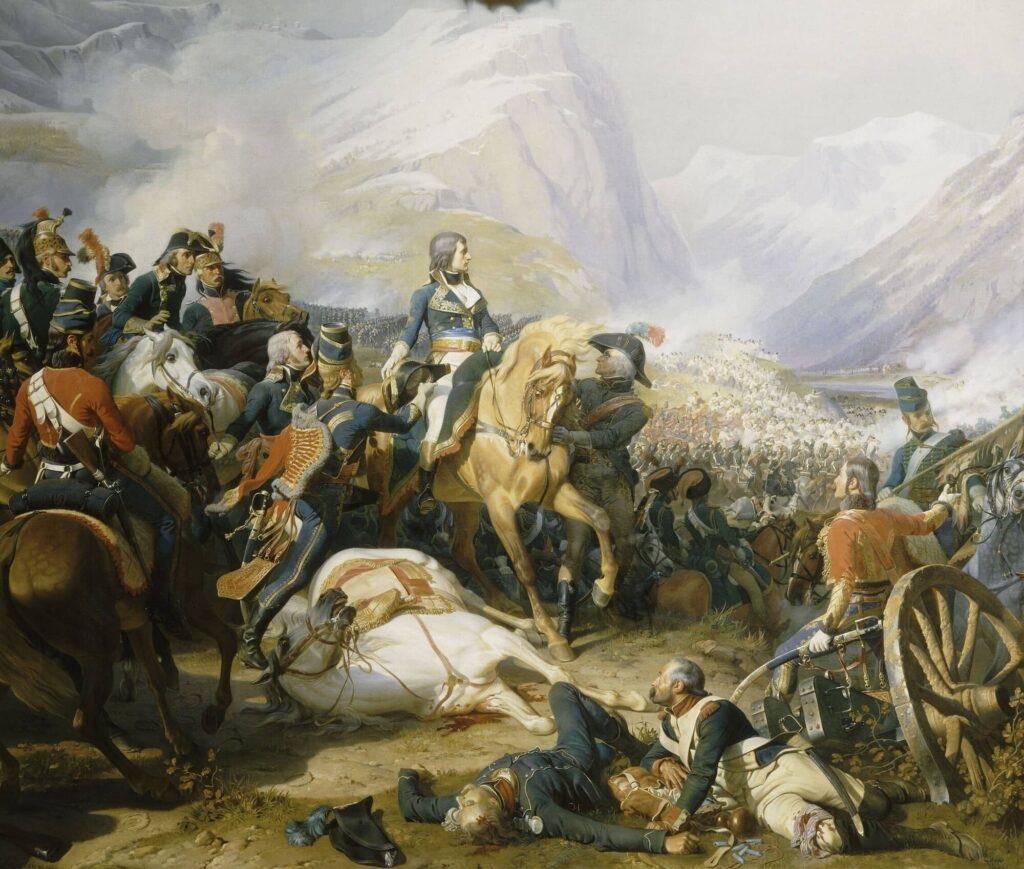
In a dramatic turnaround of his fortunes, Napoleon was then put in charge of military forces that ruthlessly put down major anti-government unrest in Paris known as the 13 Vendémiaire. The Revolutionary Government were impressed by this and put Napoleon in charge of the campaign to invade Italy.
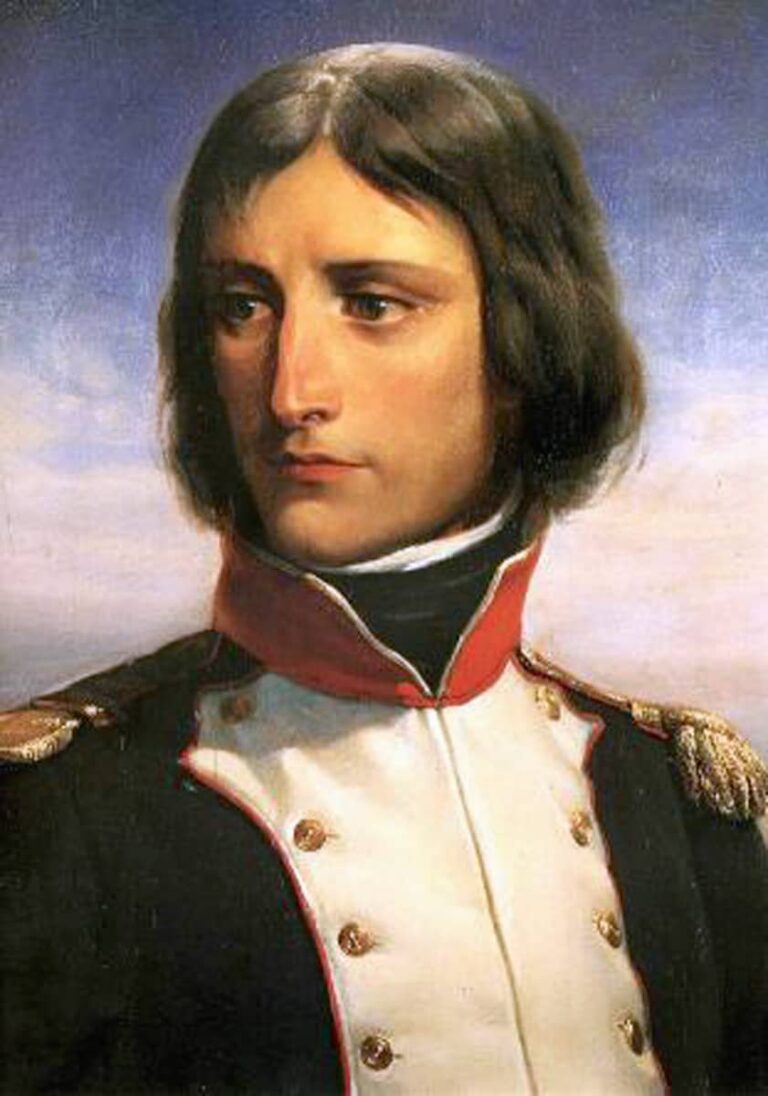
During this time, he showed a completely different more romantic side to his nature. Indeed, portraits of him at the time, show a rather foppish young man. This is at odds with later pictures depicting him as a determined rather belligerent individual. After an unsuccessful liaison with a woman called Desiree Clary, Napoleon wrote a romantic novella thought to be based on this affair.
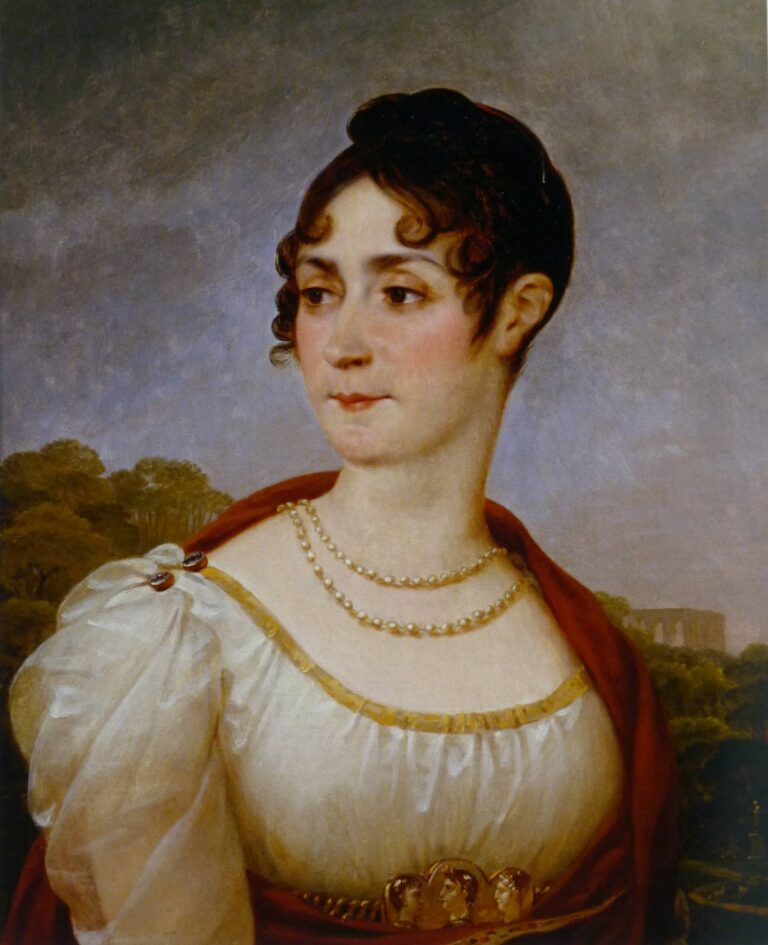
In 1796, he met one of the great loves of his life Joséphine de Beauharnais who became his wife in the Spring of that year. Born in the Caribbean colony of the Antilles, like Napoleon, she felt a bit of an outsider in French metropolitan society. They were married on 9th March 1796 Two days later Napoleon had left to command the French invasion of Italy.
This campaign was a decisive victory for France and Napoleon. They gave the Italians and their Austrian allies a terrible mauling. It also brought the French a vast amount of loot, prisoners and war materiel.
The French Government feared this military success would lead Napoleon making a bid to take over France. With this in mind they sought to keep him away from Paris on further military ventures. Initially, he was given the job of commanding the force earmarked for the invasion of England. However, Napoleon realised this would only lead to disaster as long as the Royal Navy was the strongest in the world.
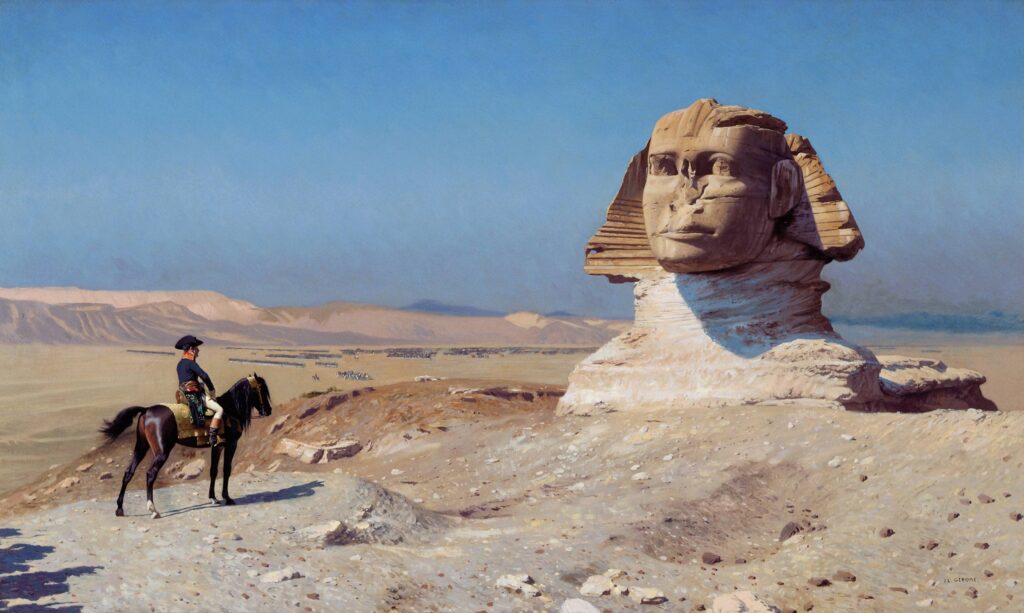
Instead, he took on the Ottoman Empire in Egypt and Syria between the summer of 1798 and the Autumn of 1801. With 220,000 troops and a large British contingent as allies, the Ottomans far outnumbered the French force of 40,000 men. As a result, it is no surprise that they won this particular war. The deciding engagement was The Battle of The Nile in which the Royal Navy commanded by Nelson destroyed the French Fleet. Nevertheless, the Egyptian campaign would provide Napoleon a springboard to power in mainland France.
On his return to France, Napoleon, forever the wily military and political strategist, began plotting a coup that would put him in control of France. With two conspirators, he sprang his trap on the 9th November 1799. Known as The Brumaire Coup he and his fellow conspirators seized power in France. He was nominated First Consul for ten years. This marked the time that Napoleon Bonaparte was at the peak of his power. His position was further strengthened on 18th May 1804 when he crowned himself Emperor with the title Napoleon Ist.
Prior to this, there was a short period of peace in Europe when The Treaty of Amiens was signed between France and England in March 1802. Worn down by almost constant hostilities, mainly with France, Britain badly needed this peace to restore its battered trade with mainland Europe. However, as long as The Great Disturber as Napoleon was dubbed was on the scene, there would be no long-term peace in Europe. So it proved with this ill-fated concord lasting only a year. From 1804 until Napoleon’s final downfall after Waterloo, war would stain the fields of Europe.
Between 1805 and Napoleon’s final downfall in 1815, he commanded French troops in no less than 44 different battles and wars. Of these, two were disputed results at Eylau on 8th February 1807 and Borodino on 7th September 1812 and four were out and out defeats. However, all six of these reverses were footprints on the path to Napoleon’s nemesis and final exile on the far off South Atlantic Island of St Helena.
The battle of Eylau was a bitterly fought engagement between the French Empire and a coalition of Russian and Prussian forces. The French General Ney probably summed up the result best with his comment: “What a massacre! And without result!”. Figures from various sources vary but casualties for belligerents ran into thousands. If anything, this was a painful, pyrrhic victory for the French in which both sides fought themselves to a bloody standstill.
Borodino was probably the most famous battle of the Napoleonic Wars and involved 250,000 troops. Casualties were high on both sides with approximately 42,000 dead and injured French to over 50,000 Russians. Whilst neither side could claim victory, it was the Russians under the command of their wily General Kutuzov who eventually got the better of their French enemy.
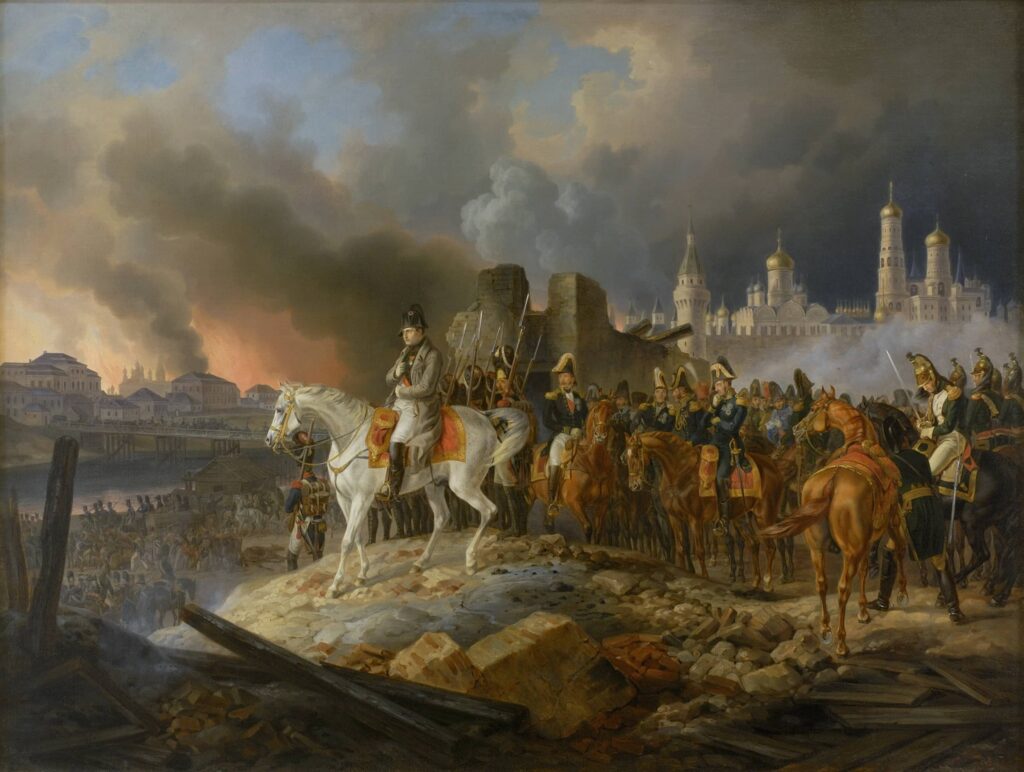
Kutuzov ordered his forces to retreat thus luring the French into the open trap of the city of Moscow. Napoleon occupied the Russian capital only to find if decimated by his opponent’s scorched earth policy. He had expected to be greeted by a delegation and glittering city instead he was confronted by an empty grey ruin. He also waited for the Czar to capitulate, but pleas for surrender from the Russians never came. Napoleon waited too long for this before quitting Moscow on 19th October. This rainy day presaged the cruel winter that would be the nemesis of the French Army.
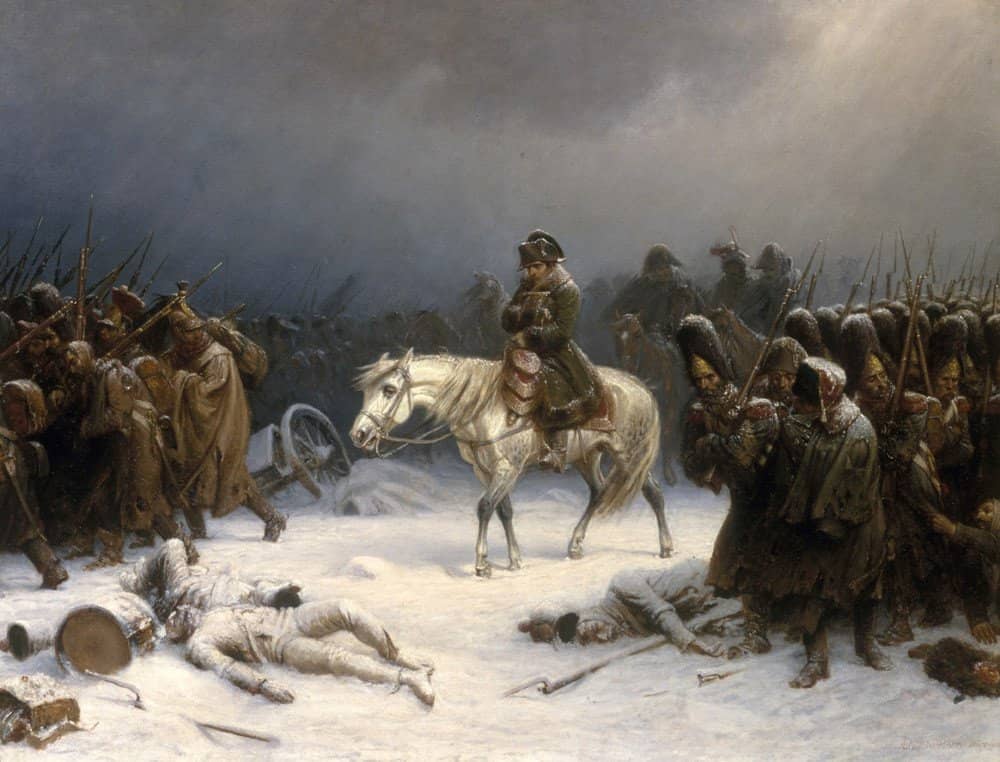
Without enough food for his Grande Armee and the bitter Russian winter forced Napoleon into this terrible retreat. This is what Kutuzov had been waiting for at a safe distance. With fertile lands that had not been destroyed to his back, he had plenty of supplies to keep his army in good shape.
Ravaged by the cold and continually harassed by groups of Russian Cossack guerrilla forces, Napoleon’s once proud Grande Armee disintegrated into a chaotic retreat. Napoleon had commanded an army of over 450,000 men when he invaded Russia in June 1812 but returned to Paris with only 120,000 men six months later. The legend that was Napoleonic invincibility had finally been shattered. The coup de grace came with his defeat at the hands of Wellington on the field of Waterloo on a rainy summer’s day in 1815. Four months later, he was exiled in the middle of the Atlantic.
The fact that the British exiled Napoleon on St Helena, one of their most isolated colonies, showed how worried they were about him escaping. It is an island in the middle of the South Atlantic, the nearest land mass being what is now Namibia 1,165 miles away on the south western coast of Africa.
His home on the island was a large and rather uncomfortable wooden bungalow called Longwood. In spite of the odd rumour of escape, it would be where he ended his days. Napoleon died at the age of 51 on 5th May 1821 of stomach cancer. Because large quantities of arsenic were found in his body there was speculation that he was poisoned. However, arsenic was extensively used in medicines and commodities such as wallpaper at the time. So the medical consensus has always been that it was cancer that killed him just as it had done for his father.
Anyone searching for the true nature and motivation of Napoleon is likely to have a barren time of it. None of the many historians who have written his story can agree on this. On one point they can all agree that Napoleon was a great leader who inspired all that followed him. His British arch rival, the Duke of Wellington believed his presence on the battlefield was “worth 40,000 men.”
He was a highly complex and intelligent man who believed his destiny was also that of France. His failure to accept that he was not always right was a flaw that would lead to his downfall. Two hundred years ago, people also did not think the same way as we do in the twenty-first century about life and death. As such, Napoleon would have regarded the staggeringly high casualties in the many battles and wars he fought to be the natural order of things. In his book, the soldiers who signed up to join Le Grande Armee did so in the knowledge they would most likely end up as a corpse on some battlefield of Russia, Poland or Spain. A violent and painful death was simply a soldier’s lot. If you came home alive, you were very lucky.
In fairness, it should be pointed out that during his reign, Napoleon carried out many good reforms in France. In fact, it could be said that he was the ruler who modernised the country. If only he had stuck to that, there would have been far fewer widows in Europe.
© Nick Brazil 2025
Photos: Wiki
Nick’s books are Available on Amazon
Click above to purchase
Click to see full BMMHS event listing pages.
Contact us at [email protected]
Copyright © 2026 bmmhs.org – All Rights Reserved
Images © Nick Brazil