The LST: ‘the queen of the amphibious warfare ships’
by James Goulty
Amphibious operations were a major facet of the Second World War
For the Allies amphibious operations were a major facet of the Second World War, and planning for them commenced almost as soon as it was appreciated that a return to the Continent would ultimately be necessary if Hitler was to be defeated. One aspect of this was the provision of landing craft to get men, supplies and equipment ashore, together with appropriate training on how to operate them. According to naval historian Brian Lavery, the Royal Navy adopted or developed at least 38 different types of landing craft during the war. Initially attention focused on smaller types, such as the British Landing Craft Assault (LCA) and its American equivalent the Landing Craft Vehicle Personnel (LCVP), better known as the ‘Higgins boat,’ after Andrew Higgins the boss of Higgins Industries in New Orleans, that built over 20,000 of these little war winning machines.
Essential to get your tanks ashore ASAP
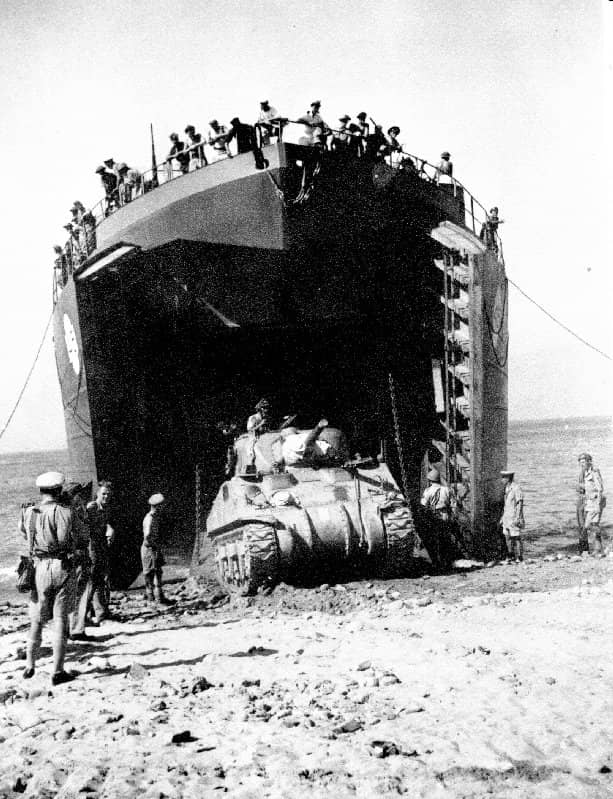
Made from hardwood, and clad with light armoured plating, the LCA was 411/2 feet long, powered by two 65hp engines, and had a crew of four. It had a shallow draught and could deliver 36 fully equipped infantrymen or 800lb of cargo ashore via a bow ramp. Likewise, various models of the larger Landing Craft Tank (LCT) were developed. These were ocean going, and could transport three of the heaviest tanks (40 tons) which entered/exited the long open deck via a bow ramp. Yet, something larger was clearly required if significant amounts of armour and heavy vehicles were to be brought ashore in one lift, an essential prerequisite to any invasion. As George Henderson, a naval veteran of amphibious operations in the Mediterranean and Normandy stated:
‘If you don’t get your tanks in to support, the infantry are struggling because they can’t cope with the armour that can be brought in against them. So it’s essential that you get your tanks ashore ASAP.’
The Landing Ship Tank (LST) offered a solution to the above challenge, and became an essential ingredient in amphibious warfare during 1942-1945. As the name implies, LSTs were classed as ships, the difference between a landing craft and a ship being that ocean going landing vessels over 200 feet were deemed ‘landing ships,’ whereas, anything smaller and not necessarily fully sea worthy were classed as a ‘landing craft.’
Many found it awkward adjusting to walking ashore
To give an idea of the usefulness of the LST, take the example of the British LST 416. After the Normandy landings in June 1944, she made 28 trips from the UK to France until the end of September. From the start of October 1944 until just before VE-Day in May 1945, she completed 17 trips to Ostend and four to Antwerp, bringing in essential supplies etc. Similarly, the American ‘island hopping’ campaign in the Pacific would have been hindered drastically were it not for the humble LST. In his book Invaders: British and American Experience of Seaborne Landings 1939-1945 (Caxton, 2003), Colin Bruce, even describes the LST as: ‘the queen of the amphibious warfare ships.’ While proving significant in enabling amphibious operations to be successfully launched, simultaneously, LSTs were a limiting factor, because their numbers or availability was frequently one of the many thorny issues facing Allied planners.
The LST owed its existence to a British requirement for a large seaworthy vessel capable of transporting tanks and other heavy vehicles on ocean voyages that could successfully land them on beaches around the world. This was a distinct challenge because a shallow draft was required to access beaches, but vessels with such characteristics usually prove notoriously difficult to handle at sea. As George Henderson discovered, his LST ‘rolled prodigiously.’ It could ‘beach in around 4 foot of water, so that showed you how flat bottomed they were. We were like flat bottomed whales. And rolled at the slightest movement, so you felt as if you spat over the side…they would roll.’ Understandably many sailors assigned to LSTs took a while to gain their ‘sea legs.’ Conversely, once they became accustomed to walking against and/or with the role of the upper deck, many found it awkward adjusting to walking ashore.
The ship appears to move in a vertical direction
A related issue was that it was vital for tanks, vehicles and cargo to be secured properly for sea voyages. The experience of the crew of LST 215 wasn’t untypical. They found that in heavy seas the entire forward part of their ship appeared to move in a vertical direction with a gentle ‘waving’ motion, and that ‘ripples’ travelled fore and aft along the upper deck, so that the vehicles transported there seemed to be travelling on an ‘uneven road.’
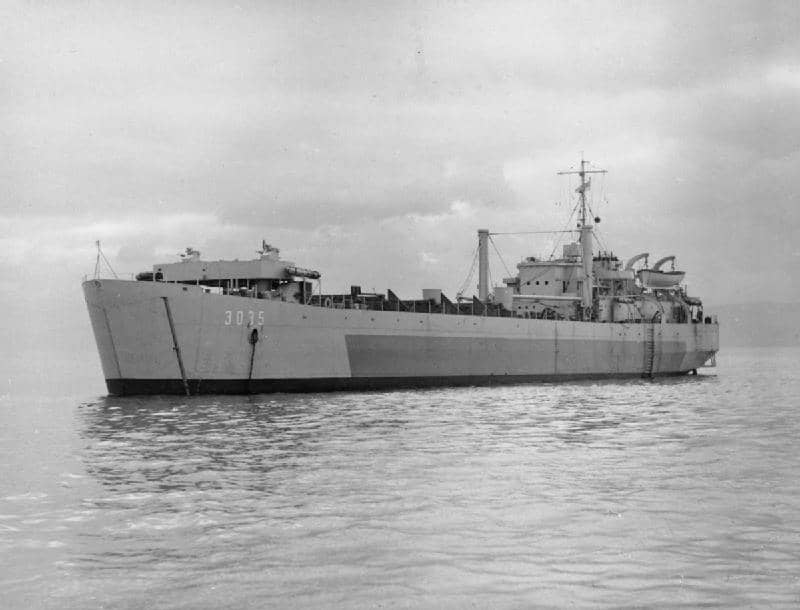
An early experiment witnessed the conversion of three shallow-draft oil tankers used to pass over sand bars on Lake Maracaibo in Venezuela. Although they needed a large articulated bow ramp to cover the distance from ship to shore, their design clearly highlighted the merits of the LST concept. These were deployed successfully during the North African invasion in 1942. Simultaneously, plans were made for three LST(1) to be manufactured by Harland and Wolff: HMS Boxer; Bruizer; and Thruster, although delays meant that these didn’t appear until 1943. With a top speed of 13 knots, the LST(1) could transport 13 (40 ton) or 20 (25 ton) tanks, or 36 trucks plus 193 troops. Again a long, awkward bow ramp was needed to get tanks and vehicles ashore, and the design didn’t lend itself to mass production.
British shipyards could not meet demand
As hard-pressed British shipyards couldn’t meet the demand for the number of LSTs that would likely be required for a successful return to the Continent, the Admiralty took the idea for a new model of LST to the United States, that President Roosevelt had notably championed as ‘the arsenal of democracy.’ Here the details were thrashed out jointly, with the Technical Director of the United States Navy’s Bureau of Ships, John C. Niedermair, having a major hand in proceedings, when he sketched out a design.
Essentially, the new LST had to capable of carrying at least 20 tanks, beaching on a 1-in-50 gradient, have a range of around 10,000 nautical miles, and be able to transport an assembled LCT as deck cargo. In practice they proved even more versatile, and carried a wide variety of loads. One even ferried a captured German mini-submarine on deck from Rotterdam to the UK. Others were converted to specialist roles such as acting as a Fighter Direction Tender (FDT) to help control RAF air assets in Normandy. Another useful task performed by LSTs was evacuating wounded and POWs from the battle area, after they’d delivered their main cargo.
Built in the cornfield shipyards
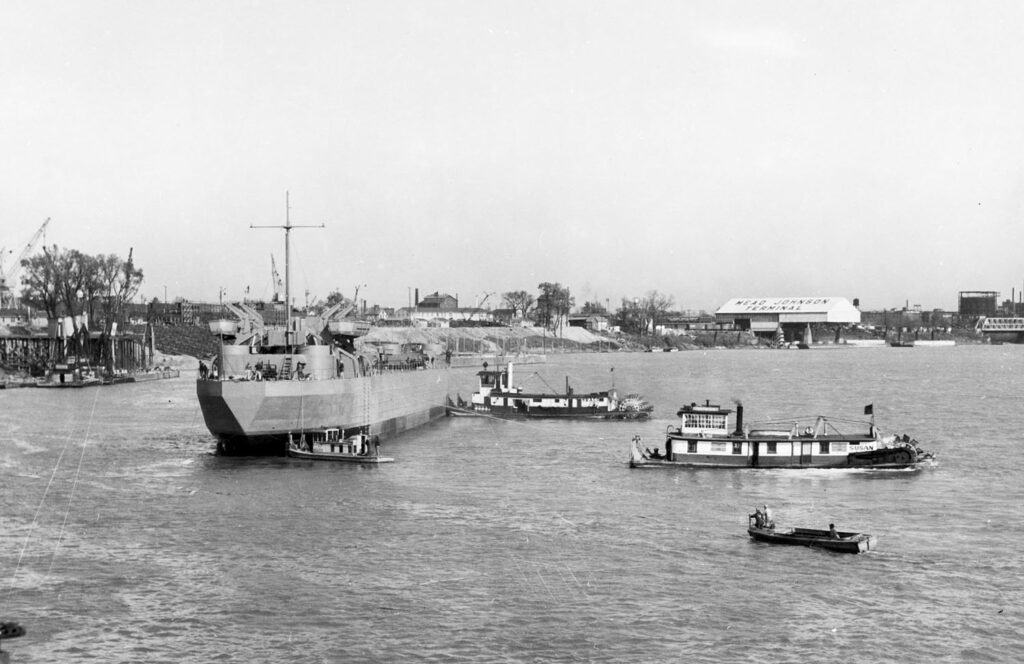
Early in 1942 the new design, known as the LST(2), was put into production, and eventually over 1000 were built. Many of these were constructed by the ‘cornfield shipyards,’ five inland yards on the Ohio and Illinois rivers specially established for LST production, run by companies that had no previous experience of ship building. They were helped by the comparative simplicity of the LST design, and the ability of American industry to apply mass production techniques to producing war material. Completed vessels were sailed down the Mississippi to the Gulf of Mexico, before being readied for active service.
Subsequently, several of these LST(2) were commissioned into the Royal Navy under the Lend-Lease programme. Among both American and British sailors there was a sense that LSTs were ubiquitous and expendable, a characteristic exemplified by the common practice of providing each ship with a designated number rather than a name. As a young volunteer with the Royal Navy, George Henderson, was among a draft posted to America in the spring of 1943 to pick-up a number of LSTs. He was assigned to LST 8, and served aboard her until September 1944. She’d been manufactured by the Dravo Corporation, Pittsburg, Pa, and on 14 May 1943 sailed from New York for the Mediterranean in convoy UGS8A. She took part in Operation Husky, the Allied invasion of Sicily, and major amphibious operations in Italy, including Operation Avalanche at Salerno and Operation Shingle at Anzio, as well as Mediterranean convoys, notably to Malta. Later LST 8 and her experienced crew were transferred to support the Normandy invasion. Subsequently, she underwent a refit in Liverpool, and ended the war assisting operations in Malaya. According to George she was a happy ship and a lucky one, in that during her entire time in the Mediterranean and Normandy she was never hit or seriously damaged.
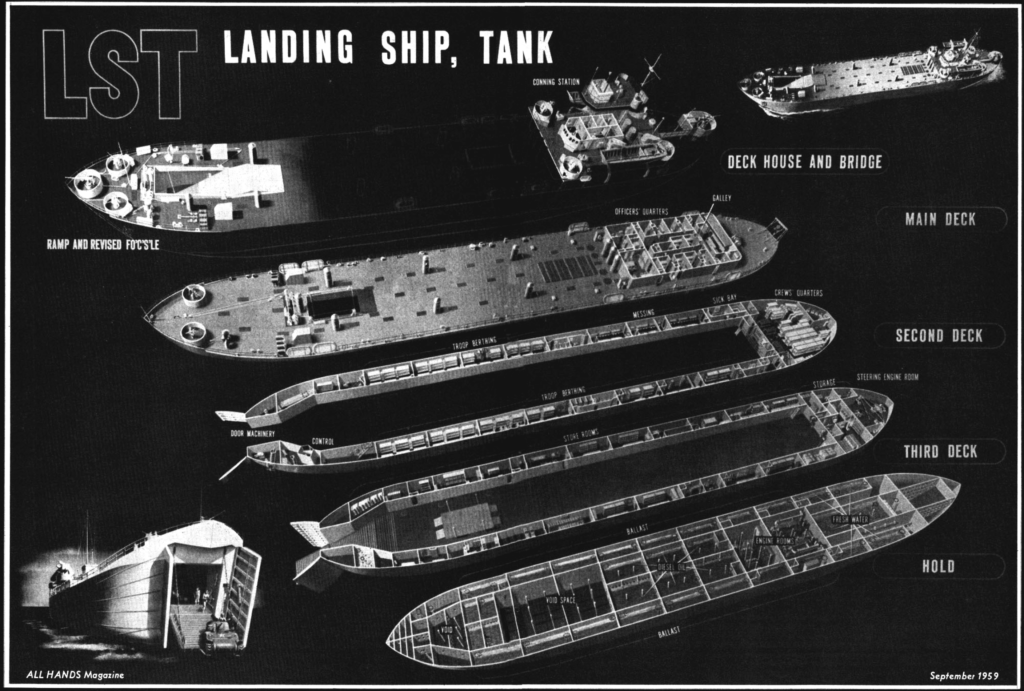
The LST(2) was nearly 328 feet long, with a beam of just over 50 feet, fully ocean going, and had a maximum speed of around 10-11 knots. Hence, for obvious reasons, many servicemen dubbed them ‘Large Slow Targets.’ It was a clever design, effectively a compromise between a cargo ship and a flat bottomed landing craft, with large power- operated bow doors that opened to let down a ramp connected to the tank deck, although in early versions a lift from the upper to lower deck slowed down loading/unloading. They could be sailed right onto an enemy held beach, and remain there via the manipulation of thousands of gallons of ballast that was pumped into forward tanks near the bows. This resulted in huge savings in unloading time, particularly when compared to the alternative of repeatedly transferring cargo from ships offshore into smaller boats or landing craft so as to ferry it to an invasion beach.
No reliance on docks
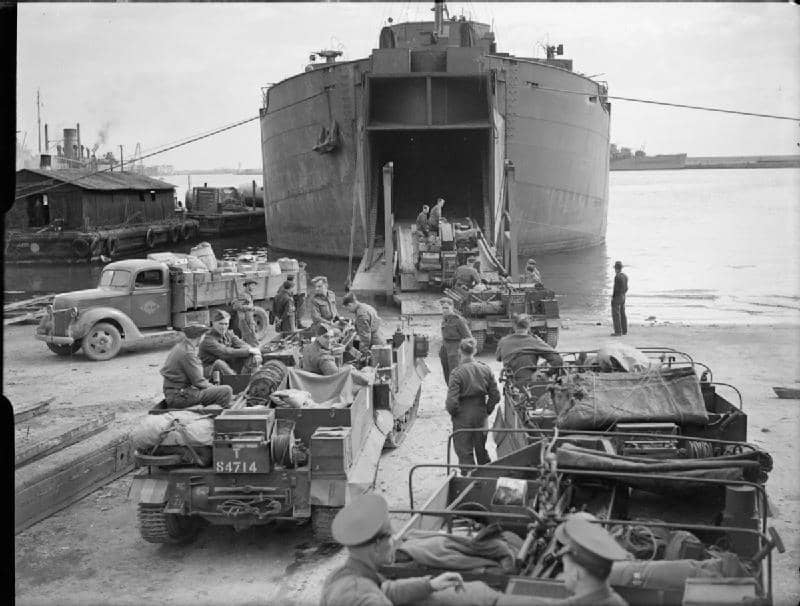
Another advantage was that LSTs weren’t reliant on docks, and so could be readily deployed in assault areas where such facilities were scarce or difficult to use owing to being heavily fortified by the enemy. Later they could be floated off a beach on the next suitable tide to return with more tanks and/or cargo. Alternatively, LSTs could haul themselves back into the sea via a kedge anchor, which had to be dropped astern during a landing. Typically, the ballast control system could be used to ensure a LST was filled so as to be seaworthy, and then pumped out for beaching. Then sea water, fresh water and fuel could be pumped forward to hold a vessel on a beach. When it withdrew the crew of the LST, would pumped out the sea water and send the fuel and fresh water back into storage tanks situated aft.
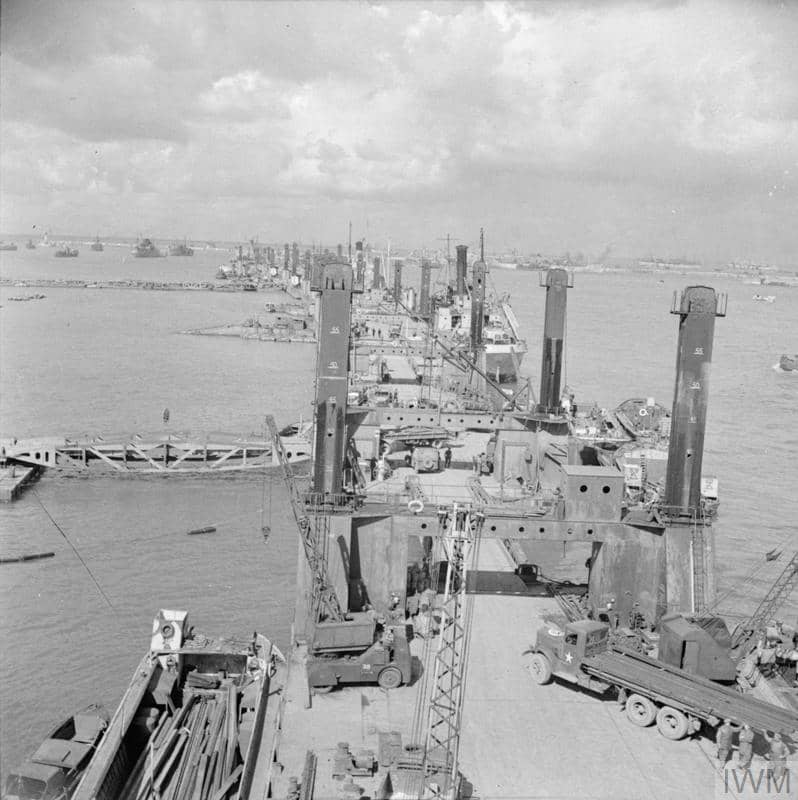
Another method of unloading entailed employing pontoons or what was known as a Rhino ferry, effectively a motorised pontoon that could bridge the gap from ship to shore, and bring in vehicles, supplies and equipment from an LST. Over 70 Rhino ferries were employed during D-Day. Once the Mulberry Harbours were operational in Normandy, it proved possible for LSTs to dock at specially arranged ‘Spud Piers’ formed into LST pier heads. These enabled two LSTs to unload simultaneously, and provision was made to unload their top-decks in conjunction with their main tank decks. Under such conditions a single LST could be completely unloaded in around 18 minutes, an impressive feet.
The conditions they faced
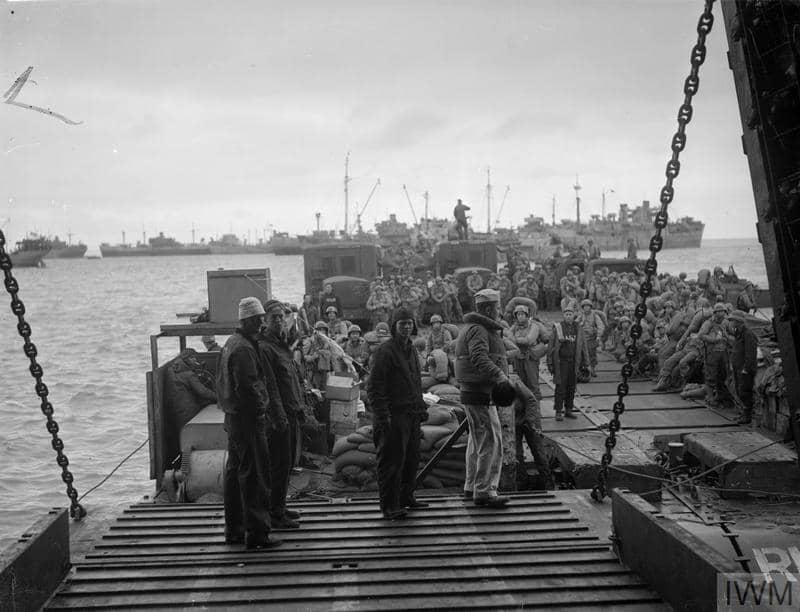
However, as the crew of LST 8 found, there was a stark contrast between operating in a non-tidal area such as the Mediterranean and somewhere tidal such as Normandy. George Henderson vividly recounted the conditions they faced during beaching operations after D-Day:
‘With a non-tidal, it means that you can land on the beach and on your way in the basic idea was to go as hard in as you could go, so you could get as far up on the beach out of the water or into about 3-4 feet, drop your stern anchor which was a kedge hook on the way in, and it would dig into the sand-about 100 yards, a big cable on the stern-and when you were empty you pulled in on your stern anchor, and that pulled the ship along the sand into the deeper water.
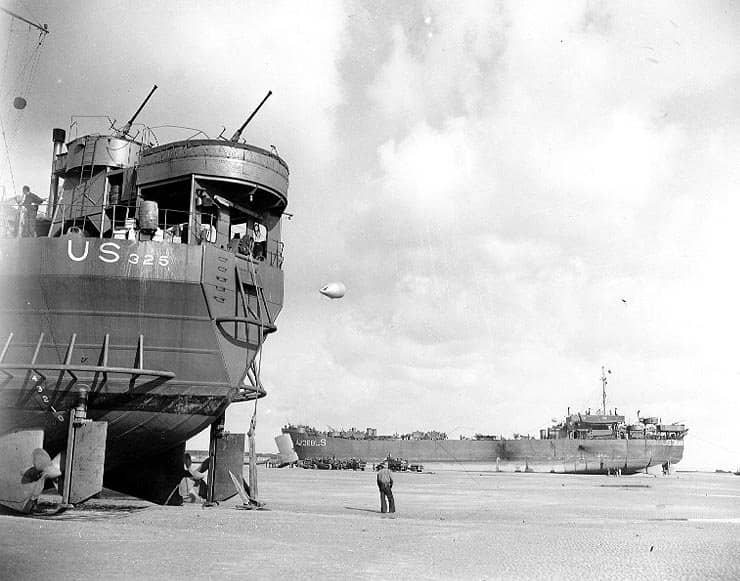
That’s fine in the Mediterranean, but in France it’s tidal so by the time we went on and dropped the tanks and unloaded-because it takes a while to unload [straight onto a beach] as it does to load-and by the time we’d unloaded the tide had gone out, so we were left on the beach about ½mile from the water like whales, stranded whales, you know all the LSTs. The LCTs and that would unload and chug back off but by the time we’d unloaded the heavy stuff, the tanks, the tide had gone, so we were there until the tide came in. That’s not everybody’s cup of tea, it’s a bit nerve wracking because you can’t do anything. You can fire up but you can’t do much else and you can’t help the soldiers. And sometimes we used to carry ammunition. I am talking about hundreds of tons of ammunition and you’re on the beach with hundreds of tons of ammunition, and nowhere to go, that’s when it becomes a bit fraught, but you had to put up with it.’
As the above shows LSTs could provide tempting targets to the enemy, and clearly being involved in any opposed amphibious landing was potentially risky. Although they weren’t designed as fighting ships, British LSTs carried six 20mm anti-aircraft guns for their own protection, and in Normandy were equipped with a barrage balloon to deter low-flying enemy aircraft. They also carried a 12 pounder gun in the stern, a weapon some crewmen dismissed as of limited value, given that landings took place bow first, and so to them it seemed to be facing the wrong way.

Coming under air attack
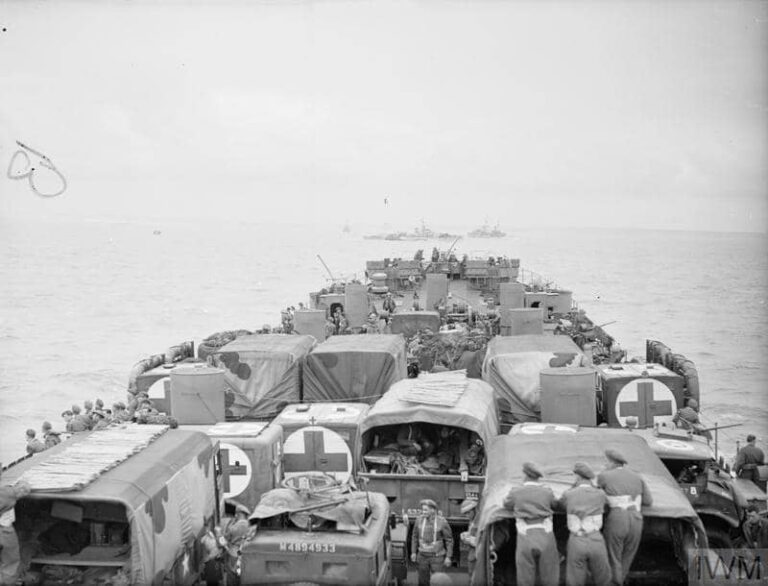
Coming under air attack could be a particularly harrowing experience, and often commenced with a warning message over the ship’s tannoy e.g. ‘enemy aircraft, expect 30 mins from SW.’ The crew of LST 8 became accustomed to air attacks in the Mediterranean, where there wasn’t always sufficient Allied air cover. George Henderson remembered being strapped into an Oerlikon (anti-aircraft gun) which ‘gave you a feeling of security,’ despite having relatively short range. Enemy aircraft would attack from ‘whichever way the sun was…Then you’d see little dots against the sun and they hurtled down, fighter-bombers. Everybody opened up.’
Sometimes friendly aircraft would pursue the enemy and ‘enter the area of fire from the ships’ but ‘the ships never stopped firing.’ Likewise, off Anzio, LST 366 had a close shave when a skilful Luftwaffe pilot launched a glider bomb at it, which exploded on the sea bed nearby leaving the ship with permanent damage to its foredeck.
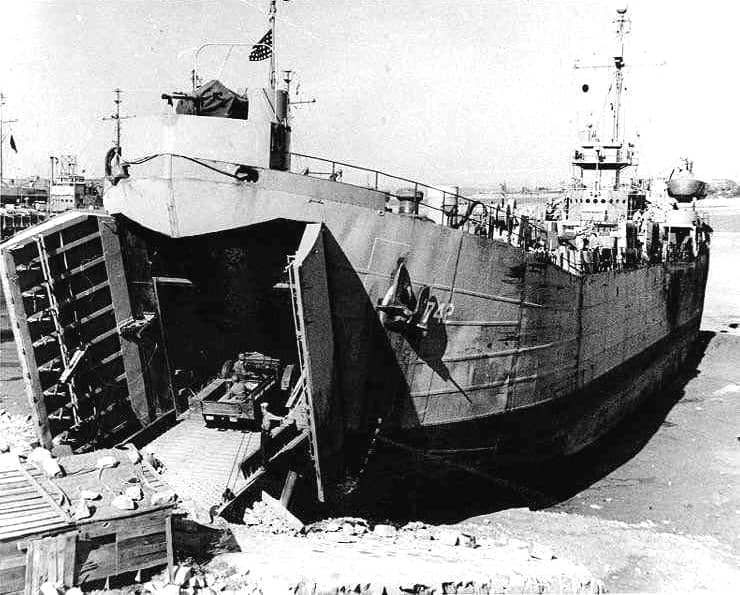
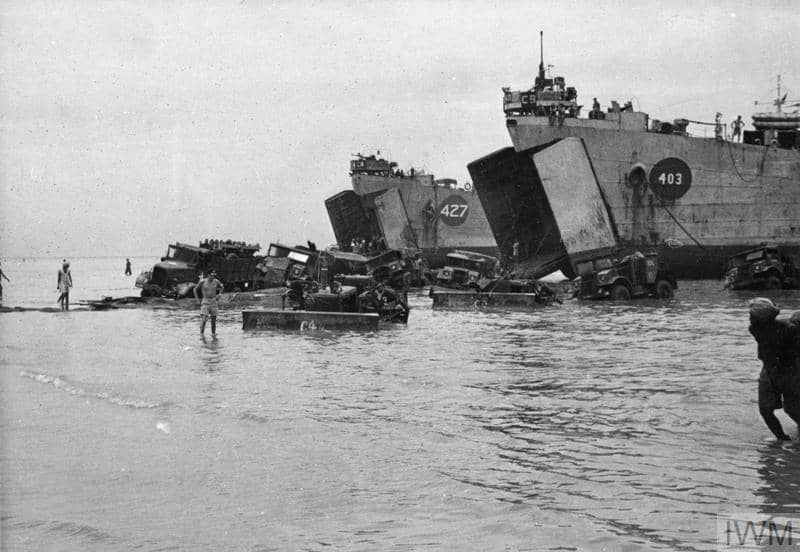
When close to shore, artillery presented another threat to LSTs. At Anzio most crews operated under frequent bombing or shell fire, and routinely heard the terrifying ‘woosh’ of shells passing overhead from ‘Anzio Annie,’ a 280mm railway gun that the Germans employed to bombard the bridgehead. In contrast, while at sea LSTs risked being sunk by mines or torpedoes, and given their important logistical role, the enemy was well aware that they might be worth attacking. Off Normandy, for example, LST 404 was carrying a number of casualties, including ironically several wounded Germans, when she was torpedoed by U 741. Under tow she made it to the Isle of Wight. Not all were so fortunate. Having left Anzio on 16 February 1944, LST 418 was torpedoed by U 230. One of the crew, John Holden, recorded that as she sank there was a hideous metallic sound of trucks breaking loose from their shackles and banging about. Then she ‘reared to a perpendicular position and slid slowly beneath the surface.’ The last he and his crew mates saw ‘was the large red circle painted on the bows with the number 418 in white,’ before she disappeared below the waves, followed by a loud noise of escaping air.
A man’s store of courage ran out under the continual pressure of operations
Often the crews of LSTs comprised a handful of experienced regular sailors together with greater numbers of wartime volunteers or conscripts. There were around 100-120 sailors aboard an LST under the command of a small compliment (8-10) officers. Aboard LST 8 there were even a number of French lads who’d enlisted in the navy. Likewise, British LSTs weren’t confined to only transporting British units, as in the Mediterranean and Normandy plenty of British crews helped ferry Commonwealth and American troops as well. On one occasion in the Mediterranean, LST 366 even transported Goumier tribesmen along with their wives and animals. As one crewman recalled, this was a challenge because they lit camp fires on deck, and answered the call of nature wherever they felt like it. Consequently, it took time to maintain order, and after arriving at Naples the ship had to be hosed down with every available drop of carbolic to clear up the mess.
Given their role, there was an element of monotony to the routine aboard an LST. Watches were divided into port and starboard 4 hours on, 4 hours off, and personnel usually changed round for the ‘Dog Watches’ (4-6 and 6-8). Crewman had to perform duties such as manning guns while at sea, and in port decks had to be cleaned as soldiers being transported were often sea sick, plus ropes renewed etc. Yet, life was frequently punctuated by frantic periods when ‘action stations’ were called. An important attribute for all LST crews to master was being able to control their fear, especially during an air attack or when under fire during an amphibious landing. This wasn’t always possible. Sometimes a man’s store of courage ran out under the continual pressure of operations. At Salerno, where the Allied landings were bitterly opposed by the Germans, a crewman aboard LST 8 tragically broke down and was removed from the ship, never to be seen again.
The Navy's Rum ration was a boon.
Food was basic but often quite good. On LST 8, for example, sailors regularly had access to meat, and like many LSTs she had a full-time cook as part of her company. Another boon was the navy’s Rum ration, which in small ships, including LSTs, was a neat measure, usually taken in an enamel mug. Crew quarters were to the aft and because of the seagoing characteristics of LSTs, life aboard could be uncomfortable, especially in poor weather. As George Henderson explained, ‘bunks would twang and people fall out and then the language would start. So eventually hammocks were issued which were great and very comfortable.’ These were arranged so as to provide every sailor with 18 inches of living space between hammocks, and had to be rolled up correctly each morning or else sailors risked incurring the wrath of their Petty Officer.
Unsurprisingly, crews sought means to improve their conditions when practicable, not least so as to cope with the pressures of active service. For some this included having pets aboard ship. The crew of LST 412 acquired a monkey, named Jacko, who was immensely popular, and would often tease the ship’s dog and jump on him. Unfortunately in the Mediterranean rations aboard became scarce at one stage so that Jacko was reduced to eating onions, and much to the sadness of the crew he eventually died in Taranto.
A vital but unglamorous role
When they first saw LSTs in 1942 and 1943, many British naval personnel were perplexed. One even mistook the prominent ventilation stacks for the tank deck for funnels, and thought that they were to serve on some form of fast moving convoy escort vessel with mighty engines. Such characteristics were the antithesis of the slow moving LST. Yet, most crews came to admire the durability of their LSTs and appreciated their vital, if perhaps unglamorous role, in amphibious warfare, something that had to be developed during the war as these ships hadn’t even existed in 1939.
It was a tribute to the LST(2) idea, that by 1944-1945, some British shipyards were tasked with producing a newer model, the LST(3), although in nothing like as great numbers as those manufactured in America. These could carry 15 (40 ton) or 27 (25 ton) tanks; one LCT or 7 Landing Craft Mechanised (LCM); or 14 3-ton trucks and 168 troops. After the war some LSTs were used commercially as ferries, and inspired the design of ‘roll on roll off’ ferries that became common place. Notably, a wartime survivor, LST 325, was salvaged from Greece by an intrepid group of veterans, and today acts as a floating museum and memorial based in Muskegon, Michigan.
NB If you would like more details about LSTs and their crews please refer to the accompanying bibliography that will hopefully be made available on online. For help with this article, I would like to thank George Henderson (former crewman aboard Royal Navy LST 8) and James Smither, Professor of History and Director of the Veterans History Project at Grand Valley State University.
Bibliography re: The LST: ‘the queen of the amphibious warfare ships’
Books
Bruce, Colin, Invaders: British and American Experience of Seaborne Landings 1939-1945 (Caxton, 2003)
Churchill, Winston, The Second World War Vols. 2, 5, and 6 (Folio Society, 2002)
Falconer, Jonathan, D-Day: ‘Neptune,’ ‘Overlord’ and the Battle of Normandy Operations Manual (Haynes, 2017)
Haswell, Homer, LSTs: The Ships with the Big Mouth: The History and Adventures of LST 698 (Landing Ship Tank) and What Made These Ships So Essential in Island Actions of World War II (1944-45) (Xlibris, 2005)
Lavery, Brian, Churchill’s Navy: The Ships, Men and Organisation 1939-1945 (Conway, 2006)
Lenton, H. T. & Colledge, J. J., Warships of World War II (Ian Allan, 1980)
Macdermott, Brian, Ships Without Names: The Story of the Royal Navy’s Tank Landing Ships of World War Two (Arms and Armour Press, 1992)
Rottman, Gordon L., Landing Ship, Tank (LST) 1942-2002 (Osprey, 2005)
Oral histories
Author’s interviews with George Henderson (former crewman, Royal Navy LST 8), 19/10/15 & 19/11/15
GVSU VHP Interview with Sidney Lenger (former quartermaster, LST 651, Flagship Flotilla 23, USN, Pacific), 2011
Internet Resources
The following can all be found on YouTube:
GVSU VHP Channel: Interview with John Lutz (former USN engineering officer)
GVSU VHP Channel: Interview with David Goldsboro and Sidney Lenger who served together on LST 651, including at Okinawa
LST Story Landing Ships Tanks 8023a https://www.patreon.com/Periscope Film
LST Training Video: USN Film entitled ‘Beaching the LST’
History Channel: Hero Ships-Landing Ships Tanks. (This incorporates several interviews with USN veterans who served on LSTs, plus the story of the salvaging of LST 325)
About The Author - James Goulty
James Goulty holds a masters degree and doctorate in military history from the University of Leeds, and has a particular interest in the training and combat experience of ordinary soldiers during the world wars and Korean War.
He has published numerous articles and written 5 books for Pen and Sword Ltd, including The Second World War through Soldiers’ Eyes: British Army Life 1939-1945; and Eyewitness Korea: The Experience of British and American Soldiers in the Korean War 1950-1953.

Click to see full BMMHS event listing pages.
Contact us at [email protected]
Copyright © 2025 bmmhs.org – All Rights Reserved
Images © James Goulty & IWM