The Rationale behind the Blitz

This is an article kindly provided by Steve Richards

Exactly when the term ‘Blitz’ was coined to describe bombing attacks on British towns and cities is unclear.  It was, however, doubtless during the period of heavy and persistent raids on London in September 1940. It should be said that bombing attacks against British towns and cities (mainly at night) had been occurring for many weeks prior to the Germans shifting their focus onto the capital.

Genesis of the Night Blitz

On the night of 18/19th June, in full moonlight, Heinkel He 111s of Kampfgeschwader 4 attacked a number of areas. The RAF managed to down five of them, a success rate which was not to be repeated for many months. There were only four nights in July when German aircraft did not penetrate inland, though the numbers involved were relatively small. In August, the pace quickened especially as the month progressed. The night of 13/14th saw Kampfgruppe 100 (KGr 100) attack the Spitfire factory at Castle Bromwich and the nearby Dunlop factory. It was the first time that the unit’s X-Verfahren radio beam navigational aid had been employed over Britain. It certainly wouldn’t be the last. This attack on the Spitfire factory and the one on the Birmingham Small Arms (BSA) factory on the 26/27th (combined with another attack on 19/20th November) prompted the move to establish dispersed production sites. This particular aspect of disruption to important war industries was a spin-off success for the Germans.


The Rationale behind the Blitz By Steve Richards
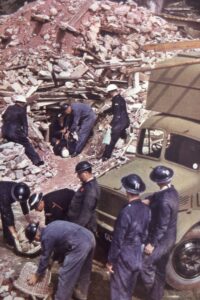
Rescue parties did harrowing work, often while bombs were falling and buildings threatening to collapse. via Peter Kennedy
The Rationale behind the Blitz By Steve Richards
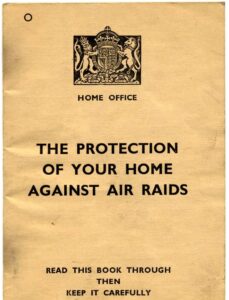
This 1938 booklet would have been essential reading for all householders.
The Rationale behind the Blitz By Steve Richards
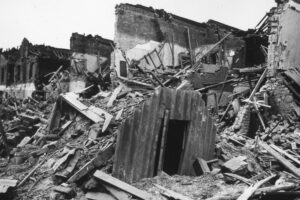
The ubiquitous Anderson shelter. via Peter Kennedy
The Rationale behind the Blitz By Steve Richards
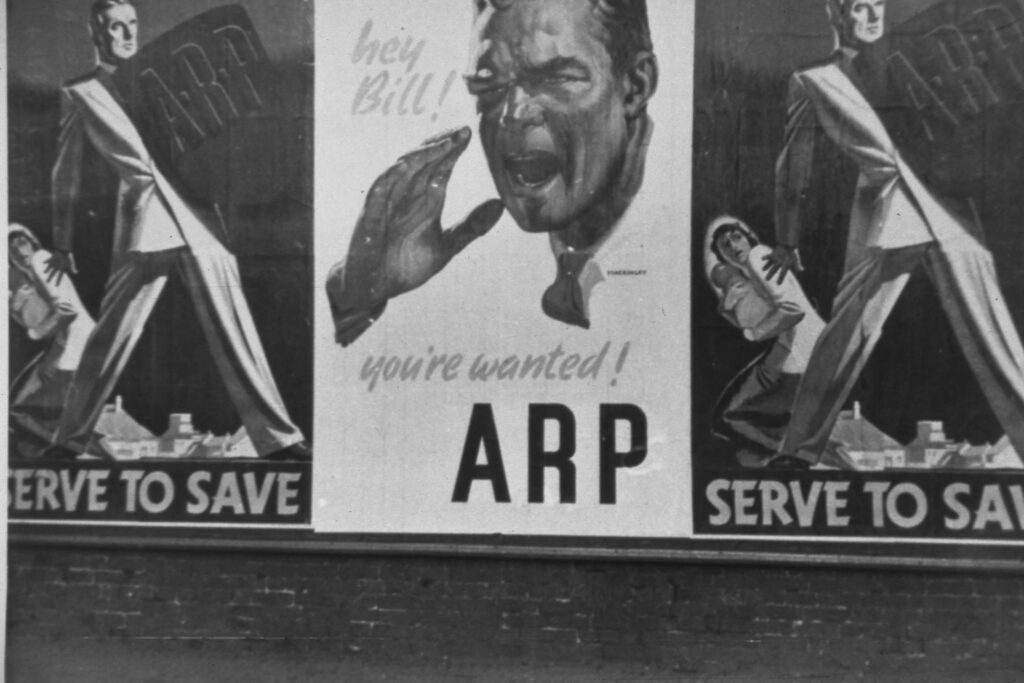
In the late 1930s Air Raid Precaution was a pressing issue. Most people recruited were volunteers.
The Rationale behind the Blitz By Steve Richards
The Anderson shelter, whilst not bombproof, kept many people from serious harm. via Peter Kennedy

Until this point, no urban area had been attacked with a force greater than around 20 bombers but, commencing on the 25th, raids increased in size. For four consecutive nights (August 28th-31st), Merseyside suffered attacks culminating in the heaviest attack to date on the 31st, which involved more than 100 enemy aircraft.

On 15th August, the head of the Luftwaffe, Reichsmarschall Hermann Göring, had stated: ‘Our night attacks are essentially dislocation raids, made so that the enemy defences and population shall be allowed no respite.’

The Rationale behind the Blitz By Steve Richards
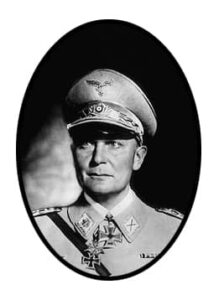
Reichsmarschall Hermann Göring.
The Rationale behind the Blitz By Steve Richards
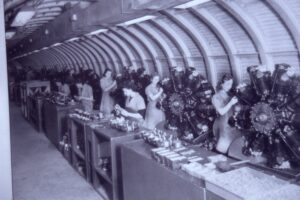
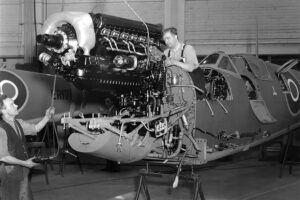
Aero engines being built in an underground factory. via Peter Kennedy

On the 19th, Göring developed his orders saying, ‘…The cloudy conditions likely to prevail over England in the next few days must be exploited for such attacks. We must succeed in seriously disrupting the material supplies of the enemy air force, by the destruction of the relatively small number of aircraft engine and aluminium plants. 

These attacks on the enemy aircraft industry are of particular importance, and should also be carried out by night. Should it however not be possible to locate an industrial target because of poor visibility or bad weather conditions, some other worthwhile target must be attacked. It would appear desirable for the purpose of night operations to allocate to units particular areas which they will come to know better during each successive raid. Within this area a list of target priorities should be drawn up, so that each sortie will produce some valuable result and flights will not be wasted due to the failure of the aircraft to find one particular target. There can no longer be any restriction on the choice of targets. To myself I reserve only the right to order attacks on London and Liverpool.’ 

Between 17th August and 6th September, 471 people were killed as a result of night attacks. By early September, one year since hostilities began, nearly 4,000 civilians had been killed or seriously injured in air attacks. Of the 98 nights covered by the period 1st June to 6th September, 77 had seen Luftwaffe bombers in action over blacked-out Britain.

It is easy to overlook this aspect of the air war, it often being eclipsed by the intense and critical daylight campaign that the Luftwaffe was engaged upon, as it sought to destroy Fighter Command both in the air and on the ground.

As is well known, by early September Fighter Command, and in particular 11 Group, was under great pressure and some respite was sorely needed.

The Rationale behind the Blitz By Steve Richards
On the night of 24/25th August 1940, Heinkel He 111 aircraft of KG 1 (illustrated) inadvertently dropped bombs on London. EN Archive
The Rationale behind the Blitz By Steve Richards
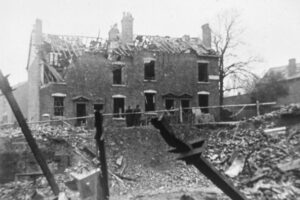
Parachute mines had a large blast effect and were well capable of wiping out a row of houses. via Peter Kennedy
The Rationale behind the Blitz By Steve Richards
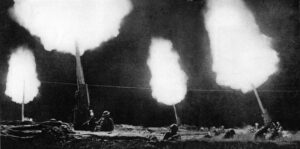
Anti-aircraft guns in action during the night blitz. Author’s collection

Changed emphases

On 7th September the Germans switched tactics. No longer were airfields the target. Instead, a massive day and night offensive against London commenced. Why this shift in policy?

Göring, fed by faulty intelligence (which confirmed what he wanted to hear), believed that RAF Fighter Command was on its knees. All that was needed was a few hammer blows against London – the city was as yet unmolested. These attacks, so went the theory, would force the RAF to expend its last reserves of fighters in order to protect the capital of the British Empire. Once in the air, the Hurricanes and Spitfires could be overwhelmed by superior numbers of Messerschmitts.

The fact was that the switch from attacking airfields brought relief to the hard pressed squadrons of Fighter Command’s 11 Group which had, so far, borne the brunt of the air war over England. There was no such relief for the Luftwaffe. With London as the target, the single-engined Messerschmitt Bf 109 was at the limit of its endurance, restricting the time it could spend in actual combat. Furthermore, the proximity of Fighter Command’s 12 Group, with its squadrons based in the Eastern Counties, meant that they could easily be brought into the battle; a battle which the Luftwaffe had to win if an invasion was to proceed. For the RAF’s part, it was a battle for which a draw was as good as a win.

The Rationale behind the Blitz By Steve Richards
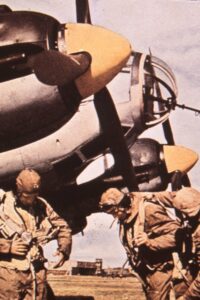
Members of a Heinkel He 111P crew prepare for another mission.
The Rationale behind the Blitz By Steve Richards
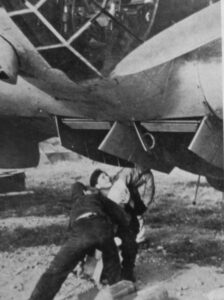
Ground personnel load up a Heinkel He 111H for another mission.
The Rationale behind the Blitz By Steve Richards
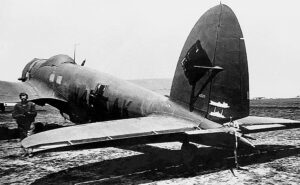
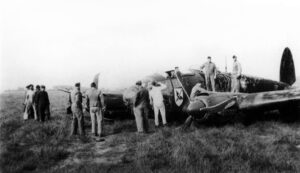
By the start of 1941, the number of German bombers available for missions over Great Britain was much reduced, either through accidents, routine maintenance, lack of serviceability or as a direct result of combat. Here, a Heinkel He 111H-3 (1G+BL ) belonging to 3KG 27 has crashed in France during 1940. EN Archive

Fighter Command held its own and 10 days after the first dreadful day and night assault on London, Hitler postponed indefinitely Operation Sea Lion, the invasion of England.

Once again, there was a shift in German policy. Heavy daylight bombing raids reduced noticeably, while night attacks on London continued and were extended to include other towns and cities throughout the country.

The reasons for the continued bombing campaign against Britain at this juncture, which would see the cessation of daytime operations and the intensifying of night operations, may be summed up as follows:

Firstly, the Luftwaffe simply did not have the resources to continue heavy daylight attacks. Night operations would bring some relief to the Luftwaffe while continuing to bring pressure to bear on Britain.

The Luftwaffe could not sustain the pace of operations in which it had been engaged since May. During August and early September 1940, for the first time, the Luftwaffe met its match when faced with the RAF over southern England. The latter had the advantage of playing at home. British fighter pilots did not have to keep an anxious eye on their fuel gauge, as did the Messerschmitt Bf 109 pilots, who also had to face a sea crossing before they could feel safe. If an RAF pilot baled out and wasn’t too badly injured, he could fight another day but, for a German baling out he would find himself in a prisoner of war camp located in Britain or perhaps Canada. German bomber crews, in particular, felt vulnerable in their lightly armed and relatively slow machines.

Just as tiredness and stress affected the ‘few’ (as Churchill dubbed the young RAF fighter pilots), so Luftwaffe aircrew and fighter pilots were similarly affected. A case of kanalkrankheit afflicted many a bomber crew member. Later, when roles were reversed, RAF Bomber Command would label its own sufferers as LMF (Lack of Moral Fibre).

The Rationale behind the Blitz By Steve Richards
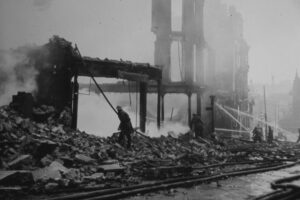
In the renewed attacks of Spring 1941, Birmingham suffered a number of major raids. Firemen are seen here at work on 10th April after the previous night’s major attack; the next night would see another significant assault. via Peter Kennedy
The Rationale behind the Blitz By Steve Richards
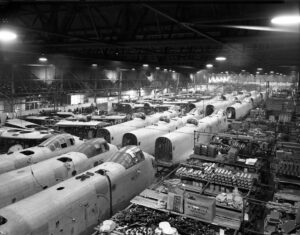
Attacks aimed against the Castle Bromwich Spitfire factory in August 1940 caused the Ministry of Aircraft Production to disperse some aircraft component manufacturing. This slowed production of aircraft for around six months. These Spitfire Vbs were being constructed at Castle Bromwich in the summer of 1942.
The Rationale behind the Blitz By Steve Richards
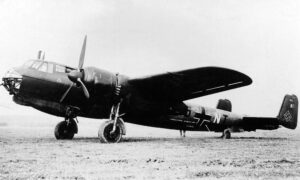
German bombing attacks did hinder British aircraft production. On the afternoon of 15th August 1940, Dornier Do 17s of KG3 bombed the Short’s aircraft factory at Rochester putting back production of the Stirling’s by some months. BMHIT

The second reason for continuing and escalating night bombing was the waging of economic war, defined as the bombing of industrial centres, infrastructure and political buildings. This would adversely affect Britain’s military capability and also drain the people’s will to fight. A quote from German planners is worthy of inclusion at this point, ‘In addition to destruction of industrial targets, it is important to hinder the carrying out of reconstruction works and the resumption of manufacturing, by wiping out the most densely populated workers’ settlements.’ The reference to workers settlements is worthy of note. Whether the German planners made any distinction between the workers themselves and their dwellings is a moot point. However, the emphasis of the 1940-1941 Blitz as a whole was not ‘terror’ or indiscriminate bombing.

Thirdly, there was a spirit of vengeance. On 24th May 1940, Hitler wrote, ‘the Luftwaffe is authorised to attack the English homeland in the fullest manner as soon as sufficient forces are available’; this as a direct response to RAF raids on the Ruhr.

During the summer of 1940, the German civilian population was increasingly wanting to hear of attacks on British towns and cities. They wished for reprisals in response to RAF raids which, since May 1940, had been flown against the North Sea ports and the Ruhr. These raids had been causing disquiet amongst the civilian population, knocking its morale and being aggravated by Göring’s boast that no enemy aircraft would fly over the Reich.

The Germans perceived these RAF bombing attacks to be indiscriminate or ‘terror’ raids. This is understandable because, due to poor aiming, the RAF bombing was so scattered and widespread that it appeared to have no obvious strategic value other than creating fear and tension. In the six months May-November, 975 German civilians would die as a result of British bombing raids. 

Nazi anger and frustration surfaced when the RAF bombed Berlin on the night of 25/26th August 1940. This significant, though largely ineffectual, raid by more than 80 Hampdens, Wellingtons and Whitleys of Bomber Command, was by way of retaliation for bombs dropped on London the previous night, by a small number of Heinkel He 111s from KG1. These German bombers were actually seeking to attack the Short’s aircraft factory at Rochester and the oil refineries at Thames Haven, but had lost their way. They jettisoned their bombs as they made for home. Until this time, both the British and German governments had deliberately targeted only military, industrial and port facilities. Prime Minister Churchill was keen to get the gloves off but did not wish to be the first to do so and thus incur the displeasure of the United States. The small raid on London gave him the excuse for bombing Berlin and other German cities, without being overly concerned if other than industrial targets were hit. The fact of the matter was that the RAF had a hard job navigating its way to specific targets in Germany. The Luftwaffe had an easier time finding their British targets, flying as they did from northern France and using the sophisticated navigational aids at their disposal.

The Rationale behind the Blitz By Steve Richards
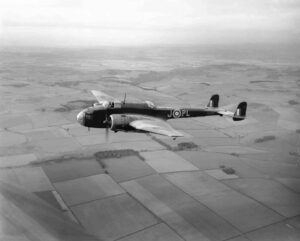
The following night the RAF retaliated by attacking Berlin with 80 aircraft. These Handley Page Hampdens belong to 149 Sqn, one of the participating units. via the author
The Rationale behind the Blitz By Steve Richards
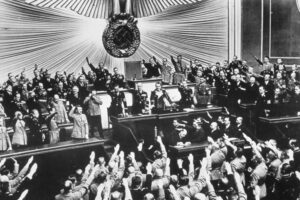
When the 17th anniversary rally of the Munich Putsch was delayed by RAF bombing, Hitler was further provoked to retaliate.

Following the raid on Berlin on the 25/26th and again on the 28/29th, Hitler gave the authorisation for the Luftwaffe to retaliate in strength, saying that it would be a punishment for Churchill’s ‘downright stupidity’. The German leader then delivered a belligerent speech at a rally held in the city’s Sportspalast on 4th September. He shouted, ‘When they declare that they will attack our cities then we will wipe out their cities.’

Another RAF raid which would stoke the fires of Nazi wrath occurred on the evening of 8th November. An attack by Bomber Command on railway yards at Munich was so timed as to disrupt the Nazis’ 17th anniversary rally of the Munich Putsch. The event was delayed; an acute embarrassment for the Nazi party which left Hitler furious. It is widely believed that the severity of the raid on Coventry six nights later was, in part, retaliation for the Nazis’ felt humiliation.

Fourthly, it was hoped that intense and prolonged attacks on England’s capital and lesser raids on other towns and cities, might break civilian morale, forcing the British Government to seek a peace settlement rather than face anarchy. This was not implausible; the disastrous raid on Coventry 14/15th November 1940 brought the population and local authorities near to collapse.

The British Government and its advisers were both surprised and relieved that the enemy did not capitalise on its success by returning to Coventry in force the following night and, perhaps, even a third. If they had, and the treatment was replicated on other industrial cities, then to what extent could the resilience of people belonging to a democratic nation be stretched? At this stage in the war, no one knew.

By the end of 1940, it was clear that Britain’s collapse was not imminent. The emphasis switched from attacking aircraft factories and industrial centres to sea ports and shipping. Of the former, western ports such as Plymouth, Devonport, Avonmouth, Bristol, Cardiff, Swansea, Manchester, Birkenhead, Liverpool and Glasgow were targeted. As for shipping, some bomber units now concentrated on hitting ships at sea and mine-laying in coastal waters. The Luftwaffe was aiding the U-boat fleet with the intention of denying Britain its vital imports of essential goods and war materiel.

Although Britain’s night defences had made little impact upon the Luftwaffe bomber force, availability of aircraft for bombing operations as at 4th January 1941 was down to 551 machines, a mere 41% of Luftflotten 2 and 3’s (the two air fleets based in Northern France and the Low Countries) bomber strength. Accidents, overhauls and repairs were the reason for this low figure and reflected the pace of operations.

In March, with the worst of the winter weather behind them, the Luftwaffe renewed its night Blitz across Britain. Seaports continued to be the main objective but industrial towns and cities were not overlooked. During the spring of 1941 more major attacks were carried out on places such as London, Sheffield and Birmingham.

What was the thinking behind these raids of spring 1941? By this stage it was obvious that the night bombing was not going to force the British government to seek a peace settlement, because the nation was determined to press on with the war. Although the notion of tit-for-tat reprisals continued to be used for propaganda purposes, this was not the reason for the renewed vigour of Luftwaffe attacks. Hitler’s mind was concentrated on more weighty matters than the vengefulness he had expressed in early September 1940.

The waging of economic war by bombing continued to make sense. Hitting centres of industry, ports and associated residential areas would hinder Britain’s ability to strike any meaningful blows at Germany which might endanger Hitler’s grand plans elsewhere, i.e. Russia.

Hoped-for distraction?

In early April Hitler called together all of the Luftwaffe commanders in France. In a two-hour long meeting he informed them that the second phase of the Battle of Britain was to commence. This would be an intensification of the night bombing. In attendance was General Adolf Galland who, after the war, when speaking of the spring attacks of 1941 said, ‘Later he [Hitler] told two of us, my friend Mölders and myself, that these had only been to camouflage the offensive against Russia.’

The raids were to be a major feint, diverting the world’s attention from Hitler’s preparations for the forthcoming attack on the Soviet Union. Thanks to the work of the code-breakers at Bletchley Park, the British government was fully aware of these preparations and was keeping the Soviet leader, Josef Stalin, informed. The latter chose to disregard the warnings. If Hitler had been aware that his secret intentions were compromised, would the air raids of spring 1941 have been less intense? Quite possibly.

Most German bomber units transferred from north-west Europe in order to participate in Operation Barbarossa, the invasion of the Soviet Union. Consequently, the attacks against Britain reduced drastically after major raids on London (night of 10/11th May) and Birmingham (night of 16/17th).

The Luftwaffe had failed to defeat the RAF, to deny Britain its port facilities and to force the civilian population into submission. Referring to the last of these, the cost in civilian lives had been very high. During the period September 1940 to May 1941, 41,480 people were killed, the peak month being September when 6,968 were lost.

Hitler’s retaliation – 1

In order to give his bomber crews both experience and a taste of success, the head of Bomber Command, Arthur Harris, dispatched 234 aircraft to bomb the lightly-defended Baltic port of Lübeck on the night of 28/29thMarch 1942. The beautiful town, being mediaeval in origin, was of historic and cultural significance but of limited strategic value – some U-boat manufacturing was done there. When the fires were finally extinguished something like 80% of the old town had been lost.

Hitler seethed with anger and ordered immediate retaliatory attacks to be made against British towns and cities noted for their architecture, historic and cultural appeal, and even health resorts. These attacks were dubbed the Baedeker Raids, being a reference to the Baedeker tourist publications.  Others call them the ‘Cathedral Raids’. 

In May, Cologne was bombed by 1,000 RAF aircraft increasing German resolve to strike back. British towns and cities which were bombed, often on numerous occasions, during the period April-June 1942 included Exeter, Bath, Norwich, York, Canterbury and Weston-super-Mare.

A notable departure from these attacks came on the night of 24/25th June when Nuneaton was bombed by as many as 35 aircraft. The intended target was most likely Birmingham (or possibly Coventry) and indeed for three nights at the end of July Birmingham suffered heavy attacks.

The Rationale behind the Blitz By Steve Richards
The Dornier Do 217E was a superior aircraft to the earlier Do 17. KG2 operated Do 217Es in the Baedeker raids of 1942. From this unit is U5+NT. ww2.com
The Rationale behind the Blitz By Steve Richards
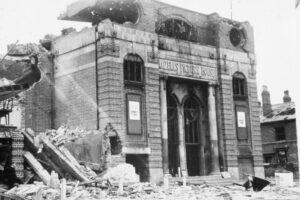
At the close of the Baedeker raids, Birmingham was subjected to a series of significant attacks. In the early hours of 28th July1942, the Lozelles Picture House was prevented from continuing its showing of the 1941 film ‘Honky Tonk’, which starred Clark Gable and Larna Turner. via Peter Kennedy

Hitler’s retaliation – 2

The ‘Baby Blitz’, also known as the Steinbock (Capricorn) raids, took place between January and May 1944. This campaign of night bombing was another intervention by Hitler meant to avenge the suffering being afflicted by the Allied Combined Bomber Offensive of the RAF/USAAF on German industrial towns and cities, especially Hamburg and Berlin. Göring took a similar position, saying that all the German people wished to hear when a hospital or a children’s home in Germany was destroyed is that German bombers had destroyed the same in England. This approach was in direct opposition to senior military planners, who had thrashed out a strategy for air  defence and increased fighter production for the coming year of 1944. Hitler insisted on offence and amassing a bomber force, even at the expense of Luftwaffe units in Italy. Planning started in late November 1943 and attacks began in early January. The force of about 500 aircraft was varied, ranging from single-engined fighter-bombers through to the four-engined Heinkel He 177.

Reflecting the retaliatory nature of Steinbock, various areas of London were given codenames of German cities which had suffered particularly badly from Allied bombing e.g. Berlin, Hamburg and Hannover.

Operation Steinbock paralleled, in part, the RAF’s own campaign against Berlin November 1943-March 1944 and was useful as propaganda and consolation for domestic consumption. The attacks accomplished little of  military value for the Germans although more than 1,500 British civilians were killed. The cost to the German bomber units, however, was great, numbering around 330 aircraft and most of their aircrew. These losses deprived the Germans of valuable assets that might have otherwise been available to counter allied forces in Normandy. Operation Steinbock was the last assault on Britain using conventional aircraft.

Vengeance Weapons

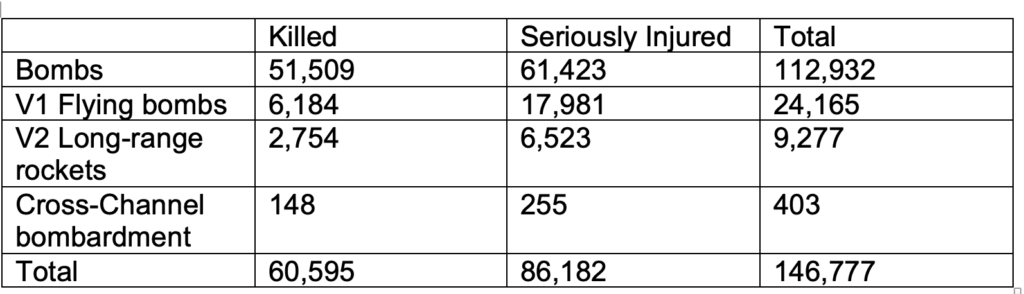
The final bombing campaign against Britain was carried out using the V1 cruise missile and the V2 ballistic missile. Following the failure of the Baedeker Raids to deter the Allies from continuing their round-the-clock air-attacks on Germany, the development of V-weapons was accelerated during 1942.

The nature of these weapons was unashamedly vengeance, the designation ‘V’ referring to Vergeltungswaffen: ‘retaliatory weapons’, ‘reprisal weapons’, or ‘vengeance weapons’. The majority of these missiles were directed at London. It was impossible for the Germans to control just where they detonated and so their use was utterly indiscriminate.

On 29th September 1943, Albert Speer publicly promised retribution against the mass bombing of German cities by use of a secret weapon.

The first V1 flying bomb exploded in England on 13th June 1944, when just four penetrated inland. By the second half of the month, around 100 were being propelled towards London each day and casualties began to mount up. By late August, 1.5 million people had left London, and the rate of work production was adversely affected.

The Rationale behind the Blitz By Steve Richards
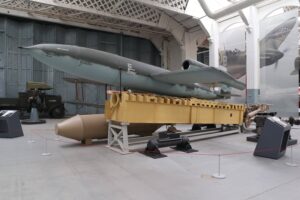
The infamous ‘Doodlebug’ V1 as displayed at IWM Duxford. Julie Richards
The Rationale behind the Blitz By Steve Richards
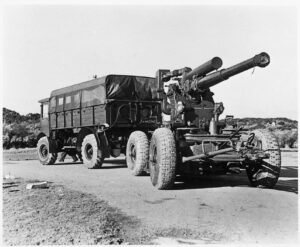
Once the V1 flying bomb assault got underway, mobile 3.7 inch heavy anti-aircraft guns were rushed down to the south coast where, with their gun-laying radar, they had notable success. Warehouse Collection

At the point when air and ground defences had turned the tide against the V1 the first of the V2 rockets exploded on 8th September. The following month rocket launches got into their stride. Once the missile was airborne there was no defensive means to prevent it following its set course. Detecting and over-running the continental, mobile launch sites was the only answer for the Allies.

On 25th November 1944, a V2 exploded at the Woolworth’s store in New Cross Road, killing 168 people and seriously injuring 121.  Yet, psychologically these weapons had a less fearsome effect on the nerves than did the V1. The latter could be seen and heard and produced anxiety as a sudden cut in the engine noise indicated that the bomb was dropping. The V2 was never heard and unlikely to be seen, the sudden explosion quite literally came from out of the blue.

The last V2 rockets struck on 27th March 1945, one of which killed 134 people and injured 49 when it hit a block of flats in Stepney. The last V1 exploded on British soil two days later.

The V-missiles had caused a large number of casualties. So many residential properties were destroyed or damaged that a housing crisis around London and South East England ensued.

The Rationale behind the Blitz By Steve Richards
Casualties during the Blitz

Civilian cost

One inadequacy of numbers is that they are a cold and soulless mechanism when it comes to understanding the effect that bombing had on actual individual lives. Josef Stalin may have been speaking cynically when he said something like ‘The death of one person is a tragedy; the death of one million people is a statistic’, but we know that, unfortunately, there is some truth in those words. It is impossible to measure the pain and sorrow, the physical and mental suffering and the short and long-term psychological effects which bombing had upon each person at the receiving end.

Chief of bomber command, Arthur Harris, said of the Germans, ‘They have sown the wind, now they will reap the whirlwind’. This was horribly fulfilled. It is estimated that the greater German Reich lost 652,000 people to Allied bombing.

The Final Judgement

To what extent did the night Blitz on Britain jeopardise the nation’s ability to stay in the fight?

It can be safely said that the German bombing of British towns and cities (even London) was nowhere near as devastating as pre-war analysts had feared. It was assumed that bombing would create panic and a migration of millions of people to the countryside. Food, water supply and sanitation would be severely impacted. It was said that the loser in any modern European conflict would be the one whose population cracked first.

When the bombing did get underway, families experiencing the immediate effect would have gained cold-comfort from the fact that things were not as widespread and intense as predicted. For all of those in positions of responsibility, who were required to limit the effects of bombing attacks, there must have been a degree of relief that the Armageddon-like predictions were not realised.

German bombing did not come near to seriously disrupting war production, although, to quote the official history of the RAF 1939-45,  The air attacks of 1940 did adversely affect the nation’s aircraft industry: ‘British aircraft production had been seriously impaired, both by direct damage and enforced dispersal of plant: not until February 1941 did output again approach the level of the previous August.’

In late 1940 neutral observers from America and Sweden reckoned that Britain’s overall production was only being adversely affected to the tune of a few percentage points. Food and fuel stocks, gas production and electricity generation were never seriously compromised. During the five months in 1941, when German attacks focused on sea ports, only 70,000 tonnes of food stocks were completely destroyed and a mere half of one percent of fuel stocks.

At this stage neither the Germans nor the British realised the shortcomings of bombing factories and what a poor return the effort yielded.

Commander in Chief of fighter command, Sholto Douglas, commented on the failure of the Luftwaffe’s bombing campaign saying, ‘…that the Blitz did fail to achieve any strategic purpose is clear enough. In eight months of intensive night raiding the German bomber force did not succeed in breaking the spirit of the British people or preventing the expansion of our means of production.’

In February 1942, Arthur Harris took over RAF Bomber Command, confident that he could guarantee a different outcome for his bomber force which, with four-engined aircraft then entering service, was better suited for a strategic mission. Nevertheless, such confidence was shown to be suspect. By way of example, in 1944, despite the massive bombing attacks on German targets by the British and Americans, more fighter aircraft than ever were being manufactured for the Luftwaffe. Post-war analysis claimed that only 1% of war production was affected for every 15,000 tons of bombs dropped on German industrial targets.

Of course, the German Air Force had not been established with a strategic bombing campaign in mind and so lacked heavy bomber aircraft. Such aircraft would have been required in substantial numbers to form a credible, strategic bombing arm. In March 1954, Field Marshall Kesselring stated that forming a strategic bomber force without utterly compromising the Luftwaffe’s support of ground forces would not have been possible. He said, ‘one of the lessons of the Second World war was the number of aircraft and quantity of munitions it takes to dislocate the economy of a nation’.

Even if Germany had possessed such a strategic bomber force, hindsight strongly indicates that bombing alone for the purpose of critically damaging a nation’s industry and economy, with conventional bombs, was unlikely to produce the desired knockout blow. Furthermore, bombing in order to cause the collapse of civilian morale simply did not work. Needless to say, the use of atomic weapons would have been a different story…

© Steve Richards

Click to see full BMMHS event listing pages.

Contact us at [email protected]

Copyright © 2026 bmmhs.org – All Rights Reserved

Images © IWM & NAM