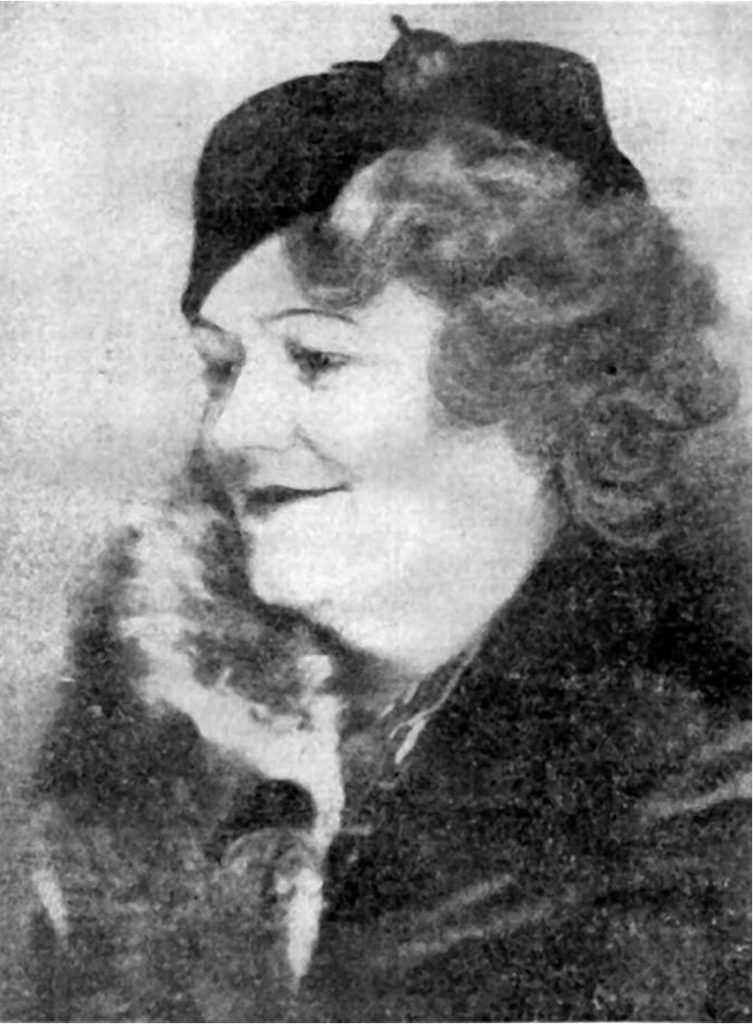
The story is historically important because the secret information which British intelligence acquired, by intercepting the German secret agent’s correspondence, led to a major spy scandal in America which ultimately helped bring the
United States into the war.
Research published this month reveals, for the first time, how
MI5 unmasked the Nazi agent.
The bizarre story began in 1937 when German intelligence blackmailed a Hamburg-based Scottish hairdresser, Jessie Jordan, into spying for Germany’s foreign military Secret Service, the Abwehr.
Back in 1912 she had married a German waiter by the name of Fritz Jordan. In 1914 the couple had a daughter called Marga who became a German actress and opera singer.
Now new research has revealed for the first time how she started sending the Abwehr information in June 1937. Using previously unseen documents from Scottish and other archives, British historian and University of Edinburgh professor Emeritus Rhodri Jeffreys-Jones tracked down that first message – and how it was intercepted. The details are featured in a book, Ring of Spies, by Jeffreys-Jones, published this month by the Gloucestershire-based UK publishers, The History Press.
Posted from a letterbox in Talgarth in south Wales, Jordan’s first report supplied German intelligence with detailed information about British military dispositions in Aldershot, the British army’s transport and logistics headquarters. It was that first report that first alerted MI5 to her spying activities.
Mr Jeffreys-Jones’ research shows that, by mid December 1937, MI5 had obtained an additional Home Office Royal Mail interception warrant to allow them to open and read all Jordan’s incoming mail, not just letters she was sending to PO Box 629.
It was this additional surveillance that, in January 1938, led to a spectacular discovery which ultimately was to have huge geopolitical consequences.
One of the letters, bound for Jordan and intercepted by MI5, was from a Nazi operative in New York (codenamed ‘Agent Crown’), outlining a plan to steal secret US coastal defence papers by kidnapping and probably murdering a senior US military official called Colonel Henry Eglin.
Eleven weeks later, Jordan was arrested – but opted to cooperate fully with the police. As a result, she was only given a four-year prison sentence and as part of the deal, she helped make sure that the Germans never found out that PO Box 629 had been compromised.
Released at the end of the war, she was deported to Germany – and died there in 1954 at the age of 67.
She had enjoyed a brief period of fame and notoriety in 1938 and 1939 – and indeed in spring 1939, just four months before the Second World War broke out, a few non-classified aspects of her story featured in a Warner Brothers film about the 1938 US spy trial and the FBI investigation.
But much of the hairdresser spy’s real story has only emerged this month. Mr Jeffreys-Jones’ research not only reveals previously unknown aspects of her case – but also sheds fascinating new light on German military intelligence operations and the often extraordinarily and sometimes surprisingly careless way in which they were carried out. Significantly, that aspect of his research is likely to have substantial implications for how historians understand other Abwehr operations – and how the organisation’s often poor performance frequently disadvantaged the German war effort.
“Pre-war mid-to-late 1930s and Second World War German military intelligence was at least partly staffed by unsuitable officers foisted on the service by the Nazi authorities for ideological and sometimes nepotistic reasons,” said Mr Jeffreys-Jones.
“The spies these officers then recruited were often unsuitable, eccentric and appointed without adequate security checks,” he added.
What’s more, adequate training was often not provided, even when it could have been (when Jordan was recruited in Hamburg, she was only given a few days training. Indeed to try to gain additional insights into her new profession, she was reduced to borrowing pulp fiction spy thrillers from Dundee public library).
Above all, the new research demonstrates the naive way in which Abwehr agents were instructed to communicate with their handlers.
“Allowing multiple agents in multiple countries to use the same ‘secret’ PO boxes was a deeply flawed strategy which predictably and inevitably made entire spy networks vulnerable to even isolated security breaches,” said Mr Jeffreys-Jones.