The Waffen-SS Soldier and the Second World War
by James Goulty
Varying degrees of military competence and combat effectiveness
Ultimately the Waffen-SS embraced a wide variety of troops of varying degrees of military competence and combat effectiveness. On the one hand there were the crack panzer divisions, such as 1st SS Panzer Division (Leibstandarte) and 2nd SS Panzer Division (Das Reich), with which many readers are probably familiar, and have received significant attention from writers/historians. Notably, 12th SS Panzer Division (Hitlerjugend), the infamous ‘HJ,’ was raised from fanatical teenage Nazis recruited from the Hitler Youth, led by combat hardened officers and NCOs, and often appears in British language sources. Largely this is due to the ferocious reputation it earned in Normandy fighting against the British and Canadians, suffering huge casualties in the process, plus its well-publicised involvement in killing prisoners on the battlefield.
On the other hand there were numerous other units with rather less distinguished fighting records, notably those recruited from Eastern Europeans. One of these: 13th Waffen-Gebrigs-Division der SS ‘Handschar’ (kroatische Nr. 1) was raised from volunteers and later conscripts among the Bosnian Muslim population, who as part of their uniform wore a sinister looking fez emblazoned with the Death’s Head insignia of the SS. As traditional enemies of Christian Serbs, who formed the bulk of Tito’s partisans, these Bosnian Muslim troops were deployed on anti-partisan operations in the Balkans. The Division suffered from disciplinary problems, committed numerous atrocities, and by late 1944 experienced wide spread desertions in the face of the advancing Soviet Army, leading to its disbandment.
Notoriety of some units
Even more notorious was: 36th Waffen-Grenadier-Division der SS, commanded by Dr.Oskar Dirlewanger, a decorated First World War veteran and drunken sadist who’d been convicted of sex crimes against children during the inter-war period. Originating as a Totenkopf penal unit in Poland in 1941, its strength was gradually increased until it constituted divisional status. It served as a security unit in Russia, and was originally recruited from personnel from Oranienburg concentration camp convicted of poaching, although on the Eastern Front casualties were replaced by Soviet turncoats and criminals. It rapidly earned a reputation for committing appalling crimes. Indeed during the Warsaw Uprising, its conduct was so barbaric, that even Army and SS commanders demanded its withdrawal. This didn’t stop Dirlewanger receiving the Knight’s Cross, and he was eventually thought to have died mysteriously in detention in June 1945, the rest of his command having been massacred by the Red Army near Berlin.
Likewise, 29th Waffen-Grenadier-Division der SS (russische Nr. 1), popularly dubbed the ‘Kaminski Brigade,’ after its commander Bratislav Kaminski, was comprised of thugs and renegades from the Ukraine who’d fought with the RONA (Russkaya Osvoboditelnaya Narodnaya Armiya, or Russian National Army of Liberation). It was initially deployed on anti-partisan activities in the rear area of Army Group Centre on the Eastern Front, which enabled it to commit countless atrocities, thus ensuring the unit’s loyalty. During the Warsaw Uprising its behaviour was again so despicable, that even SS commanders wanted it withdrawn. In one day alone (5 August 1944) it’s believed that the unit murdered 10,000 Polish civilians. Kaminski was later shot (possibly by the Gestapo), and his so called ‘division’ disbanded, some personnel possibly transferring to 30th Waffen-Grenadier-Division der SS, which was composed from Russians and other Eastern Europeans.
The Britisches Freikorps
Disturbingly from a British perspective, was the Britisches Freikorps, albeit it only had 58 volunteers accepted from British and Commonwealth POWs. Some of these men held genuine fascist beliefs others were simply looking for adventure and a way out of the POW system. Although it saw no action, a handful of British SS troops are believed to have fought with another unit during the battle of Berlin, and as a propaganda tool the Britisches Freikorps clearly had value. Similarly, Infanterie-Regiment 950 (Indische) was established in August 1942 from Indian soldiers with anti-British sympathies who were captured in North Africa, and deployed on garrison duty on the Continent. It was transferred to the Waffen-SS two years later, and ordered from Southern France to Germany as the Allies broke out of Normandy, and during this movement was attacked by both regular French troops and Resistance fighters. Subsequently, it spent a long period in German training facilities, before trying unsuccessfully to reach Switzerland, and the survivors surrendered to American and French troops in March 1945.
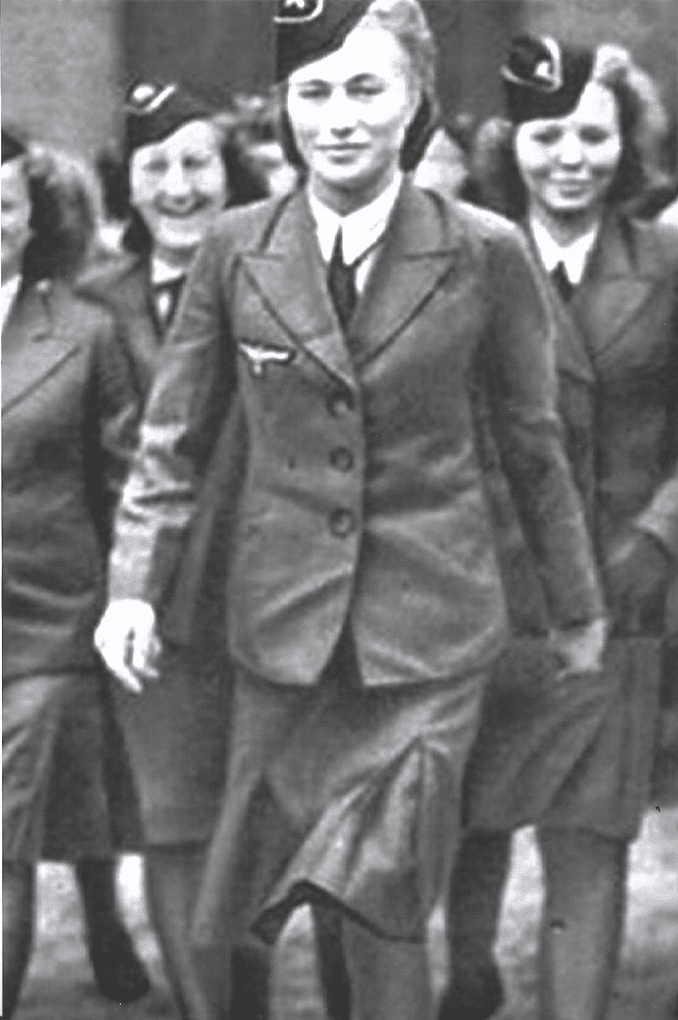
Women also supported the Waffen-SS. About 400 Norwegian nurses, for example, who’d volunteered for military service were integrated into the German Red Cross, and provided medical support as part of the Norwegian Waffen-SS Legion on the Eastern Front during 1941-1943. Twenty were recorded as missing or killed. Other Norwegian women volunteered as Kvinnehird or welfare assistants, who undertook a role akin to social workers to assist clinical staff with the non-medical requirements of convalescent patients. They sported a striking green uniform jacket and skirt, with a yellow blouse and black tie, and Nazi insignia, plus a distinctive badge in yellow and red based on the St. Olaf’s Cross.
Hitler's personal protection squad
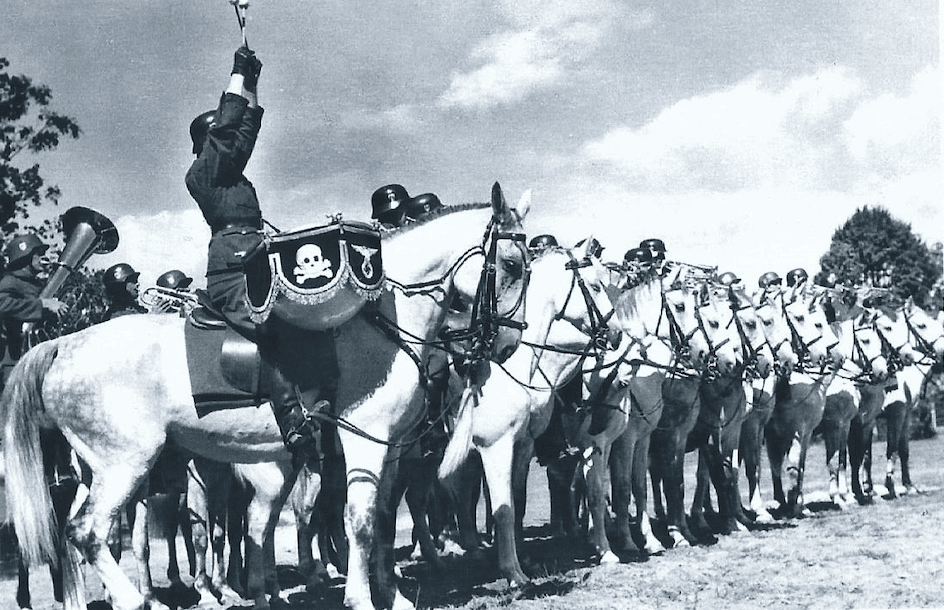
The SS originated in the 1920s as a personal protection squad or Schutzstaffel for Adolf Hitler (hence the term SS). Initially a small force but by the time of Hitler’s rise to power, there were over 50,000 members, who mainly comprised the Allegemeine or general SS, and effectively formed a military wing of the Nazi party. Membership was based on strict racial and ideological criteria. From 1935, when conscription was re-introduced in Germany, the fighting (Waffen) side developed, as SS Verfügungstruppen were established as genuine combat troops, while the elite Leibstandarte Adolf Hitler(the Führer’s personal body guard) was eventually expanded to form four regiments intended to serve under army command in wartime. Simultaneously, the SS Totenkopfverbände (SS Death’s Head troops) were employed specifically ‘to clear up special tasks of a police nature,’ which as the distinguished military historian John Keegan has emphasised, was a ‘grisly euphemism’ for guarding concentration camps and mounting political actions in occupied countries. Like the Leibstandarte Adolf Hitler, this unit was expanded during the late 1930s, and ultimately formed the basis of the 3rd SS Panzer Division (Totenkopf) that saw significant action in the West during 1940 and on the Eastern Front during 1941-1945.
Totenkopf and Verfügungs personnel were deployed during the Polish campaign in 1939, generally performing well in limited combat roles, albeit poorly equipped when compared with the German Army. Army commanders were also critical of the Totenkopf and Verfügungs because they considered them prone to taking disproportionately high casualties, a factor they ascribed to poor leadership. Even so, spring 1940 witnessed the formal formation of what became known as the Waffen-SS.
The relationship between the Waffen-SS and the SS
It’s important to observe that the relationship between the Waffen-SS and rest of the SS organisation was complex and porous, and it remained so throughout the war. Apologists for it, and Waffen-SS veterans (particularly at officer level), have attempted to maintain that it was simply a fighting formation, and as such separate from other aspects of the Nazi regime. This is simply untrue. Personnel were sometimes transferred around the SS organisation, including from guarding concentration camps to the Waffen-SS, plus the Waffen-SS was deployed to support numerous brutal SS policing operations behind the lines in occupied territories. Equally, the Waffen-SS could never escape its political origins. Unlike the German Army with its lengthy history of service, the Waffen-SS was a part of a modern institution forged on the tenets of National Socialism. As late as 1943, the preface to an SS panzer training manual even stated: ‘The SS fulfils a requirement to provide an unflinching force at the disposal of the leadership of the Reich in any situation. This includes the maintenance of order at home by the use of any and all methods.’
Competition with the German Army, and the demands of the war, particularly on the Eastern Front, led to a serious manpower shortage in the Waffen-SS. To overcome this challenge, new units were raised during 1941-1945, and recruits were sought from across Nazi occupied territories in Europe and even further afield. The numbers involved from outside Germany weren’t insignificant. As the academic historian H. W. Koch informs us, by ‘January 1945 of 40 Waffen-SS divisions, 27 consisted primarily of nationalities other than German.’ Most sources seem agreed that the figures for Western Europeans serving in the Waffen-SS, were as follows:
- 50,000 Dutchmen
- 22,000 Flemings
- 20,000 Walloons
- 20,000 Frenchmen
- 6,000 Norwegians
- 6,000 Danes
- 800 Swiss
- 300 Swedes
- 280 Others
The motivation for foreign volunteers
Thousands more recruits came from Southern and Eastern Europe. This included not only Bosnian Croats and Ukrainians as shown, but other non-Germans such as Latvians, Estonians, Russians, Albanians, Italians, and even Turko-Tartars and Azerbaijanis. Additionally, there were those deemed by the Nazis as volksdeutsche or ethnic Germans, particularly from areas such as Alsace and Lorraine, the unhappy borderland between France and Germany, and Bulgaria, Romania and Hungary. Indeed by 1944 around a quarter of Waffen-SS soldiers or 150,000 men were volksdeutsche. Some volunteered, including the teenage Elimar Schnieder from Alsace and Lorraine, who in 1944 ended up with ‘Das Reich’s’ reconnaissance battalion, and saw action in Normandy. He’d felt compelled to volunteer as his mother was an ardent Nazi, and he already had a brother in the Waffen-SS. Contrastingly, Gustav Guschtie, another youthful Alsatian, was impressed into the Waffen-SS as an alternative to serving a jail sentence.
Motivations for joining the Waffen-SS varied among foreign volunteers. Some men were swayed by the idea of adventure and performing military service, even for the power that had occupied their country. Others held genuine fascist beliefs, perhaps even being a member of one of the European fascist parties that were allowed to continue operating by the Nazis. One of the most influential of these was the Nationaal Socialistische Beweging or NSB led by Anton Mussert in the Netherlands (Holland). Yet, according to H.W. Koch, and perhaps surprisingly, only around one third of serving European volunteers in the Waffen-SS were members of Nazi or fascist type organisations in their homelands.
Service on the Eastern Front
One unit of foreign volunteers, that achieved an impressive reputation as a combat force, was SS-Freiwilligen-Panzer-Grenadier Division ‘Nederland.’ As the name implies it comprised Dutch volunteers, and the term ‘Freiwilligen’ (literally meaning volunteer) was specially adopted by the Waffen-SS. This tied in with Nazi views on race. For example, under the picture of an Aryan looking helmeted Waffen-SS soldier, a recruiting poster for Flemings proclaimed: ‘Peoples of similar blood, are called to be good comrades in the common fight.’ Notably, the first non-German to receive the Knight’s Cross for bravery, was the Dutchman Gerardis Mooyman, after he’d destroyed 17 Russian/Soviet T-34 tanks with his anti-tank gun. Another 25 non-Germans received this, the highest of bravery awards, and doubtless countless other acts of courage were performed, that didn’t necessarily receive such widespread recognition or adulation.
Whether they comprised Reichsdeutsch (native Germans), volksdeutsche or foreigners, many Waffen-SS units served in some capacity on the Eastern Front during 1941-1945. Here the better ones gained a reputation as effective fighters, typically acting as a fire brigade bolstering the line in awkward situations, which ensured the organisation curried favour with Hitler. Nazi propaganda also readily portrayed the Eastern Front as a crusade against the evils of Bolshevism/Communism. This might have pandered to many men’s views or at least helped to manipulate them, regardless of whether or not they were a committed Nazi.
5th SS Panzer Division (Wiking)
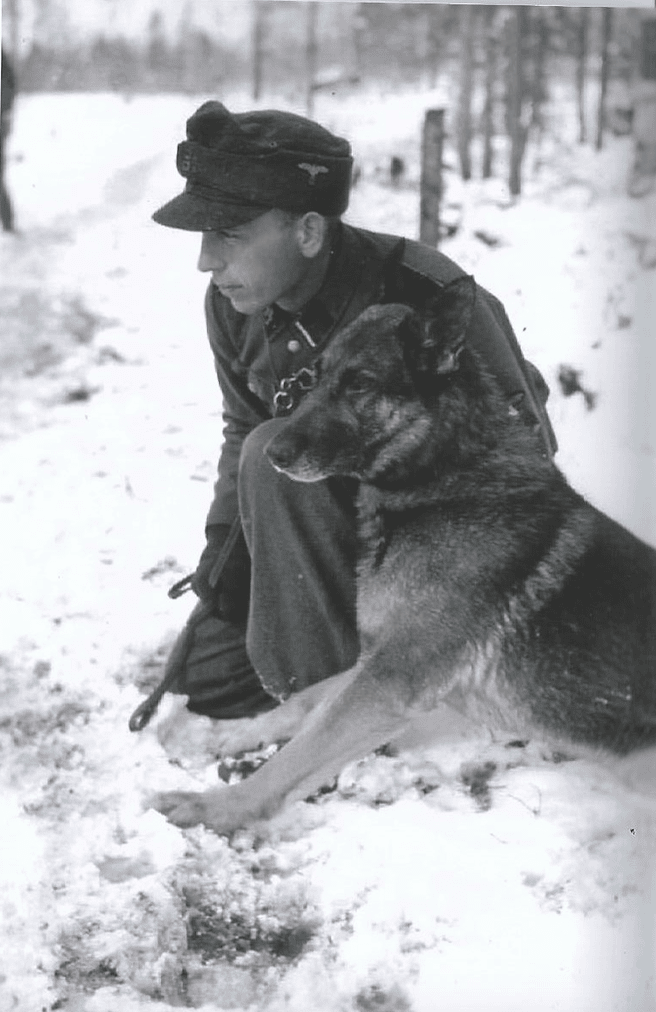
The 5th SS Panzer Division (Wiking), comprised Dutch, Fleming and Scandinavian personnel, and forged a fearsome reputation on the Eastern Front, where Soviet units were reputedly always relieved when it was pulled out of the line. However, there were challenges in deploying such a ‘multi-national force,’ notably the language barrier, and integrating so many different nationalities into an effective fighting force. A note made by OKW (Oberkommando der Wehrmacht) after one operation by the ‘Wiking’ had failed, stated this wasn’t through any lack of bravery or fighting spirit, but because ‘so many officers had been killed that there were no longer sufficient with command of the necessary languages.’
Likewise, in an order from January 1942, Felix Steiner, the Waffen-SS General responsible for establishing the ‘Wiking’ Division, with its Nordic volunteers, stressed, that it needed careful handling and good leadership was paramount. Part of it read: ‘In view of the diverse origins of the replacement troops a spirit of comradeship can grow only slowly, and mistakes made in the process can have more serious consequences than among Reichs-German troops. The most important precondition for a humane leadership is the incessant and continuous care of the superior for his subordinates. He must see that his subordinates place their fullest confidence in him in the knowledge that he is their best comrade.’
An intense sense of comradeship
Unlike many German soldiers, who if they surrendered would become POWs, many foreign volunteers in the Waffen-SS, probably also realised that they risked being tried and possibly shot as a collaborator in their native land, and this might have stiffened their resolve to fight on regardless of the deteriorating situation at the battlefront.
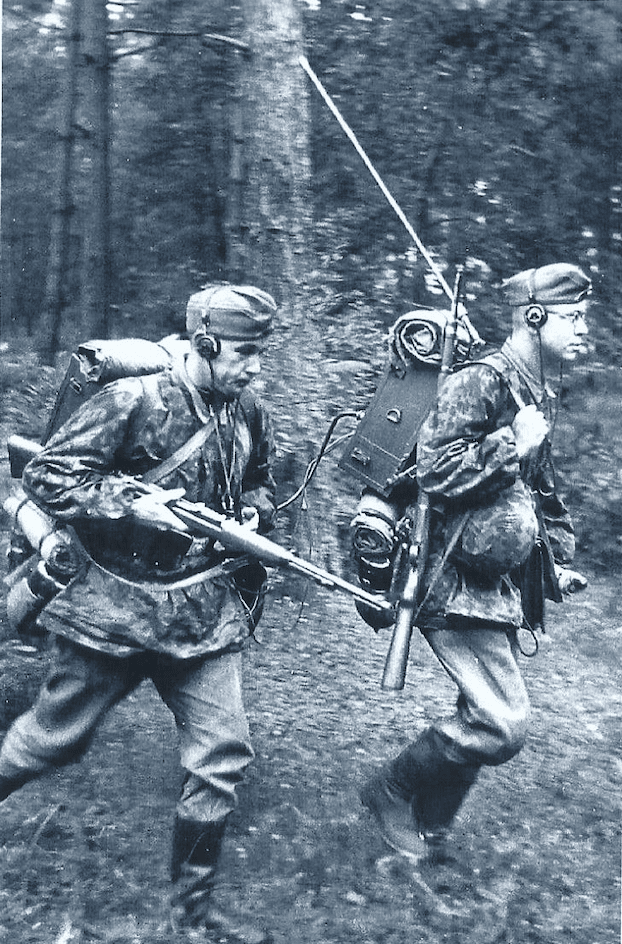
Other features that bound the better quality Waffen-SS units together were high morale, a practical approach to discipline, coupled with an intense sense of comradeship, both at officer level and in the ranks. As an artillery captain in spring 1944, the Reverend Karl Ossenkop, was temporarily seconded from the Wehrmacht to III (Germanischen) SS Panzer Corps, and commented: ‘The particular impression I received-after I had got to know during the course of the war a great many divisions and corps-was an excellent spirit of comradeship. In contrast to army units, differences in rank did not constitute boundaries between one man and another. There were no pedantic forms which had anxiously to be maintained. This did not lead to disorderly ways, but to a voluntary discipline of a kind which I have seldom experienced. There was no force, let alone terror…Nor have I ever known a unit in which members criticised as freely and openly the government and the party.’
A sense of chivalry
As Max Hastings outlined in his book Das Reich (first published in the 1980s), men from lower middle-class and working class backgrounds stood more chance of obtaining officer rank in the Waffen-SS, than they did in the army, and many did so. Additionally, there was a strong sense of chivalry that permeated the Waffen-SS officer corps. Officers from ‘Das Reich’ for example, behaved extremely courteously towards the French families that billeted them during the war, albeit in a highly Germanic manner. Indeed their officer’s gentlemanly code of conduct was so intense, that a member of the unit, who’d transgressed with a woman in Russia, was ordered to go to his quarters and shoot himself, which he promptly did. Similarly, when British airborne troops were captured by elements of the 9th SS Panzer Division (Hohenstaufen) at Arnhem, they were surprised and relieved to be treated honourably, rather than be shot out of hand, because these Waffen-SS troops respected them as fellow combatants who’d fought hard.
Training was tough, realistic and potentially dangerous, particularly for troops from the elite Waffen-SS formations. Rather than an intense focus on drill (with the exception of the Leibstandarte which had a ceremonial as well as military function), there tended to be much emphasis on weapon handling and tough exercises with live fire to accustom men to the realities of the battlefield. This could, and did result in casualties, but it also produced troops characterised by personal hardiness who were ready to sacrifice themselves in combat if necessary. Coupled with this was the influence of charismatic leaders, such as the notorious ‘Panzermeyer’ who led 12th SS HJ in Normandy, and did much to foster the above characteristics. Like other German units, the Waffen-SS, was also adept at deploying Kampfgruppen or battle groups, whereby units were split-up into smaller fighting bodies, and leadership frequently devolved down to NCOs, who had a significant role in maintaining a high level of fighting spirit amongst the men.
Some units had a sense of adaptability
Equally, like their non-German counterparts, German Waffen-SS troops were capable of acts of extreme bravery. Emil Dürr from Mülacker served as an SS Unterscharführer (Corporal) with 26th SS Panzergrenadier Regiment (12th SS HJ), and was awarded the Knight’s Cross posthumously for his actions near Caen, Normandy, on 27 June 1944. Although seriously wounded, he succeeded in knocking out a Canadian flame-throwing tank that had been pinning down his men, and lost his life in the process.
The higher quality units also demonstrated adaptability, a very useful characteristic on active service. Take the example of a Spiess (senior company NCO responsible for supply) with ‘Das Reich,’ in Normandy, who was well aware that the men were fed-up with their monotonous rations. Consequently, he hid near a burnt out vehicle, and waited for an Allied fighter-bomber to mistake it for a target. When this happened he shot a nearby cow. Blaming this on the Allied air forces, he bought the carcass from the French farmer, who was delighted to have the money, while his soldiers were equally pleased that fresh meat was back on the menu.
Equipment varies
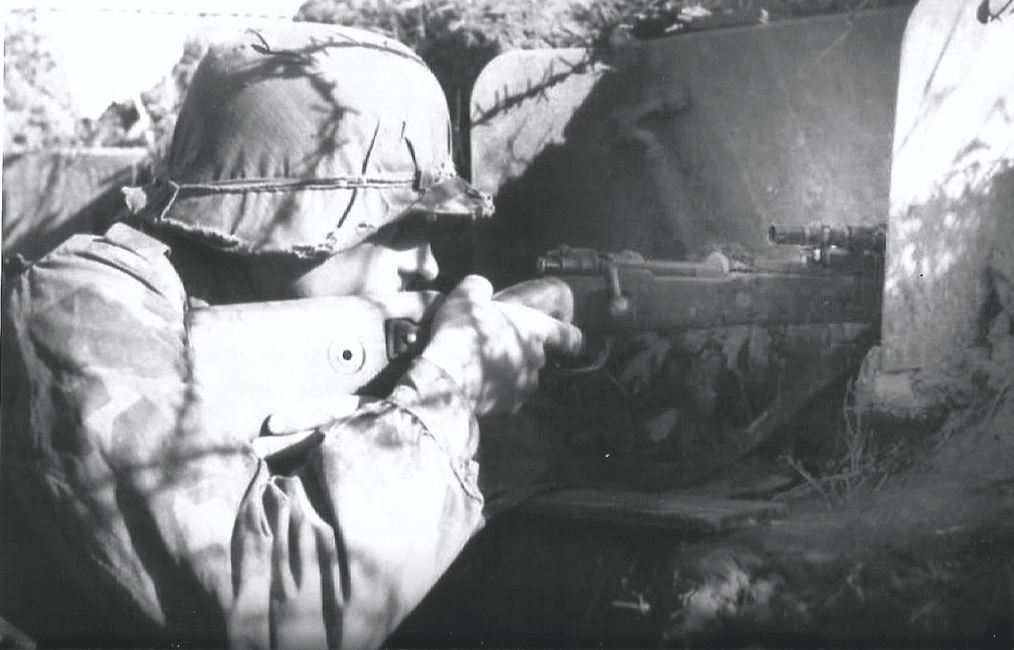
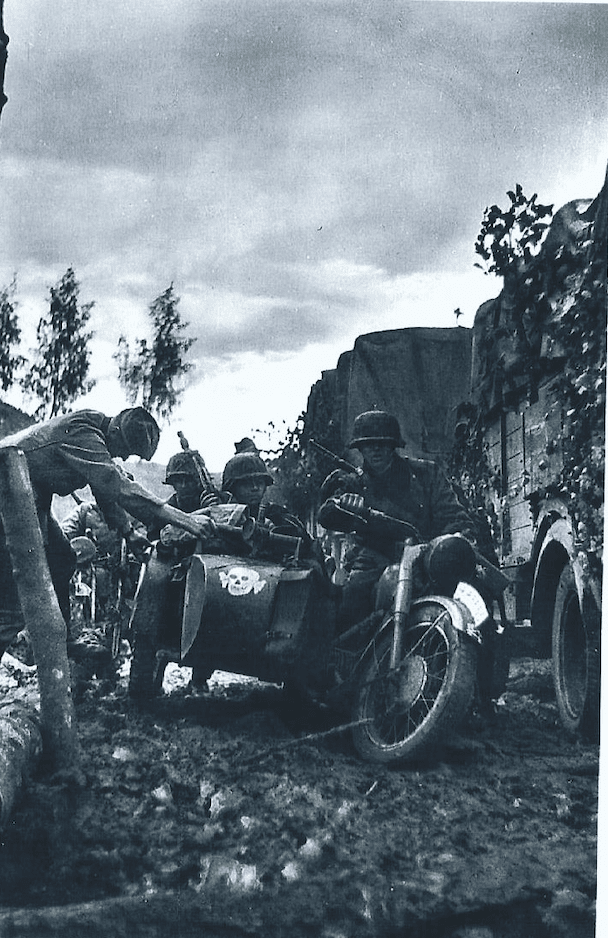
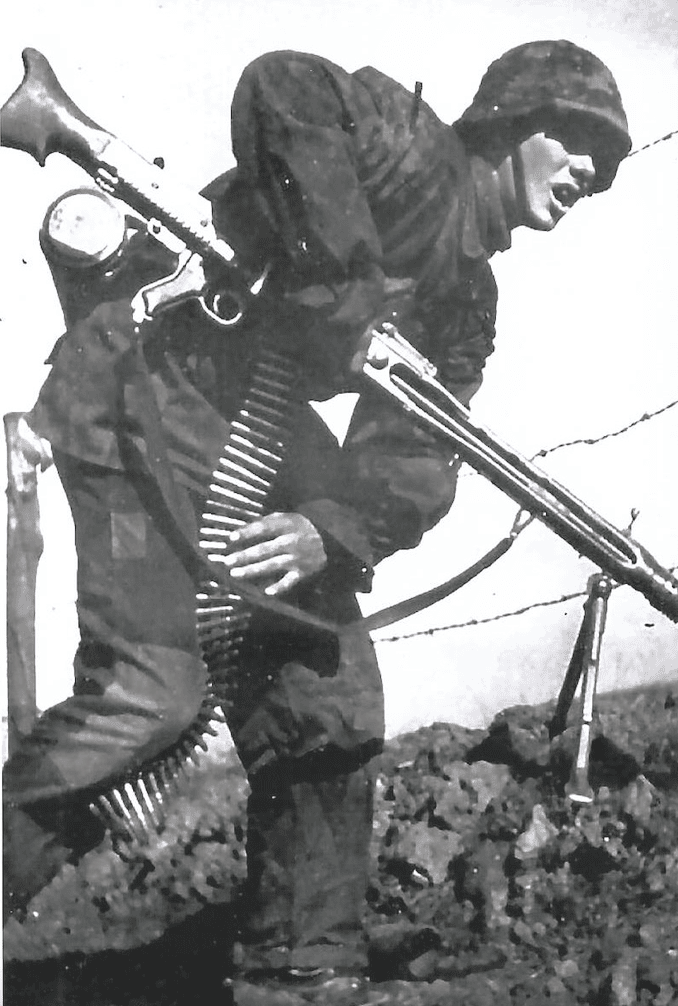
Initially the Waffen-SS soldier wore a uniform broadly similar to his Army counterparts. However, he wasn’t usually as well equipped, and units typically had to employ a range of obsolete German weapons and captured items. This changed once the Waffen-SS distinguished itself in Russia, and by the middle of the war better quality units in particular, received some of the best weapons and equipment available from Germany’s armoury. Infantry units could expect to field small arms such as the MG 42 machine-gun, notable for its high rate of fire, and a variety of distinctive camouflaged combat uniforms were introduced, that became a hall mark of Waffen-SS troops. Similarly, the order of battle for ‘Das Reich’ in 1944, shows that at full establishment it comprised: an SS Panzer Regiment with 62 Panther tanks and 64 Panzer Mark IV tanks, eight 3.7mm Flak (anti-aircraft) guns and six 20mm Flak, plus 53 motorcycles and 313 other motor vehicles, and a complement of 1,770 men. This SS Panzer Regiment was supported by two SS Panzer Grenadier Regiments of 3,340 men each, and an artillery regiment, flak unit, Nebelwerfer unit (smoke/rocket launcher), anti-tank unit, assault gun unit, plus reconnaissance, signals, medical and pioneer elements.
Contrastingly, units involved on policing operations behind the lines or anti-partisan warfare throughout the war, frequently had to use second rate equipment. The 7th SS-Freiwilligen Gebrigs Division (Prinz Eugen) was established as a mountain division for anti-partisan operations in the Balkans, and mainly comprised volksdeutsche volunteers and conscripts from Romania, Hungary and Yugoslavia. These had to rely on a motley collection of captured weaponry, including aging French tanks and Czech manufactured machine-guns.
Formidable opponents
The personal hardiness, determination, and willingness for self-sacrifice, which many of the high quality Waffen-SS units exhibited, made them formidable opponents on the battlefield. Simultaneously it fostered an attitude of contempt for prisoners and civilians alike which led to several atrocities. Some of these were the work of individuals or small groups, possibly spurred on by the pressure of being in action. In Poland in 1939, a member of an artillery unit decided to round up several Jews into a synagogue and shoot them. Similarly, 100 POWs from the Royal Norfolk Regiment were murdered by elements of 3rd SS Panzer Division (Totenkopf) at La Paradis after it’d endured tough fighting in May/June 1940. Other acts entailed entire units, and were a matter of policy, such as when ‘Das Reich’ murdered 642 men, women and children at Oradour-Sur-Glane, France in response to Resistance activity. As Max Hastings stated, by 1944 there can have been few experienced officers and men in the Waffen-SS, ‘who did not regard it as a perfectly legitimate exercise to carry out mass reprisals and wholesale killings if the situation seemed to justify it.’ Equally, a litany of unspeakably evil crimes, were committed in the Balkans and elsewhere by lower grade units, under the guise of ‘anti-partisan warfare.’
A point of German policy was that foreign volunteers wouldn’t be deployed for combat in their native countries, and this was largely adhered to. However, by 1945 all elements of the Waffen-SS were being drawn into the maelstrom of defeat, and many foreign volunteers, branded as traitors in their liberated countries, fought on along with their German counterparts. This ensured survivors and their families were understandably ostracised after the war, and is perhaps why a number from the ‘Wiking’ Division were serving with the French Foreign Legion in Indo-China during the 1950s.
© James Goulty 2024
List of Sources
Articles
John Keegan, ‘Waffen SS’ in History of the Second World War Vol. 7 No. 13 (Purnell, 1968), pp. 3025-3031.
H.W. Koch, ‘Hitler’s Foreign Legions’ in History of the Second World War Vol. 7 No. 8 (Purnell & Sons, 1968), pp. 2900-2909.
Keith Simpson, ‘Panzer Attack: 12th SS Panzer Division ‘Hitlerjugend’-Normandy 1944’ in The Elite Vol. 1 Issue 2 (Orbis, 1985), pp. 26-33.
Books
Massimiliano Afiero, Norwegian Waffen-SS Legion, 1941-43 (Osprey, 2019)
Chris Bishop, Hitler’s Foreign Divisions: Foreign Volunteers in the Waffen-SS 1940-1945 (Spellmount, 2005)
W.J. K. Davies, German Army Handbook 1939-1945 (Ian Allan, 1972)
Will Fey, Armor Battles of the Waffen-SS 1943-45 (Stackpole, 2003)
Adrian Gilbert, Waffen-SS: An Illustrated History (Guild Publishing, 1989)
Max Hastings, Das Reich: The March of the 2nd SS Panzer Division through France, June 1944 (Pan, 2009)
Chris Mann, SS-Totenkopf: The History of the ‘Death’s Head’ Division 1940-45 (Spellmount, 2001)
Bruce Quarrie, Hitler’s Teutonic Knights: SS Panzers in action (Guild Publishing, 1987)
Jonathan Trigg, D-Day Through German Eyes: How the Wehrmacht Lost France (Amberley, 2020)
Martin Windrow, The Waffen-SS (Osprey 1985)

About The Author
James Goulty holds a masters degree and doctorate in military history from the University of Leeds, and has a particular interest in the training and combat experience of ordinary soldiers during the world wars and Korean War.
He has published numerous articles and written 5 books for Pen and Sword Ltd, including The Second World War through Soldiers’ Eyes: British Army Life 1939-1945; and Eyewitness Korea: The Experience of British and American Soldiers in the Korean War 1950-1953.

Click to see full BMMHS event listing pages.
Contact us at [email protected]
Copyright © 2024 bmmhs.org – All Rights Reserved
Images © IWM & James Goulty