Trash Mags and Airfix Kits
by Tom Dehn
Growing up in the 1950's & 6o's
It was hard, as a boy growing up in the 1950’ and 60’s, not to be influenced by matters military.
At home “What did you do in the war, daddy?” led to a retinue of stories. Not infrequently did Daddy disappear in black tie and miniatures for some HAC, Burma Star or Desert Rats dinner. As he aged the subsequent morning trains to the City ‘got later’. Annual weekends away in Llandudno with his HAC chums were followed by a degree of mystique.
The streets were full of military uniforms; schoolboy cadets travelling on the bus to their afternoon with the cadet force, national servicemen, convoys of army trucks, often led by an Austin Champ, and sailors, returning to their ships at Portsmouth, who filled the ticket office at Waterloo station. A common sight in London was the limbless first war veteran selling matches by tube station entrances or getting about in wheeled bath chairs operated either by a pair of handles or a hand /‘pedal’ .
Films at the local 'flea-pit'
The local Remembrance Day services were sombre affairs with a local military band and many, many be-medalled veterans in the congregation. To the two world wars were added those who had served in the Korean, Suez, Malayan, Mau Mau and Cyprus campaigns.
Those were different days; at the end of cinema performances the audience stood up when the national anthem was played. Pathe news nearly always had (or seemed to have) some military content. Film going itself was a different ‘experience’. The projectionist’s main task was to switch seamlessly from one projector to another. Once whilst at the cinema, or local flea- pit, with my mother, at the moment critique as spool 1 expired, a pigeon landed on the ledge in front of the projectors. The bird was silhouetted on the screen; its flapping brought up clouds of dust, equally well projected. This threw the projectionist off his stride; spool one flapped around aimlessly. The main feature ceased, also at a moment critique, before the pigeon flapped away allowing the projectionist to regain his composure and the film to continue.
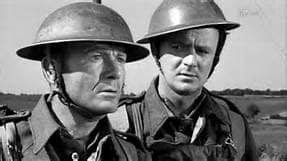
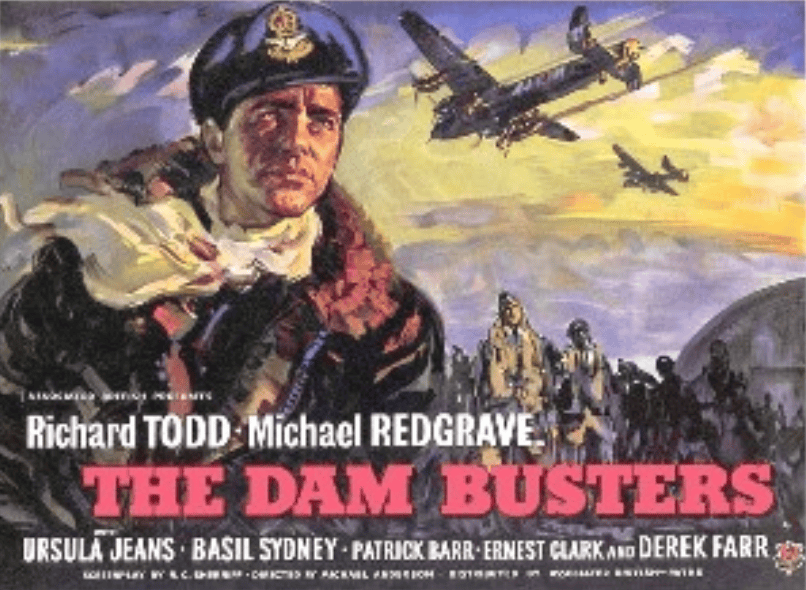
There was a plethora of black and white war films to excite any young boy; Dunkirk (far better than the recent rendition), Reach for the Sky, the Dam Busters, Ice Cold in Alex, The Battle of the River Plate, the Cruel Sea and so on.
Airfix Kits
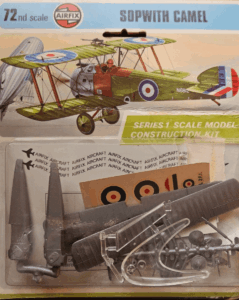
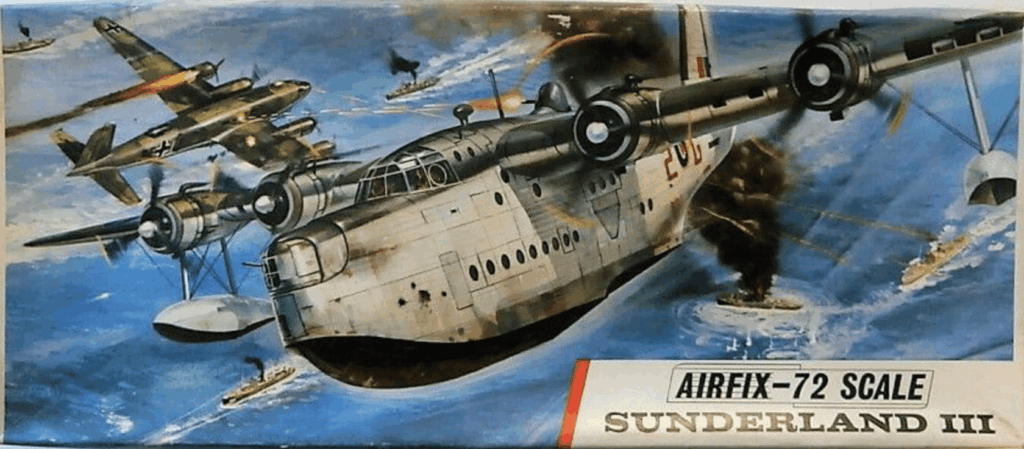
If that was not enough the manually skilled school boy had the fun of assembling Airfix models. Stupidly, I decided to begin modelling on an historic basis. My first model was a Sopwith Camel. Getting the top wing to sit neatly on my unequally set interplane struts resulted in an aircraft which would never have got airborne. One’s skills improved with 2nd war monoplanes. The grandest models I recall constructing were the Sunderland and Lancaster; the key with these was keeping excess glue away from the clear plastic canopies and revolving gun turrets. There were battle ships with rotating turrets and elevating barrels. Painting models required a mass of little tins of Humbrol paint with their coloured tops.
Once I had an excess of completed models I used to ‘shoot them up’ with a BSA 0.177 air rifle with an extraordinarily useless telescopic sight (60 years on, the air rifle, with a decent sight, is still in use vs squirrels). Other slightly more expensive plastic models were made by Revell.
For the army enthusiast were lead, and the not nearly so real, plastic, soldiers. These were often of WW2 chaps wearing khaki battledress, carrying a knapsack and a Lea Enfield rifle.
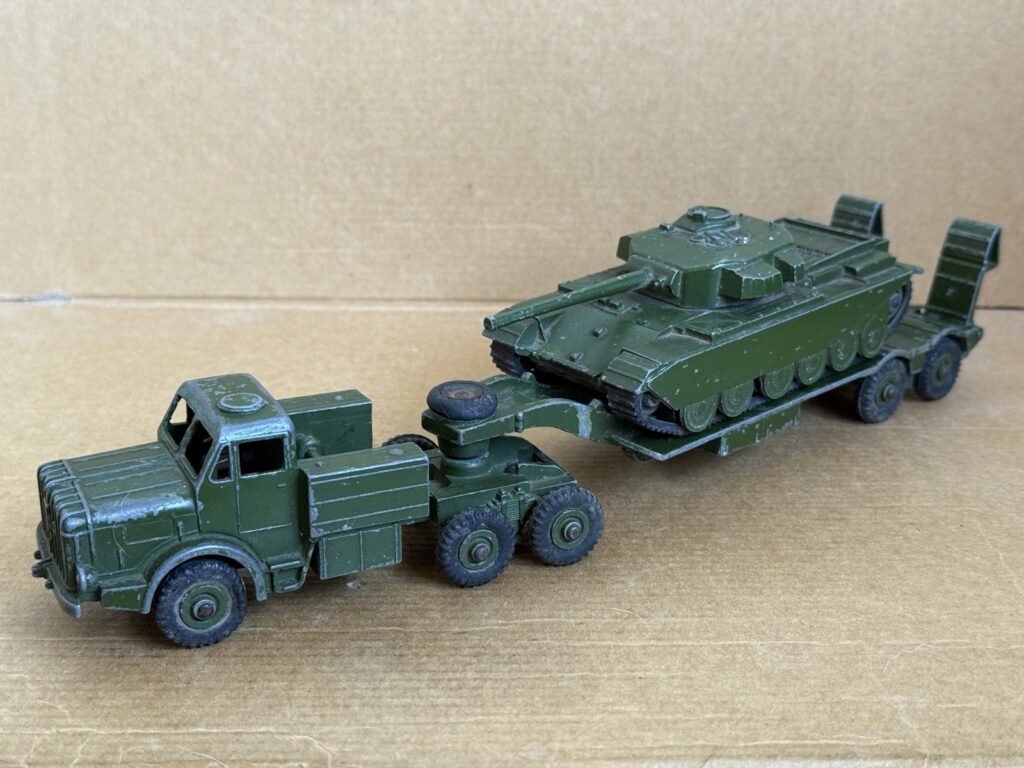
Dinky Toys manufactured a magnificent array of military vehicles; my most treasured was a Thornycroft tank transporter with a Centurion tank. These can now fetch hundreds of pounds on eBay.
Reach for the Skies
One stage up brought one to model aircraft that flew (or they were supposed to when made properly). Balsa wood gliders were the first stepping stone. One had to cut away the formed constituent structures of the wings and fuselage, glue them together then lightly glue the tissue paper over the various components. Then came the doping. Usually two to four coats of this heady substance were applied. Little did we, or our parents, know of its brain enlightening features!
Getting the fuselage frames, ailerons, wing ribs and stringers to stay fixed at right angles proved pretty taxing. The flight characteristics of the initial results were brownian at the very best.
As confidence grew we moved to control line models. For my first, I followed the plans from an Eagle book. Two wrist controlled lines operated the elevators, allowing solely up and down movement. The engine was a single cylinder diesel, usually of 0.05 cc capacity. At the very best it was a bugger to start. Endless flicking of the plastic prop wore one’s index finger to the bone. Backfiring took off the skin from the opposite side of the index finger. Once started the compression could be increased by screwing down a little lever on the cylinder head. One soon learned the perils of a rapidly rotating plastic propellor.
Flying these required a) a crewman to launch the beast and b) functioning semicircular canals since the ‘pilot’ had to pirouette in one direction until sufficient skill had been acquired to perform a half loop and fly inverted for a few seconds then reversing again before the engine cut. The ‘ground crew’ ran around the circumference of flight to catch the machine before it crash landed.
Bulldog Drummond and Biggles
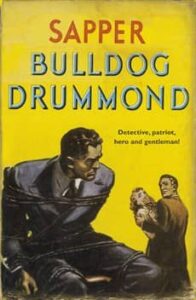
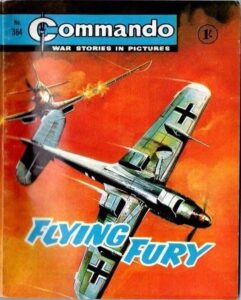
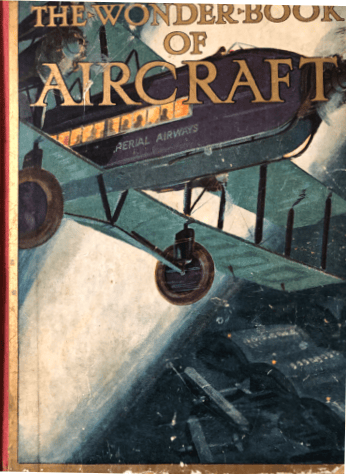
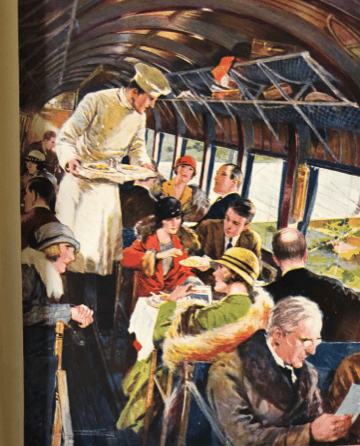
Reading matter included the tales of Bulldog Drummond (Sapper) and his opponents Carl Peterson (who could be recognised, despite numerous persona, by his habit of drumming his fingers on the table) and Irma. Drummond lived in a service flat in the evocatively named Half Moon Street in Mayfair. Biggles and Algy (Capt. W E Johns) provided endless tales of aerial adventure. But, the cheapest and, readily available to be swapped, were ‘trash mags’ published by Commando. These were stories of British derring do against the dastardly Hun, portrayed by a series of line drawings, often of Tommies in shorts lobbing grenades out of Bren gun carriers with voice bubbles “take that Fritz” succeeded by “aaargh” as the stormtrooper, limbs outstretched, was ejected from his position. The aviation ones contained lots of “Himmel und gotten, Spitfeur” as the Me109 was riddled by a burst of Browning 303s from a Spitfire. The Wonder Book series contained magnificent photographs and was written in colonial text.
One small step for Man...
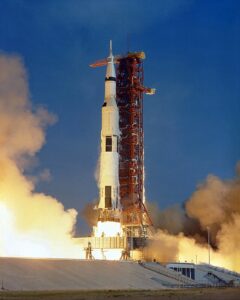
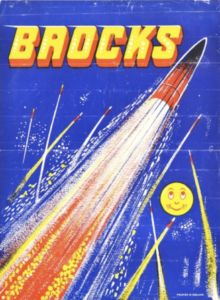
My efforts at rocketry design met with spectacular failure. I glued together the bodies and sticks of 6 Brocks 1/6d rockets then made a fuse wire of diesel soaked cotton which connected all the blue paper ‘light and stand back’ tabs. An empty wine bottle propped up with stones subbed for the launch gantry. With due count down the blue tab was lighted. The out of balance Saturn rose about 15‘ into the air and shot, with an oscillatory flight path, across the garden, over the fence, narrowly, but skilfully, avoiding an out of use hot house with multiple glass panes. Stage 2 lit , but on one side only. The oscillatory flight path had naturally toppled the on-board gyros so the flight path now deviated, significantly, to the right taking the climbing rocket into a closed window of Mr Gorsky’s bedroom. The Saturn fell to the ground along with broken glass; a furious Mr G. The rocket eventually fizzled out. I think Elon Musk has failed to pay me design copyright.
The government reparations, paid by my father, were enough to deter further experimentation. For those readers not acquainted with Mr Gorsky research Buzz Aldrin and Mr G.
Defence of the Realm...Joining the CCF
Into teenage years and a change of school. Corps, or Combined Cadet Force (CCF), was compulsory for all on Wednesday afternoons. Joining the army section for 2 years and passing Cert A part 1 before transferring to the RN or RAF sections was the norm until the rules of engagement were changed my first term. This was ‘free’ of corps, allowing the new boy to choose which section he wished to join. My chum Jeremy and I, having passed our new boy’s tests, wandered down to the parade ground. Jeremy was a clarinetist and thus was taken on by the corps band. Few, if any, sound recordings were made of this particular unit. We observed much shouting of orders by the school sergeant major, largely directed at the army section. No sale there. The RN section looked terribly smart with blancoed white gaiters and highly polished boots. At the rear of the parade ground was the RAF section. No one in authority appeared to take any interest in it, including the OC, an army chap, whom, I was soon to learn, had long ago abandoned any interest in the Air Force section.
That clinched it. I had an interest in things with wings and anyway would rather not have spent my Wednesday afternoons being bawled at and digging holes in the ground. I signed on, was given an oversized RAF blue ‘Hairy Mary’ uniform, webbing belt, gaiters and boots. The boots needed breaking in and both toe caps and heals required endless hours of spitting and polishing. This was a skill that had to be learned fast. Kiwi black polish was applied along with a bit of spit. The mixture was polished in a rotatory fashion until one’s index finger had worn away. This was repeated until you could see your face reflected. The boots were then placed in one’s compendium under a special ‘boot only’ use yellow duster.
The webbing required application of just the right amount of RAF blue blanco. Too much filled in the little valleys between the bobbles of the material. Brasses were polished with Duraglit. Little pieces of newspaper had to be inserted between irremovable brasses and the webbing to ensure the webbing remained pristine. My first impressions of laxity of the RAF section were well and truly misplaced. Following the stint on the parade ground the RAF section retired to various form rooms to study basic aerodynamics and principles of flight.
Air Experience Flying
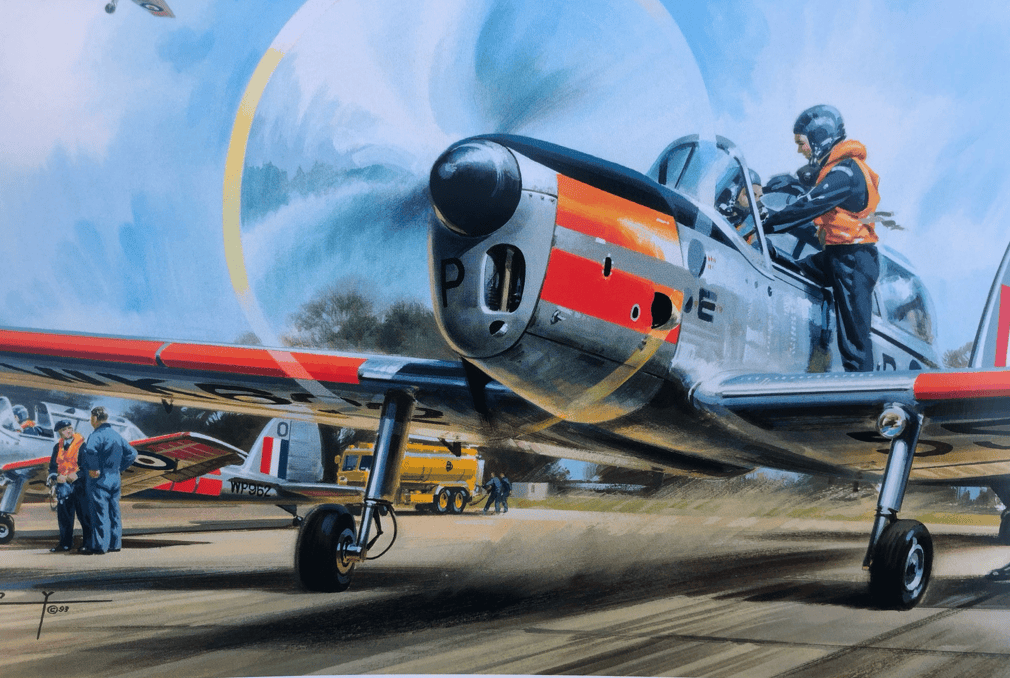
Twice each term we were taken to RAF White Waltham, near Maidenhead, for ‘air experience flying’ in DH Chipmunks. Our parents were obliged to sign a form absolving the Air Ministry from fault should little Peregrine unwittingly dig a hole in the ground. The select few were herded into an austere class room where we were shown how to don and operate a seat type parachute. The latter was fairly simple. “If the pilot tells your to bale out, disconnect the lead to your head set, undo the seat straps AND NOT THE PARACHUTE STRAPS. Stand up on the seat and jump over the trailing edge of the wing. Count to 3 and pull the metal ring on your left chest until your right arm sticks out”. Simple. The thought of actually doing this never entered our minds. Over the years a number of Reservist Pilots died when their cadet in the back froze and failed to jump.
Fuel On, Brakes On....
The seat type parachute weighed a ton; its straps were done up so tightly that we walked bent over like old men. We were helped into the rear seat by kindly ground crew who, whilst doing up the aircraft seat belts even tighter than those on the parachute, sent us on our way with instructions to turn off the microphone should we feel ‘unwell’ and to use the sick bag provided. If we failed in the latter; clearing up the cockpit of chunder was our responsibility.
Starting the Gypsy Major engine required liturgical refrains and responses between pilot and ground crew. Pilot,‘Fuel on, brakes on, mags off, switches off, suck in’. His left arm stuck out of the cockpit with his thumb down to indicate the magneto switches were off. The ground crew then primed the carburettor with fuel and turned the prop around several times to suck fuel into the cylinders. G/C,“ready for starting”.
The pilot then set the throttle and turned on the mag switches, his thumb then went up, indicating the engine was live. “Fuel on, mags on, brakes on, throttle set”. G/C, stepping back out of the way of the prop, “all clear”.
The pilot then pulled a ring in the right side of the cockpit. This operated a firing pin which set off a shotgun cartridge, less pellets; the explosion of gas was directed onto vanes which spun the flywheel thus turning and hopefully starting the engine complete with the obligatory loud bang and clouds of blue smoke. The aeroplane shook, we turned on our intercoms and, with a wave of the pilot’s hands, the chocks were removed and off we bounced across the grass.
During the taxi run, after a series of mysterious turns and more liturgy, the pilot would say “anything you would like to do, laddie?” Older boys, with an evil glint in their eyes, had primed we tyros with the refrain “oh, some aerobatics, please sir’”. The pilots liked doing aeros to relieve the boredom of straight and level flying. We climbed and climbed. “Straps tight, laddie?” “Yes sir”.
The aircraft seemed to dive straight for Mother Earth. My arms, legs and head seemed to weigh three times as much as normal and were immovable. Suddenly the sky appeared below me and the earth above before the g kicked in again. Several more of these followed by “enjoying this, laddie?” No answer from a very green, in more than one way, laddie. The canopy was partially opened allowing in a blast of air. No therapeutic benefit. The inevitable happened. Luckily I found both sick bag and intercom switch before filling the former with my lunch of greasy sausage and mash plus sponge and custard pudding.
The next visit, a fortnight later, I was asked the same introductory question to which I responded “aerobatics, please sir”. “I recognise that voice, weren’t you here two weeks ago, laddie?” “Yes sir”. “Well, we’ll do some gentle ones then, laddie”. They seemed no gentler than my previous exposure.
White Waltham was a large grass airfield, requisitioned in 1938 and famous for it being the HQ of the ATA, ladies (and men) who delivered war planes to service airfields.
As well as 6 Air Experience Flight, there was an RAF gliding school, the University of London Air Squadron, the HQ of the Air Cadets, the civilian West London Aero club and Fairey Aviation. ML Aviation had a unit on the far west of the field. All sorts of wizz bangs emanated from behind security fencing. Hardly surprising since ML designed and made an ejector seat, reputedly as good or better than the early Martin Baker ones, made nearby in Chalgrove.
At the take off end of the runway in use was a red and white chequered motorised control tower complete with red, white and green signal lamps and Very flares.
Whirlwinds & Scrambled Egg
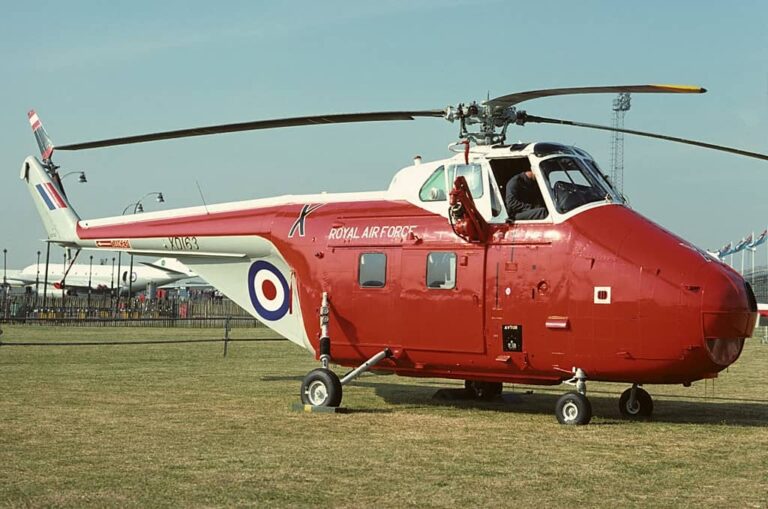
The whole corps was inspected annually by a scrambled egg bevvy from one service or another. One year, it was the turn of the RAF. An area of the parade ground was cordoned off. A Whirlwind helicopter arrived (fig ). No ambulance, fire engine and police as is the norm nowadays. Its arrival was presaged by not only noise, drowning out that of the band, but a tornado of cinders from the parade ground surface and a covey of flying berets and hats. The ranks broke, chasing their headgear and rubbing their eyes. One up to the RAF. Once the parade had reassembled and the inspection was over we, in the RAF section, went up for jollies around the school grounds. Six at a time, we sat on the floor of the chopper, no belts or health and safety. The crewman stood throughout the jolly at the door, presumably to catch us should we break loose.
The intrepid parachutist
The other annual event was the two week summer camp. My first year I was excused this, since rashly, I had stuck up my hand volunteering to go on a parachuting course. For some reason, known only to the military mind, we intrepid parachutists, after parade, spent the remainder of Wednesday afternoons, in the company of a bull necked Para, taking apart and reassembling a GPMG (general purpose machine gun). This lodged in the school armoury, guarded over by sergeant major. The armoury housed at least 600 Lea Enfields as well as 303 ammunition. We could do this with our eyes shut by the start of the summer hols. Quite what purpose this served I have yet to learn. All was in vain. Harold Wilson was elected PM (an event which precipitated my father throwing his shoes at the TV set) disbanding the TA unit destined to teach us. This was probably a stroke of luck for we learned that the first 3 jumps were from a tethered balloon. One sat in a large Fortnum’s type wicker basket (without goodies) with a circular hole in the bottom through which one’s legs hung. The basket was attached to a balloon which rose to 800’. The para instructor then ‘helped’ you out should your legs have turned to jelly. It was too late to join the regular camp.
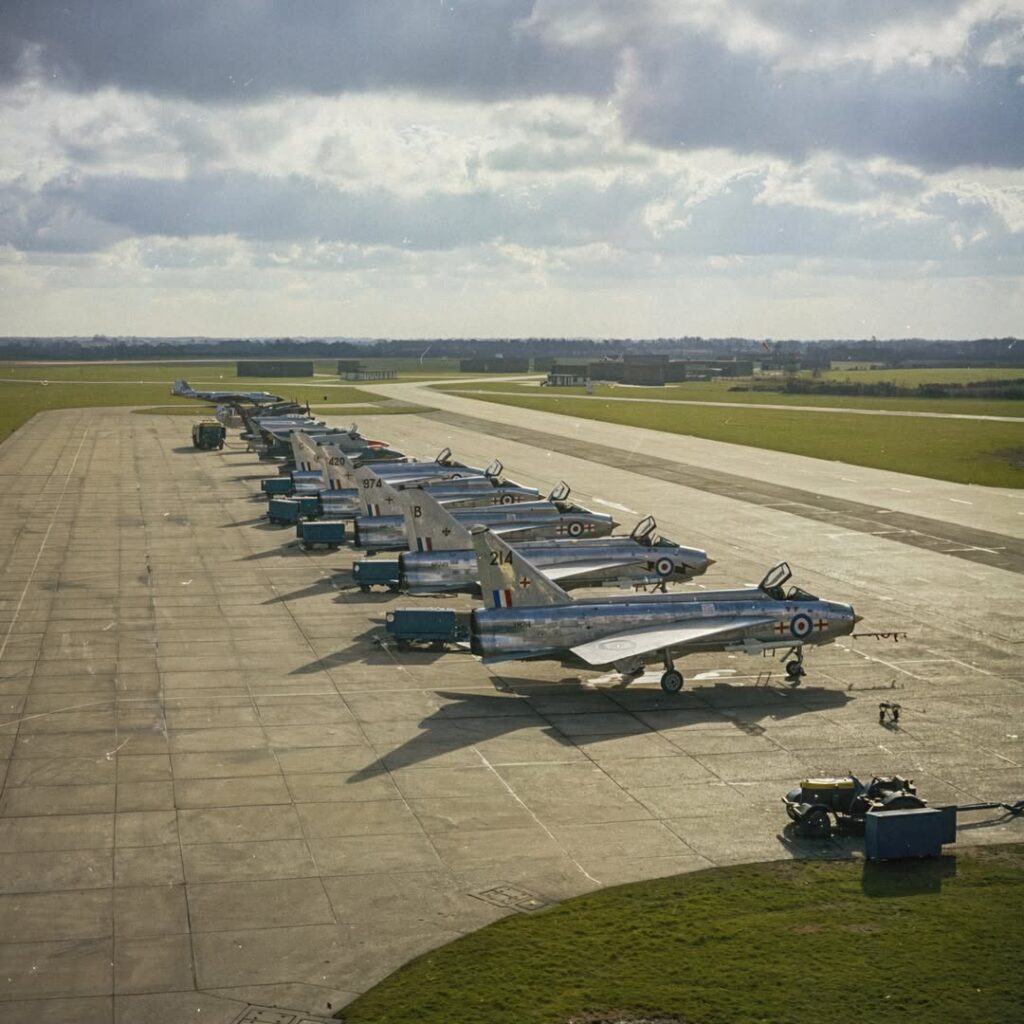
The only true camp I attended was at RAF Coltishall, in Norfolk and home to Lightening Squadrons. We were housed in the airmen’s barrack blocks; we ate chips and beans with everything in their mess. Usually 2 or 3 schools attended these camps. This resulted in minor raids/punch ups. In the evenings we went by bus from the camp gates into Norwich, blagged our way into one of its 365 pubs, drank too much beer, much of which, with the assistance of Gitanes or Gaulloise fags, found its way up en route back to the guardhouse. By this time I had been promoted (vide infra).
I recall 2 exercises. The first was to construct a seaworthy raft comprising 3 barrels, some planks and inadequate lengths of rope. The ‘lads’,under my pathetic tutelage, made the only raft that survived 75% of the river crossing before disintegration. Barnes Wallis would have been happy to observe the rotation of the barrels. We plunged into the cold March river water. We joined the remainder of the shivering contingent, wrapped in blankets, in the back of an ancient RAF bus, before returning to steaming showers in the barrack block and hot tea in the mess.
The second was an escape and evasion exercise; really evasion only. After dark we were taken to various drop offs. We were provided with map and torch and instructed to make our ways to the collection point near the coast, without being caught. I was getting too big for my boots. For I had been navigating along footpaths until 100 yards from the end. Out of the shadows appeared a great – coated Officer. “Vot are you here doink” he said in his best trash mag German. “You are, as you zay, in ze bag”. A mug of tepid chocolate supplemented with a biscuit in the RAF bus and return to the barrack block. We were all captured.
The means to promotion were obscure until one lunch Capt. Parry, master i/c RAF section, sat at the head of the table where I sat, two down from the top. For beaks it was a dubious honour to be invited to partake of the boys meagre rations. My friend, Jeremy, he of the band, piped up “don’t you think, sir, Dehn should be promoted? He really is quite keen on the Air Force”. “Well, yes, you’re right.” First stripe or whatever one got. Pudding came. “I really think Dehn should be given more, sir. He is, after all, thinking of joining the Air Force.” News to me. “Yes, perhaps I have been a bit mean.” Corporal’s stripes. By the time grace was said (in Latin), my rank had risen to sergeant. From AC2 to sergeant during one lunch. Jeremy extracted his ‘arrangement’ fee at a later date.
Keeping the wings level
The corps had a variety of extras to offer. In the summer hols of ‘65 I went on a gliding course at RAF Halton. This was one of the 3 apprentice schools, commissioned by Trenchard, the father of the RAF. Sixteen year old boys were admitted and, under a rigorous 3yr training programme, becoming highly proficient technicians in the trade of ‘their’ choosing. The discipline and bull were fierce. We, the CCF glider cadets, lived in one of the barrack blocks and were permitted to eat in the apprentices’ mess. Our drill standards were sloppy by comparison to those of the immaculate apprentices. Halton was home to a large RAF hospital. The officer’s mess was in a massive Rothschild house.
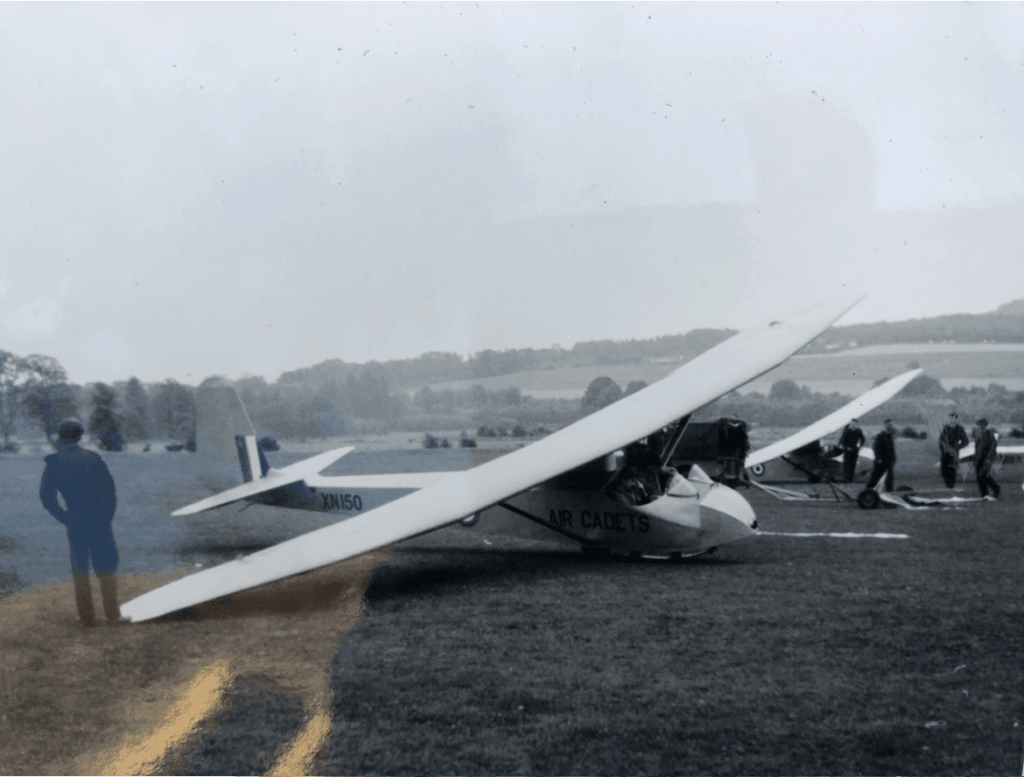
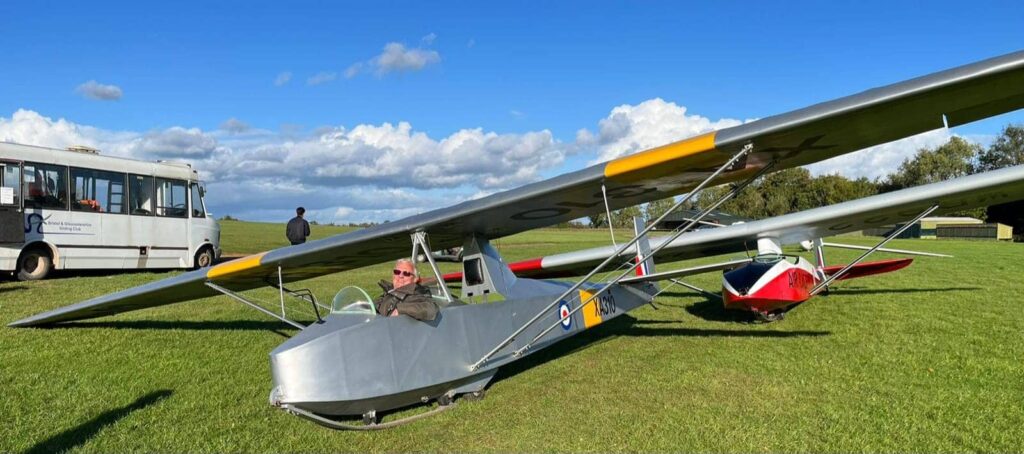
Gliding requires a lot of a) hanging about and b) dragging of gliders from hangar to launch point and from landing final resting place back to the launch point. Our instructors were VR officers: the aeroplanes; the tandem seated Kirby Cadet mark 3 and the side by side seated Slingsby Sedburgh mark 21.
The gliders were launched into the air by a winch. This was positioned at the upwind end of the grass runway and from it ran a long steel cable, attached to the nose of the glider. The commands to the winch operator, who sat in a protective cage, were by signal lamps. Upon the order to launch the winchman shortened the cable. A cadet ran alongside the glider keeping its wings level until he couldn’t keep up. Once airborne the glider climbed steeply to about 1000’. The cable was then released from the glider by the pilot and was wound in onto the winch drum.
In the air..silence. In the short time airborne we were taught stalling, spinning and recovery then in addition to turnings, various, with progress, approaches and landings. We practised endless simulated cable breaks, when at various stages of the launch the instructor disconnected the launch cable. We had to sort out the situation.
Going solo
Our tuition began on the Sedberg then progressed to the Kirby Cadet in which we did our 3 solos. One could anticipate the impending moment by the revision of various emergencies and the final check by the senior instructor. He got out of the glider, saying, “enjoy yourself”. There was no time for colly wobbles. The cable was hooked up and off I went. Cable release is followed by a palpable quietness as the noise of being dragged into the sky is replaced by the gentle hiss as the glider makes its slowish descent. I felt very grown up being in sole charge 800‘ above terra firma. It was easy to follow the previous instruction whilst, all too briefly, taking in the green landscape of Buckinghamshire. Soon I was crosswind, then making the turn onto finals. Bump, bump, bump onto the grass then that odd desire to hold the wings level as one of them tipped slowly to the ground. Two more and one gained sufficient experience to get the BGA A & B gliding licence. Once back at the launch point my instructor came to congratulate me. I saluted him and received a minor bollocking since he wasn’t wearing his officer’s cap (one salutes the commission not the man). One never ceased to learn.
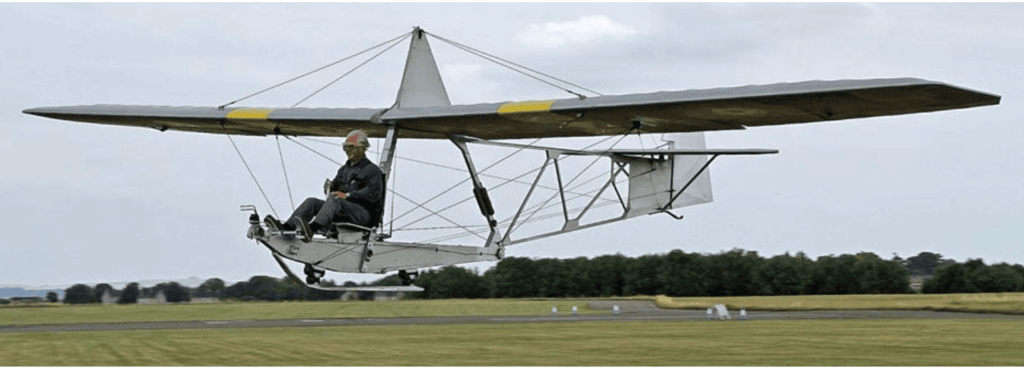
The acquisition of CCF glider wings enabled the holder to ‘fly’ the school’s RAF section A frame glider . This is what it said on the tin: a wooden A, to the front of which was screwed a seat, to the back, a fuselage (of sorts) and tailplane and to the top, the wings, onto the leading edges of which could be attached two planks of wood (spoilers) to spoil any airflow over the wing thus spoiling the production of lift.
To launch this leviathan a metal stake was bashed into the grass, adjacent to the tail assembly; between the two was a ‘releasable’ clip. A troop of young cadets manned a Y shaped rubber bungee hooked up to the nose. The launch boys strained at the leash until they were about to be pulled en masse A over T. At that moment the pilot operated the release clip to the tail stake. The machine was supposed to hop along the ground; my first flight, much to the amazement of all around, resulted in a climb to approx 20’ a gentle glide and a perfect landing.
This was a first for the RAF section. No further aerial sorties were permitted that day. These A frames were manufactured either by Slingsby, which aptly named theirs the Grasshopper, and Elliots of Newbury. Theirs was named the Eton. Why? Anyway that name was anathema at my school so we had a Grasshopper! Even more wondrous was that the intrepid were aerotowed to 1000’ or more.
Second class to Biggin Hill
The final hurdle was to apply for a flying scholarship. These awards provided the successful applicant with 30 hrs of free tuition towards the 35 hours required to gain a private licence. Selection required a trip to RAF Biggin Hill, in Kent, where the OASC (officer and aircrew selection centre) was then housed.
Second class rail warrants were issued to Bromley South station thence by bus to the guard room, the all too familiar barrack block and mess for chips and all. Day 1 was spent being examined from top to toe. At the end of the day a number of names were read out. These fellows sat in line on hard MOD chairs whilst waiting their turn to be told by an aged (to us) Wing Commander doctor that his sight/hearing/thigh length/renal function was up the spout. The RAF’s medical criteria were stringent, even at that stage of life. Not surprising really since the Queen was on a recruitment drive for the real McCoy. Those poor buggers caught an early train home.
Day 2 started with initial aptitude tests. These comprised timed tests of mental arithmetic and situational awareness. Following lunch were the real aptitude tests of eye-brain-hand coordination. One comprised an horizontally rotating brass drum covered with insulating ceramic though which a series of meandering holes had been fashioned. The candidate ‘drove’ a brass contact, through which flowed a current thus making a circuit every time the contact and brass ‘hole’ aligned. The brass contact had a built in lag so anticipation of the meander was necessary to score points and, points mean prizes!
The most realistic piloting test involved the candidate sitting in a pilot’s seat looking at a cathode ray tube with a square marked in its centre. Using stick and rudder controls the ‘pilot’ flew a randomly moving dot to stay within the confines of the square. His left hand controlled a ‘throttle’. When a red light shone the throttle was advanced, green retarded. By my 2nd trip to Biggin Hill OASC I learned to hang back whilst seating was arranged. If one sat on the far right row one could spot the lights reflected in turn onto the CRT!
The final afternoon was spent being interviewed by a selection panel. The questions were pretty easy for any air-minded teenager. Then back to school. I failed in my first application but was successful on my second. l left school at the end of the Christmas term, keeping my CCF uniform and beret to take with me to the Cambridge Aero Club (CAC) in late January 1968 to learn to fly powered aeroplanes.
Those who have lived in East Anglia will know how lovely it can be with cloudless anticyclonic skies. In an anticyclonic winter the fine days are succeeded by brass monkey nights. For the duration of my course I was housed in a barrack room for 10 at Marshall’s. I was the only occupant, my sole company being a cast iron upright coke stove which threw out a max of 1Bthu per hour at best.
My muckers on the PPL course were 8 rookie air traffic controllers. They received the full 35 hours necessary for a PPL, were paid handsomely by the CAA and billeted in various comfortable and warm B & Bs. They were a good bunch who readily took me into their group, especially since I was the only one wearing a uniform. The latter created a minor harrumphing from an RAF officer sent to inspect my progress. I had unilaterally declared independence from the RAF collar, tie and Adam’s apple gnawing collar stud for the warmth of a white cable knit polo neck jumper. I rather fancied myself as a WW2 ace. This variation on the Queen’s Regs for uniforms was not met with approval. Return to stud, collar and black tie.
We learned on Cessna 150s. These were bog standard American high wing spam cans with flaps the size of barn doors. Later models reduced the barn to stable door sized flaps. In a decent headwind and with full flaps the a/c could ‘hover’ overhead the runway!
Our instructors were all ex RAF and, when not gritting their teeth with us, flew the many types of service machines passing through Marshall’s. My instructors were Geoff Page, who died only a few years ago, and the CFI, Frank Worsdell. The first solo came and went; everyone followed by a jolly in the pub.
There were no major events during our time at Cambridge. Three of us were sent off on our triangular cross countries; Cambridge-Oxford-Cranfield -Cambridge. We thought it would be nice to chat to one another en route on an unused R/T frequency. Good idea at the time; bad idea on our return to Cambridgeshire. We were summoned by Mr Page and all metaphorically spanked.
Marshalls was a busy airfield; a daily entourage of military aeroplanes arriving and departing; the Chipmunks of Cambridge UAS, Tiger Moths of the Cambridge Flying Group (the only organisation where one can still learn ab initio on prewar biplanes) and the Aero Club C150s. Marshalls aerodrome, in existence since WW1 is now to be sold for housing development.
I got my PPL on 29th May 1967, my mother having paid the £7-10s per hour for the remaining 5 hrs (£200 + per hr nowadays). Whilst I was at CAC I received a succession of rejections from universities, despite having a conditional place at St John’s which, mysteriously, got annulled by UCCA. The school RAF CCF, the gliding and flying scholarship drew me into the RAF. A third trip to Biggin Hill and a train journey from Kings Cross to Sleaford took me to the RAF College at Cranwell, hut 145 to be specific. Eventually I got a place at university to read Medicine which provided me with a very satisfying career. At University I joined the London University AS (as a VR pilot, not a medic). More camps, more rail warrants.
Later, I became a part time flying instructor and a part owner of 4 a/c (at different times!).
Perhaps many others shared similar starts with trash mags and Airfix models?
Postscript.
Old habits die hard. For my 70th birthday I was given a kit to build a radio controlled Tiger Moth. Off we go again…..

Click to see full BMMHS event listing pages.
Contact us at [email protected]
Copyright © 2026 bmmhs.org – All Rights Reserved
Images © Tom Dehn Collection & Wiki