
‘War Booty’ Tanks and the German Military c. 1939-1945
by James Goulty
The German Army uses captured British tanks after Cambrai
The Beutepanzer or ‘war booty’ tank was a feature of the First World War. After the Battle of Cambrai in November 1917, the Imperial German Army captured over 100 British Mark IV tanks, and reused many of them prominently displaying German markings, and in some cases rearmed with Russian manufactured 57mm cannon. Likewise, during 1918 one German unit was entirely equipped with the Whippet medium tank. Again these had been captured from the British, and at the time it was the most mobile and speediest tank in existence. Subsequently, following the occupation of Czechoslovakia in spring 1939, over 460 armoured vehicles of all types were captured, and the substantial Czech armaments industry subsumed into the Third Reich, so that by 1941, Czech armour, principally 35(t) and 38(t) tanks comprised 25 percent of the entire German panzer arm.
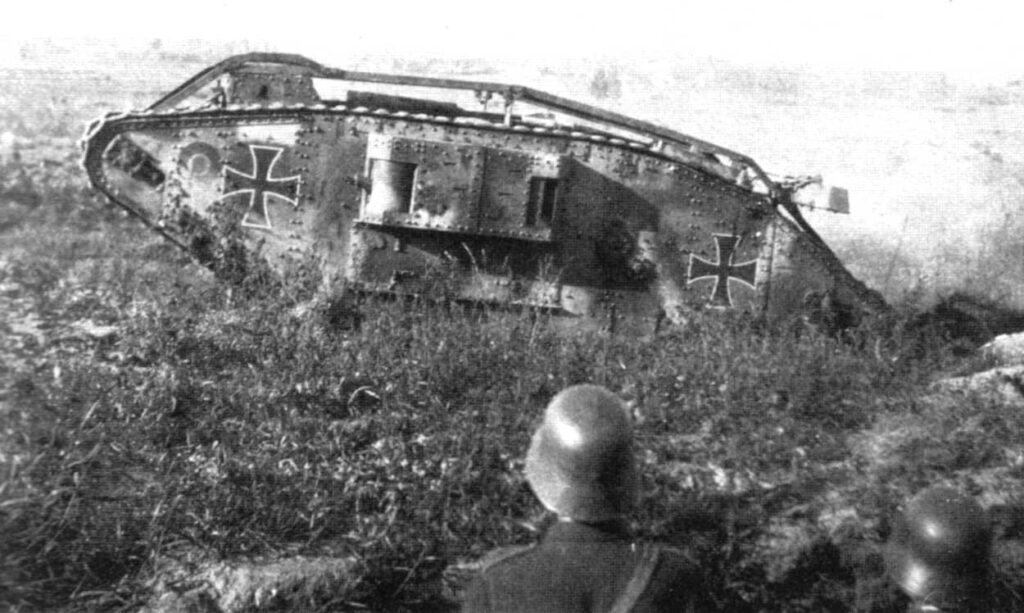
The phenomenon of the Beutepanzer
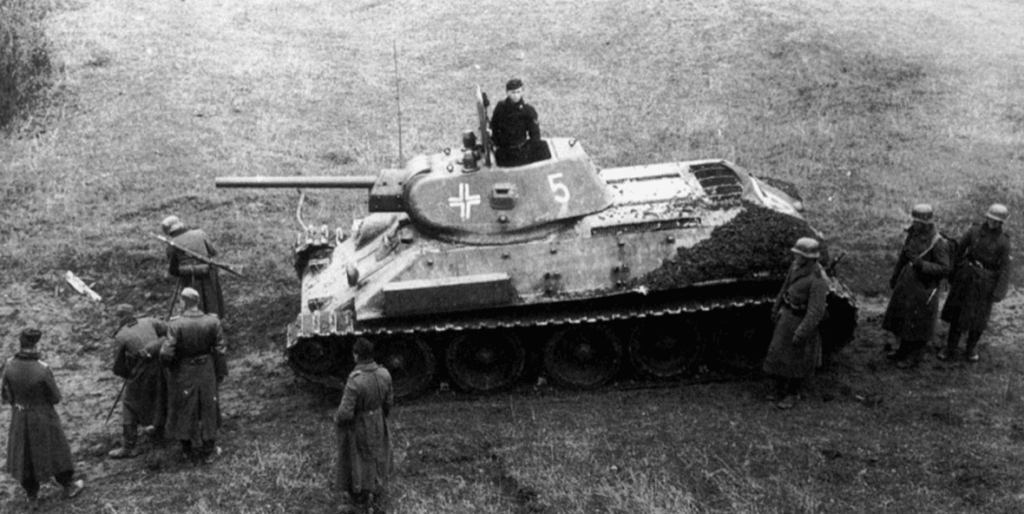
During the Second World War the phenomenon of the Beutepanzer re-emerged as part of the Nazi war machine. However, the overall numbers of captured tanks actually used at any one time might not necessarily have been that great, at least not on an organised scale. At Kharkov a Panzerwerk was established by the Waffen-SS for example, that reconditioned around 25-30 T-34 tanks captured from the Russians, enough for SS-Panzer Grenadier Division ‘Das Reich’ to establish an added third battalion, which saw combat in the battles around Kursk during summer 1943.
Equally, in numerous theatres, including North Africa and North West Europe, the Germans made use of captured tanks on an impromptu basis, to meet local needs and/or make up for shortfalls in equipment. In late September 1939, 1stPanzer Division re-employed a captured Polish 7TP tank, while in Italy on 1 November 1943 the 3rd Panzer-Grenadier Division captured and operated an Allied Sherman tank until it was destroyed. Similarly, 15th Panzer Division of the Afrika Korps employed a clutch of captured British Matilda Mk. II tanks in the wake of Operation Battleaxe in June 1941. Then in February 1942, the Afrika Korps even established a specialist Beutepanzer unit in order to operate captured tanks so as to boost its depleted tank strength. Arguably, one of the most well-known usages of captured equipment by the Germans was again in North Africa, when Field Marshal Rommel’s staff took on strength two British AEC Dorchester armed command vehicles, and christened these lumbering beasts ‘Max’ and ‘Moritz’ after characters in an 1865 children’s book. On the Eastern Front, German infantry divisions sometimes employed captured Russian tanks to bolster their firepower, as they had no organic armoured unit to rely upon. Of course all such measures were highly dependent on being able to keep captured vehicles running, not necessarily an easy proposition, especially if spare parts were in short supply. One unit stationed on Crete was originally entirely equipped with captured French Beutepanzers, but by late 1944 it could only muster a dozen such serviceable vehicles within one company, the rest of the unit having had to revert back to German tanks.
A bewildering array of captured tanks and AFVs
Despite the above, by 1945 the Germans had employed a bewildering array of captured tanks and other armoured fighting vehicles (AFVs), converting several into self-propelled guns, plus deploying many on secondary duties, such as security in occupied territories or anti-partisan operations, notably in the Balkans. Consequently, as defence analyst and author, Steven Zaloga, comments, Beutepanzers were remarkable ‘for their sheer variety and exotic service: Dutch armoured cars in the Battle for Leningrad in 1941; French tanks on the Arctic Circle in Norway and Finland; Polish tankettes in Alsace in 1945; Italian tanks in the siege of Vienna. The list goes on and on.’
After the Polish campaign of September-October 1939, the Germans captured around 111 tanks and tankettes, and established a repair facility at Lódź. As indicated, this included a small number of the 7TP, a reasonable tank by the standards of the day, its design based on the popular inter-war Vickers six ton tank, and one which combined firepower and mobility with an adequate level of protection. These remained in German service before some were passed to their Romanian ally. Contrastingly, the TK/TKS tankettes, were diminutive two-man vehicles, typically armed with one machine gun and sporting very thin armour, which limited their combat role, and ensured they were only really fit for occupational duties. Nonetheless, the Germans seem to have employed them throughout the war, particularly on security duties or as tractors for light artillery.
The creation of a 'War Booty tank staff'
During the French campaign in 1940, field repair units were tasked not only with recovering German tanks, but also salvaging French and Allied ones which were collected at depots. Subsequently, the OKH (Oberkommando des Heeres) or Army High Command, instructed four Panzer divisions in theatre to establish a Panzerbeutestab or ‘War-booty tank staff,’ dedicated to overseeing this process, and reconditioning French equipment via a number of facilities in France that had formerly been part of the French defence industry. In other words, there was a concerted effort to re-use French tanks and other vehicles where possible. That said, of the thousands of AFVs captured in France and Belgium, many were only suitable for scrap metal or spare parts. Another challenge was that French tank design did not mesh well with German tactical doctrine. Notably, one-man turrets were a problem. On the Renault R-35 and Hotchkiss H-39 tanks, this ensured that the commander had also to serve as the loader/gunner, making it extremely difficult for him to actually command the tank effectively. Neither was the design of the cupola on these tanks desirable from a German perspective, because as Zaloga explains, it prevented German tank commanders from their usual method of operating with their head ‘outside the tank for situational awareness.’ Consequently, the Germans had to modify the cupolas with split-hatches on these tanks before deploying them. Alternatively, some had the turrets removed altogether, and were used as gun tractors or driver training vehicles. Others were converted into self-propelled guns, and in many cases the turrets freed up by these developments ended up as part of the defences on the Atlantic Wall. Another German concern was the relative small size of these tanks, and their limited armament. Both, only weighed around 10-12 tons, had a crew of two, and were armed with a puny 37mm main gun, plus one or two machine guns. This was probably why others were relegated to security roles, anti-partisan duties, or palmed off on allies, notably the Italians, who operated a number of R-35s which eventually saw action against the Americans in Sicily.
Neither were the Germans that enamoured with the design of heavier French tanks. The Somua S-35 medium tank lacked all round observation and did not have a hull mounted machine gun to tackle the threat of stalking infantry. Again it suffered from having a one-man turret, and its armour was far from impregnable. Yet, fitted with modified cupolas and German radios, many saw service with the German Army to counter balance its shortage of armour. Notably, when 21st Panzer Division was reformed in France during 1943, S-35s typically served as commanders vehicles in mixed platoons of S-35 and H-39 tanks. Likewise, the formidable looking Char B1, armed with a 75mm gun in the hull and a 47mm gun in the turret, plus machine-guns, was reputed to have impressed Hitler. Captured vehicles were redeployed by the Germans on occupation duties, including in the Channel Islands, or as driver training vehicles, plus 24 were converted to flame thrower tanks, and a small number used as the chassis for self-propelled guns mounting a 105mm howitzer. Char B tanks in German service were even encountered by British airborne forces during the Battle of Arnhem. It was an awkward tank to operate, in keeping with French designs of the period the commander doubled up as the gunner on the 47mm gun, making it very difficult for him to command and direct the tank simultaneously. Similarly, the driver/gunner aimed the 75mm gun in the hull via a complex transmission system, enabling precision turning, but which was prone to mechanical breakdown. Such characteristics were understandably loathed by the Germans.
French half-tracks formed another part of the haul acquired by the Germans, and were a type of vehicle that was adapted more easily into the German inventory, as they already operated half-tracks of domestic manufacture. Eventually, the French ones were put to various uses, including as armoured personnel carriers; vehicles mounting a 75mm PAK 40 anti-tank gun in a modified armoured body; or as the platforms for anti-aircraft guns, mortars and even rocket firing artillery. A French vehicle captured in great numbers was the UE tractor, another diminutive two-man vehicle, principally used by the French as an ammunition carrier and for towing 25mm anti-tank guns. Werner Muller documents its wide spread usage by the Germans, including as: ammunition carriers; gun tractors for towing various artillery pieces; reconnaissance/security vehicles when fitted with a machine-gun; and as a towing and transport vehicle by the Luftwaffe. Some were adapted with extra armoured plate, and mounted two or more machine-guns, so as to have a degree of combat power, while others served as platforms for 37mm PAK 36 anti-tank guns, thus potentially providing a mobile tank killing capability. Later in the war in Normandy, some UEs were even fitted with launchers for 28/32 cm rockets, according to a suggestion by 21st Panzer Division to produce improvised weapons capable of salvos against landing areas. Twenty four were converted to armoured observation posts for use by artillery units, and at least one was used as the chassis for a mock-up of a Russian T-34 tank employed to train German troops.
The BEF lost 690 tanks in France
The British Expeditionary Force and 1st Armoured Division lost around 690 tanks in France and Belgium during 1940, but there seems to have been little attempt by the Germans to reuse these. However, Bren carriers were found useful in roles such as armoured ammunition/supply carriers or as towing vehicles, and with Luftwaffe units tasked with jobs such as airfield defence. Ahead of Operation Barbarossa, the Nazi invasion of Russia in June 1941, a handful of A 13 Cruiser tanks were operated by Panzer-Abteilung (Flamm) 100, although these rapidly were lost owing to mechanical breakdowns and shortages of spares. Another example of potentially how difficult it could be to operate Beutepanzers when the logistical means were simply not in place to sustain them.
Hauptmann Alfred Becker
Of far greater significance was the work of Hauptmann Alfred Becker, a slightly portly middle aged artillery officer with a genial smile, who championed the use of captured Allied vehicles as a means of making his guns more mobile. Initially this entailed using Dutch equipment captured in 1940 to motorize his previously horse drawn unit. Subsequently, he hit on the idea of using British Mark VI light tanks as the basis for a self-propelled gun mounting the leFH 16 10.5cm howitzers employed by his battery. These were dubbed: Geschützwagen MK VI 736 (e), and like all self-propelled guns had the added advantage that the guns did not have to be unlimbered for action, and were already facing the right direction.
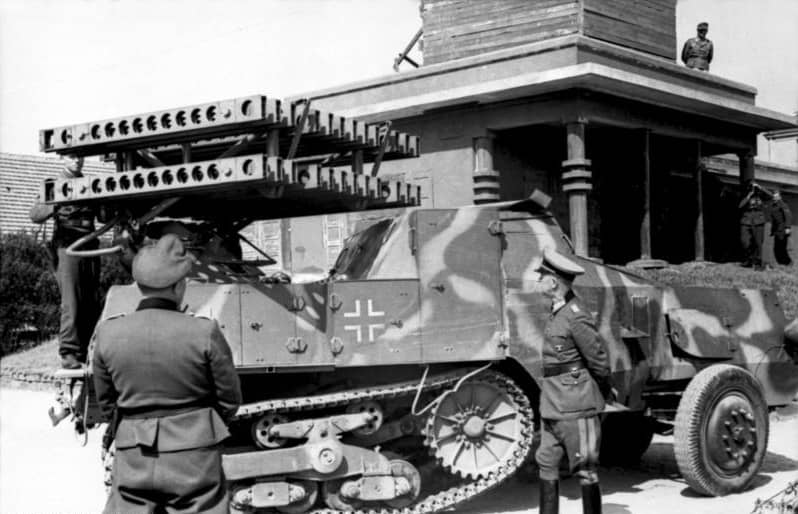
Baukommando Becker
Becker had volunteered for service in the First World War, aged only 15, and fought at Verdun and Cambrai, before becoming a mechanical engineer after the war, establishing his own business in Bielefeld. In 1939 he was called-up to serve with 227th Infantry Division and became an officer with its 15th Artillery Regiment. The Division had been raised in the Krefeld area, and contained numerous sheet metalworkers, who Becker was able to rely on in helping him convert the Mark VI tanks, and these proved highly successful in Russia during 1941 on the Leningrad Front, earning him the German Cross in Gold for his endeavours.
In 1942 Baukommando Becker (Construction Unit Becker) was established under the authority of the Reich Minister for Armaments and War Production, tasked with making further use of French and Allied vehicles, and based its activities around three factories in the Paris area. Under Becker, vehicles, including not only tanks but soft-skinned half-tracks, were gathered and sorted into three groups: those ripe for minor refits; ones needing major repairs; and those only fit for spares. As indicated, numerous offensive uses were found for the converted half-tracks. Typically, changes in design for all vehicle types were considered on the assembly lines at the various factories, and prototypes of replacement superstructures constructed in wood. These were then sent away for steel fabrication before being shipped back to Baukommando Becker. Generally one vehicle type was converted at a time on the production lines, so as to ease manufacture and increase efficiency. According to Camille Vargas, ultimately 1,800 AFVs were produced in this fashion by 1943-1944, a significant achievement, for which Becker was awarded the Knights Cross of the War Merit Cross with Swords. Some of these conversions saw action on the Eastern Front, but most were issued to units in France, notably the reformed 21st Panzer Division that in the course of its later war service operated a wide variety of French Beutepanzers, earning it the nick-name ‘Rommel’s Zirkus.’ Indeed Becker went on to command Sturmgeschütz Abteilung 200 from that Division during the Normandy campaign, that was equipped with 75mm PAK 40 anti-tank guns and 10.5 cm leFH 18 howitzers mounted on the chassis of French light tanks. The unit was one of those instrumental in halting Operation Goodwood on 18 July 1944, and inflicting severe losses on the British 11th Armoured Division. More details about this action, and the unusual structure/organisation of 21st Panzer Division, and its equipping with Beutepanzers, can be found in the works by Werner Kortenhaus and Niklas Zetterling. According to Hans von Luck, commander of Panzergrenadier-Regiment 125, the troops initially mocked ‘the monstrous looking assault-guns’ but learned to respect them because the assault-gun companies of Sturmgeschütz Abteilung 200 were trained to co-operate closely with the grenadiers, and this proved ‘a decisive aid to our defence forces.’
The Becker conversions
To give a flavour of what these sorts of vehicles were like, take the example of the Marder 1 or to give its full German designation: Sd. Kfz. 135 7.5cm PAK 40/1 auf Lorraine Schlepper (f). This was among the most numerous of the Becker conversions, with around 170-180 being built based on the chassis of the Tracteur Blinde 38 L or Lorraine Schlepper in German parlance, a lightly armoured ammunition/supply and personnel carrier that had entered French service in 1938. As it had its driving compartment situated forward, an engine amidships, and an open area towards the rear, it made an excellent carriage for a self-propelled gun, and could be converted by Baukommando Becker without undue difficulty. Completed vehicles had a crew of 4, weighted 8 tons, and as seen mounted the formidable 75 mm PAK 40 anti-tank gun, which had a rate of fire of 12-14 rounds per minute, and with standard ammunition could penetrate 104mm of armour at 30 degrees at 500m.
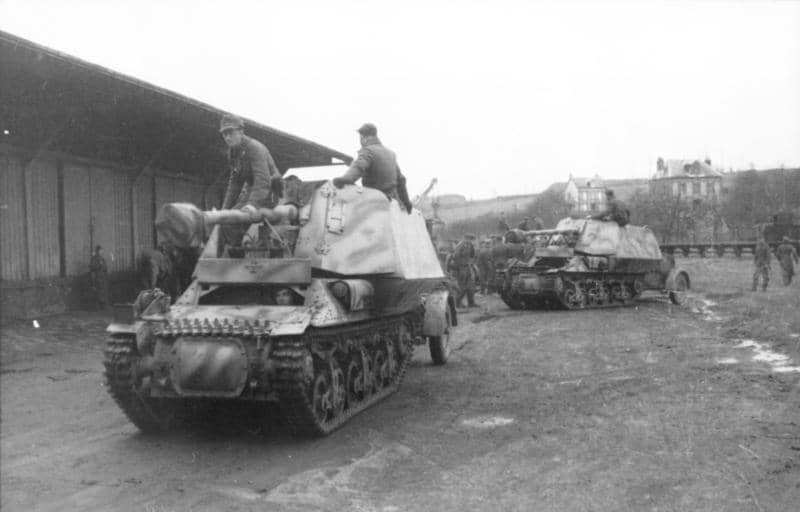
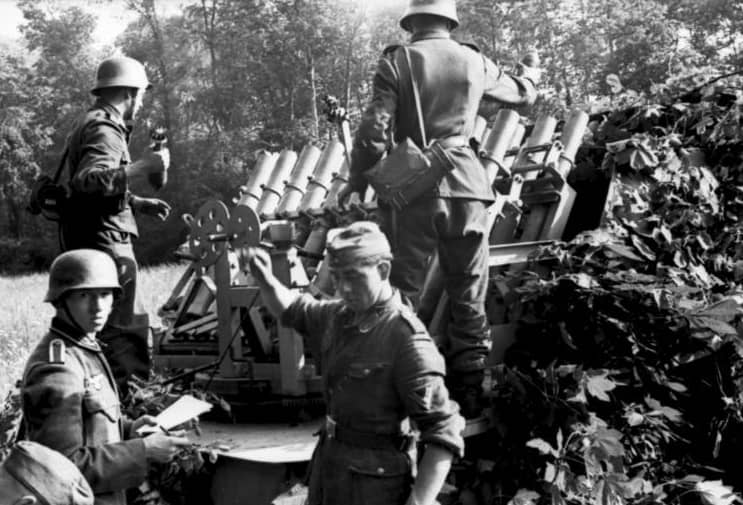
Beutepanzers in Russia
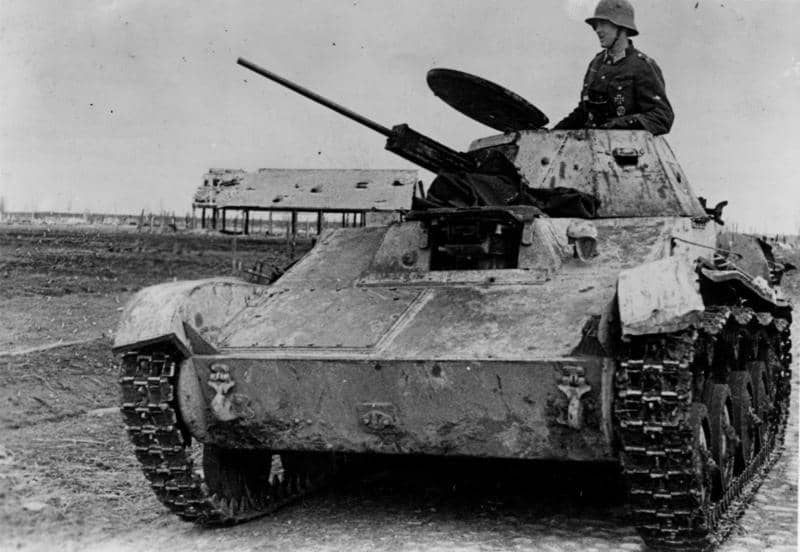
On the Eastern Front designated salvage units were attached to each of the field army supply commands or Oberfeldzeugstäbe, plus security formations were ordered to establish Beutepanzer companies to police rear areas. Yet, in reality it proved impossible to recover significant numbers of Russian tanks, owing to the harsh conditions and awkward terrain, especially in autumn and winter. Another issue was that many of the Russian tank types initially encountered, such as the T-26 light tank and vehicles from the BT series were deemed mechanical liabilities and of little combat value. Even so, as indicated, it is likely Russian Beutepanzers were commonly employed on an ad hoc basis, but records for such usage are scant. More respect was shown for the formidable T-34 tank, and rewards offered to incentive troops to capture them, such as 40 bottles of vodka to any unit that obtained an intact example. As the example of SS-Panzer Grenadier Division ‘Das Reich’ demonstrated, these were put to good use by the Germans, and welcomed as additional armoured support.
Operation Herkules - the proposed invasion of Malta
Perhaps one of the most ‘exotic’ employments of Beutepanzers also concerned Russian tanks. In May 1942 Panzer-Abteilung z.b.V.66 was established as an armoured assault force for Operation Herkules, the proposed invasion of Malta. In the end only one company was formed, equipped with a motely selection of heavy KV and T-34 tanks camouflaged and re-fitted to German standards. As Herkules never occurred, the company was subsequently attached to the Ski-Jäger-brigade, which later became a division, and it was one of the few units on the Eastern Front recorded as operating a significant amount of Russian armour e.g. 22 T-34s and two turretless recovery T-34s in January 1944. Aside from the T-34, another Russian vehicle the Germans notably prized was the Komsomolyets semi-armoured artillery tractor, which was fully tracked, a boon given the conditions. These proved valuable as supply carriers or artillery tractors, as they had been with the Red Army, and some were even modified to carry a 37mm PAK 36 anti-tank gun.
Italy capitulates
Unless captured and put to use by German troops, few American tanks ended up as Beutepanzers on an organized scale because of the limited number of operational vehicles that were seized. However, as Thomas L. Jentz and Werner Regenberg have illustrated, a handful of captured Sherman tanks were turned against their former owners, especially in North-West Europe during 1944-1945. An American vehicle that seems to have found great favour with the Wehrmacht, was the M3 half-track, which as with the captured French half-tracks was a type of vehicle that readily fitted into German military organization, and there is photographic evidence of these being employed in limited numbers on an ad hoc basis in North Africa and North-West Europe.
Another source of Beutepanzers was Italy. Once that ally of the Nazis had capitulated on 9 September 1943, Operation Achse was instigated, whereby German units disarmed Italian forces in Italy and the Balkans, acquired their weaponry and equipment, plus took over Italian tank manufacturing plants. Although the quality of Italian armour was something of a mixed blessing, it was a useful windfall, in that Italian tanks in many cases could be employed to replace French Beutepanzers in security and anti-partisan units which were by then showing their age. For example, some panzer units in the Balkans were re-equipped with Italian M15/43 medium tanks, and one German unit even started operating obsolescent L3/33 tankettes, another diminutive two-man vehicle, considered by the Germans to be too small and frail to possess any meaningful combat role. Arguably, the most useful Italian AFV, and one the Germans kept in production, was the squat looking Semovente assault gun based on the M15/43 medium tank chassis. With its low silhouette and powerful 75mm gun, this was akin to the Stug III assault gun already widely employed by the Germans, and so it handily slotted in with existing German organization and doctrine. By the end of 1944, around 204 had been allocated to German Divisions in Italy in lieu of Stug IIIs, where their firepower was welcomed.
21st Panzer Division effectively reconstituted as a ‘Beutepanzer division.’
More information on Beutepanzers and the sheer diversity of vehicle types employed by the German Army, Luftwaffe and Waffen-SS can be found in the accompanying bibliography. Many, as shown, provided the basis for conversions into self-propelled guns, and these were most significant in Normandy, where 21st Panzer Division was effectively reconstituted as a ‘Beutepanzer division.’ Likewise, as former British Army officer and military historian Jonathan Trigg implies, Becker was perhaps an unlikely hero of the Wehrmacht. Set against such organised usage of captured vehicles, was the wide spread deployment of captured tanks and armoured vehicles on an improvised or unofficial basis in all theatres, perhaps sometimes only for a matter of days or weeks, depending on how long they could be kept running, or until they were destroyed in action. Any use of captured armour, whether official or unofficial, posed a potential logistical challenge, and this could militate against the effectiveness of the Beutepanzer concept. On the other hand reliance on ‘war booty’ often made up for shortfalls in German tank production and supply. According to Zaloga, in May 1943, the Heer (German Army) had a total of 822 Beutepanzers in operation in all theatres, which provides an indication of the reliance the Germans placed on these types of vehicle.
© James Goulty 2025
Bibliography/Further Reading
Below are the titles I have found useful in preparing this article. Thanks to my friend Alastair Fraser for loaning me some of them.
Articles
Camille Vargas, ‘Under New Ownership’ in Iron Cross: German Military History 1914-45, Issue 14, pp. 100-109.
Books
Chamberlain, P. & Doyle, H. L., A Summary of the Self-Propelled Weapons of the German Army 1939-45, Part 2: Weapons on Foreign Built Chassis (Bracknell: Bellona Publications, 1968)
Fleischer, Wolfgang, Captured Weapons and Equipment of the German Wehrmacht 1938-1945 (Atglen, PA: Schiffer, 1998)
Grove, Eric, World War II Tanks (London: Orbis, 1983)
Jentz, Thomas L. & Regenberg, Werner, Panzer Tracts No. 19-1 Beute-Panzerkanpfwagen: Czech, Polish, and French Tanks Captured from 1939 to 1940 (Boyds, MD: Panzer Tracts, 2007)
Jentz, Thomas L. & Regenberg, Werner, Panzer Tracts No. 19-2 Beute-Panzerkanpfwagen: British, American, Russian and Italian Tanks Captured from 1940 to 1945 (Boyds, MD: Panzer Tracts, 2008)
Kortenhaus, Werner, The Combat History of 21. Panzer Division (Warwick: Helion, 2018)
Lindberg, Leo, Captured Tanks WW2: Captured & Converted French Vehicles in German Service (Amazon, undated)
Muller, Werner, Captured Tanks in German Service: Small Tanks and Armoured Tractors 1939-1945 (Atglen, PA: Schiffer, 1998)
Trigg, Jonathan, D-Day Through German Eyes: How the Wehrmacht Lost France (Stroud: Amberley, 2020)
Tucker-Jones, Anthony, Hitler’s Great Panzer Heist: Germany’s Foreign Armour in Action 1939-45 (Barnsley: Pen & Sword, 2007)
Zaloga, Steven J., Beutepanzers of World War II: Captured Tanks in German Service (Oxford: Osprey, 2024)
______________, German Tanks in Normandy 1944 (Oxford: Osprey, 2021)
Zetterling, Niklas, Normandy 1944: German Military Organization, Combat Power and Organizational Effectiveness(Havertown, PA: Casemate, 2019)

About The Author
James Goulty holds a masters degree and doctorate in military history from the University of Leeds, and has a particular interest in the training and combat experience of ordinary soldiers during the world wars and Korean War.
He has published numerous articles and written 5 books for Pen and Sword Ltd, including The Second World War through Soldiers’ Eyes: British Army Life 1939-1945; and Eyewitness Korea: The Experience of British and American Soldiers in the Korean War 1950-1953.



Click to see full BMMHS event listing pages.
Contact us at [email protected]
Copyright © 2024 bmmhs.org – All Rights Reserved
Images © IWM & James Goulty